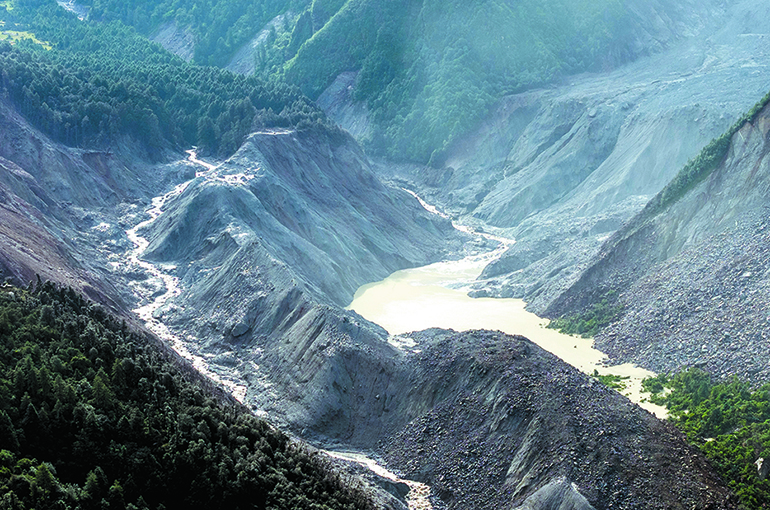
 China-Nepal Border Flash Flood Leaves 5 Dead, 558 Missing in Gyirong County
(Yicai) Aug. 28 -- At least five people have been killed and 558 are missing in China’s Gyirong county after a devastating flash flood originating in Nepal struck the China-Nepal border two days ago.
Of the 558 people missing in Gyirong, 260 are foreign nationals, China Central Television reported today. Nearly 100 Chinese citizens are missing in disaster-hit areas on the Nepalese side of the border, Chinese Foreign Ministry spokesperson Lin Jian said at a press briefing yesterday.
The flash flood began on the Nepalese side of the border at around 10.30 a.m. local time on Aug. 26 and the vast torrent of water subsequently smashed into Gyirong Port, a key border crossing point and trade hub in China’s Xizang Autonomous Region.
The death toll in Nepal, located on the southern slopes of the Himalayan mountain range, rose to at least 469 today, while at least 1,300 people remain unaccounted for, including dozens of Americans and other foreign nationals, according to Nepalese police.
Preliminary data from the Nepal Tourism Board showed that 644 tourists are still missing, including 517 foreigners from about 30 countries and 127 Nepalese. Most of the missing foreign tourists are Indians who had planned to travel through Nepal to make a pilgrimage to Mount Kailash, a sacred mountain, and Lake Manasarovar in Xizang.
Nepal is home to eight of the world’s 14 highest peaks, with Mount Everest spanning the China-Nepal border, and has a young and unstable geological structure. Monsoon rains from June to September often trigger flooding and landslides, while global warming is accelerating glacier melt, further increasing the risk of deluges from glacial lakes.
Scientists say this week’s deadly deluge may have been triggered by the melting and collapse of glaciers or glacial lakes as a result of mountain fires, climate change, or other factors. Because the collapse occurred at a high altitude, it is difficult to detect using conventional methods, making it difficult for monitoring systems to provide an early warning.
Ongoing Flood Risk
The risk of further flooding remains high because of blockages in rivers upstream of the border, while Chinese authorities are closely monitoring a barrier lake in Nepal that could breach.
A barrier lake has formed near the confluence of the Chhochen Khola and Purepu Tsangpo rivers in Nepal, CCTV reported yesterday, citing China’s water resources ministry. The lake held an estimated two million cubic meters of water as of the morning of Aug. 27 and was overflowing.
Another three million cu m of water is expected to flow into the lake over the next three days, creating a high risk of a breach. The ministry is closely monitoring the lake and running simulations of potential discharges.
Economic Fallout
Gyirong and Zhangmu are the most important of the five commercial ports between China and Nepal, Liu Zongyi, director of the Center for South Asian Studies at the Shanghai Institutes for International Studies, told Yicai. The other ports are at higher altitudes, where infrastructure on the Nepalese side is underdeveloped.
For landlocked Nepal, the disruption at Gyirong Port has implications for the country’s economy, Liu noted. Regardless of whether the port is rebuilt, China and Nepal need to strengthen their practical cooperation on natural disaster management, he added.
Agriculture and tourism are pillars of Nepal’s economy, and the country remains one of the world’s least developed nations.
CNY4.2 billion (USD632 million) of goods imports and exports were supervised and cleared through Gyirong Port in 2024, ranking it first among all Xizang’s ports and accounting for nearly 30 percent of total trade between China and Nepal. Gyirong is also the designated exit point for the proposed China-Nepal railroad, which is in the feasibility study stage.
Editor: Emmi Laine