



 China Seeks New Growth Path as Hard Tech Gains Momentum, Experts Say
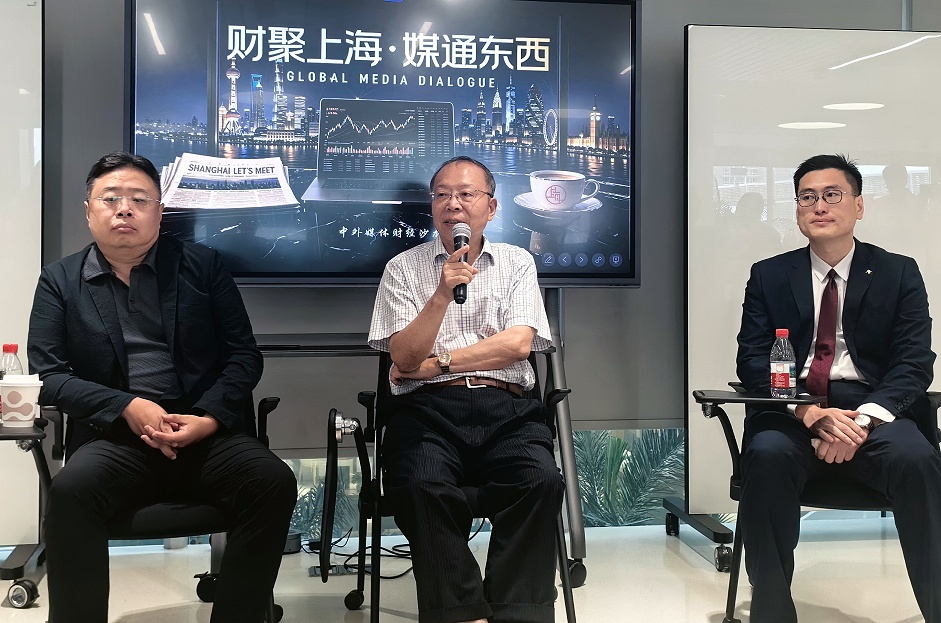
(Yicai) Aug. 31 -- As investment and profits in hard-tech sectors surge, China is exploring a new growth path focused on using institutional measures to ensure that a broader range of traditional industries and consumers can share in this growth momentum, several experts said at a Global Media Dialogue event held by Yicai in Shanghai on Aug.28.
Investment in China’s high-tech industries jumped 5 percent in the first seven months from a year earlier, while nationwide fixed-asset investment slumped 6.7 percent, according to official data.
Emerging industries represented by hard tech currently account for about 20 percent of the overall economy, said Shao Yu, a professor of Fudan University and Chief Economist and Chief Strategist of Orient Securities Company. However, these industries have a weaker direct impact on employment than the real estate and automotive sectors had in the past.
The current industrial restructuring is not unique to China but a common phenomenon amid the evolution of the global technology cycle, said Xu Mingqi, a researcher at the Shanghai Academy of Social Sciences. From a long-term perspective, the global economy remains in a relative trough and a “cluster-type breakthrough in technological revolution” has yet to emerge.
Taking the United States as an example, Xu said that US economic growth was 2.1 percent in the first quarter and 1.5 percent in the second quarter. The US is still leading innovation in artificial intelligence technologies but it has not been able to drive rapid growth across the entire economy.
China faces a similar dilemma, Xu said. “It is extremely difficult to boost growth across all traditional industries. Consequently, investment and growth in emerging sectors have moved forward, while workers in traditional industries struggle to see their incomes keep pace. We are in the midst of a transition between old and new growth drivers. In my estimation, the widespread adoption of AI could still take another 10 years.”
Growth Sharing
Shao and Xu proposed approaching the issue from two perspectives, namely empowering traditional industries and providing support during the transition.
At the industrial level, Shao suggested that hard-tech companies should play a greater role in driving traditional businesses forward. Technological capabilities and capital advantages could be transmitted to traditional firms through supply-chain linkages, helping them improve efficiency.
In terms of supporting the transition, Xu said economies with stronger fiscal capacity can provide greater support to industries and workers affected by the shift from old to new growth drivers, thereby reducing the economic disruption caused by the transition. China has relatively strong fiscal and administrative coordination capabilities in this regard, while expectations for its economic growth prospects also remain relatively positive, he added.
On the consumption front, Xu suggested that, in the short term, policymakers could focus on improving public services such as elderly care and childcare, followed by reforms to the social security system. Adjustments to income distribution and the tax system should be considered as longer term priorities.
As the social security system gradually improves, some household savings held for precautionary reasons, such as retirement and medical expenses, could be unlocked and converted into actual consumption, he added.
Editor: Kim Taylor





