



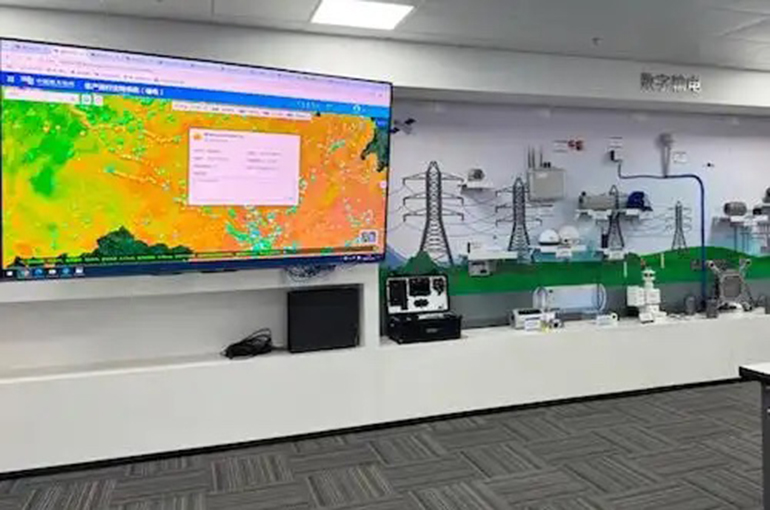
 China Southern Power Grid's IoT OS Revolutionizes Power Industry Operations
(Yicai) Dec. 3 -- The Internet of Things operating system developed by China Southern Power Grid, dubbed Dianhong, is transforming the fundamental working methods of China's power industry.
"Before, it took four hours to install and commission one device; but now, with remote operations enabled by Dianhong, it can be completed within 30 minutes," Du Shaohui, senior manager at CSG's Dianhong Operation Center, told media, including Yicai, during a recent on-site visit to the company.
"Maintenance work for power equipment used to require on-site visits, which consumed a lot of time for front-line employees and exposed them to safety risks," Du explained. "After connecting to the Dianhong OS, the equipment upgrade time has been reduced from three hours to 20 minutes."
CSG's innovation began in 2023, when the firm connected tens of thousands of devices for power generation, transmission, distribution, and consumption through a single OS and then started to use peripheral equipment, such as drones, for remote management and inspection.
Dianhong was developed mostly based on two major open-source projects by Huawei Technologies: OpenHarmony and OpenEuler. Over the past two years, CSG has collaborated with ecosystem partners to comprehensively upgrade and transform the power supply system across the entire chain, from power transmission, transformation, and distribution to consumption and dispatching.
"The new power system faces practical challenges, such as managing complex and numerous terminals and data silos, as well as difficulties in business collaboration,” Xuan Liang, deputy general manager at CSG's digitalization department, told Yicai. "The use of Dianhong has built an efficient bridge between business needs and underlying technical support."
Through optimization, Dianhong can support more new types of intelligent terminals, including smart meters, IoT switches, and micro sensors, Du said, adding that Dianhong has made unified management and interactive collaboration of power equipment possible, while giving hardware devices, such as monitoring systems, cameras, and sensing devices, their own "soul."
CSG has built a complete 'space-air-ground' three-dimensional monitoring system. Beidou satellites can detect millimeter-level displacement of power towers, drones automatically patrol according to preset routes to identify potential risks, and Dianhong terminals can detect risks, such as wildfires and floating objects, in real time.
The non-contact fault location module used by this system can accurately locate fault points within a 30-kilometer range with an error of no more than 300 meters.
However, Xuan believes that the digital transformation of the power system is not only about achieving technological breakthroughs in the industry's own management, but it is also about its ability to connect with industry partners.
To promote the power OS community, large state-owned energy enterprises, scientific research institutions, and ecological enterprises, including CSG, Inner Mongolia Power Group, and power generation companies, have established an open-source community, Xuan said.
As a resource aggregator for the upstream and downstream reaches of the supply chain, the power OS community promotes the broad application of open-source Dianhong in various industries, he added.
More than 500 supply chain manufacturers have joined the Dianhong ecosystem and are carrying out system adaptation work for more than 3,000 different terminals, according to the latest data provided by CSG.
Through resource aggregation and scenario application of upstream and downstream supply chain enterprises, Dianhong is moving towards the direction of "entering thousands of industries and thousands of households," Xuan pointed out. Its application fields may extend to agriculture, transportation, mining, and other sectors in the future, he predicted.
Editors: Tang Shihua, Futura Costaglione





