 China to Step Up Measures to Boost Demand, Optimize Supply, and Protect Livelihoods
(Yicai) Aug. 31 -- China is preparing to ramp up economic support in the second half, signalling plans for a fresh slate of policy and effective measures to bolster counter‑cyclical adjustment, shore up domestic demand, improve supply, and safeguard people’s livelihoods.
China will focus on drawing up a plan to carry out its strategy for expanding domestic demand, fostering emerging forms of consumption, deepening reforms of state‑owned enterprises and assets, and encouraging greater private investment, according to a report on implementing the National Development and Reform Commission’s annual economic and social development plan, presented by Vice Chairman Wang Changlin at the Standing Committee of the National People’s Congress, which was held in Beijing from Aug. 25 to 28.
The push comes as policymakers seek to sustain the country’s economic growth momentum -- gross domestic product expanded 4.7 percent in the six months ended June 30 from a year earlier -- amid soft consumption and a prolonged downturn in investment.
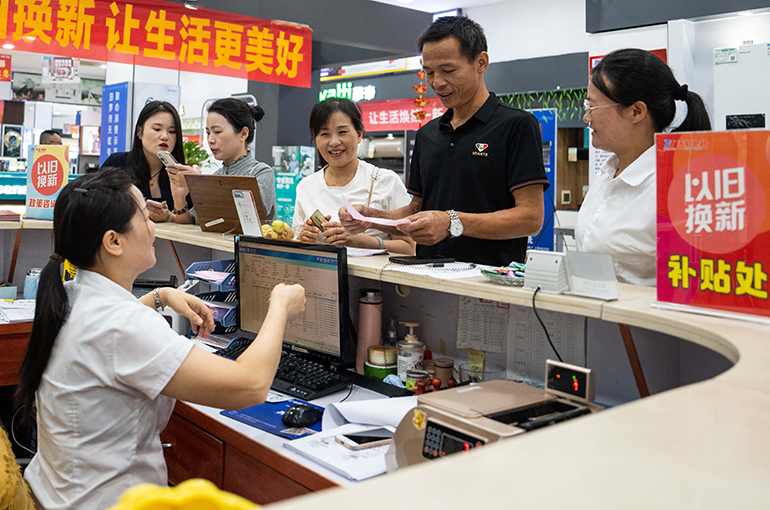
The report calls for executing a more proactive fiscal policy as well as faster fiscal spending and use of funds raised through government bond sales to advance the “two major initiatives” (major national strategies and capacity building in key areas) and the “two renewals” (large‑scale equipment upgrades and consumer goods trade‑ins), the report said. Local authorities will also be supported to meet their basic spending obligations on wages, public services, and debt repayment at the grassroots level (the “three guarantees”).
Unlocking policy effectiveness and sustaining momentum for innovation‑driven, structural improvement ranks high on the economic work agenda for this half of 2026, said Wei Qijia, research fellow at the State Information Center.
China should fully leverage existing policies while planning ahead, Wei noted, adding that it is critical to foster a virtuous cycle between consumption and investment, nurture new consumption drivers underpinned by household income growth, and prioritize effective, practical, and purpose‑driven investment projects.
A moderately accommodative monetary policy will be pursued, with monetary policy tools deployed and fine-tuned as needed to keep the Chinese yuan generally stable at a reasonable and balanced level. Coordinated fiscal and monetary policies will be optimized to bolster domestic demand, while economic policy consistency will be enhanced and the mechanism for managing and guiding market expectations improved.
Politburo Plans
The refined set of coordinated fiscal and monetary policy measures carries forward arrangements from the Politburo meeting, Luo Zhiheng, chief economist at Yuekai Securities, told Yicai. The policies are particularly relevant amid insufficient aggregate demand and structural divergence, lowering operating costs for businesses and consumption‑related costs for households to spur corporate investment and household spending, Luo pointed out.
A plan to carry out the country’s strategy for expanding domestic demand needs to be created, the report stressed. It calls for expanding the supply of high-quality goods and services to meet the diverse needs of different groups, fostering emerging consumption trends such as artificial intelligence smartphones and intelligent services, and unlocking the potential of services consumption. In addition, it aims to refine the regulatory frameworks for cultural performances, tourism, and sports events, while further expanding inbound consumption.
Sluggish consumption has drawn broad attention in recent years, with retail sales contracting year on year in some first‑tier cities, Luo said. Consumer promotion policies should be tailored to local constraints across cities, with improved policy precision, synergy, and ease of use, Luo stressed. Better supply of goods, commerce, and services is essential to generate durable structural consumption growth, he added.
The NPC Standing Committee outlined key tasks across various areas, including funding, projects, coordination mechanisms, and factor support. It emphasized the need to intensify and speed efforts to steady investment and reverse the slump, and called for exploring investment opportunities in fields such as technological innovation, industrial upgrading, urban renewal, rural revitalization, new infrastructure, public welfare and livelihood support, and green, low-carbon development.
The session signals an accelerated rollout of a new round of effective structural investment, noted Li Jin, chief researcher at the China Enterprise Research Institute. Major projects under the “two major initiatives” and the “six network systems” are entering their peak construction periods, Li added.
A key challenge facing the economy is the imbalance between strong supply and weak demand, Li said, noting that a recovery in consumption will take time, while trade faces geopolitical headwinds. As a result, effective investment must play a more pivotal role to stablize the economy, Li stressed.
Editor: Martin Kadiev