 China's AI Race Is Shifting From Bigger Models to Commercial Deployment, Experts Say
(Yicai) July 15 -- The focus of China's AI industry is changing from "model parameters and computing power" to "who can bring its capabilities to production scenarios and the global ecosystem the fastest," including in factories, hospitals, and other real-world workplaces, according to several experts.
Robotic intelligence is "behavioral intelligence," Gao Feng, chair professor at Shanghai Jiao Tong University's School of Mechanical Engineering and Power Engineering, said at the Converging in Shanghai cross-border media forum yesterday. Its fundamental difference from general computer intelligence lies in the necessity to complete a closed-loop process of perception, cognition, and action, he noted.
For example, tightening screws on an iPhone assembly line "requires behavioral intelligence," Gao pointed out. "First, being able to see where the logo is, second, applying gentle torque while tightening, and third, tightening it correctly."
If industrial settings test a robot's precision, hospitals test its ability to replicate results consistently, said Pan Jing, chairman of Shanghai TMI Robot Technology. The company's products have entered more than 700 top-tier Chinese hospitals over the past decade, he noted.
The original rationale for deploying robots in industrial settings was never to simply cut labor costs but to guarantee standardized, consistent output, Pan stressed, adding that a fully automated production line can cost thousands of times more than human labor, with the same logic applying to healthcare.
Regarding the technical conditions for widespread robot adoption, Pan identified batteries, sensors, artificial intelligence, and semiconductors as the four key elements, with the first three already largely in place. However, embodied intelligence remains the main bottleneck in model control capabilities, he added.
Drawing on historical trends, such as the about 30-year adoption cycle of personal computers and the roughly 15-year cycle for electric vehicles, robots would likely take 15 to 30 years to become commonplace in households, according to Pan.
Behind the technical and commercial validation lies industry-wide scale, said William Xu, deputy secretary-general of the Shanghai AI Industry Association. Based on the association's tracking, the city's core AI sector is expected to have reached CNY137 billion (USD19 billion) by the end of last year, up 40 percent from the previous year, while it will likely exceed CNY1 trillion (USD147.6 billion) over China's 15th Five-Year Plan that runs through 2030, he stressed.
There are six categories of the industry's core elements: models, computing power, data, application scenarios, ecosystem, and capital, Xu said, noting that Shanghai has amassed around 200 industry-specific large models, backed by a local industry fund worth about CNY100 billion aimed at supporting startups.
Embodied intelligence training has shifted from a single action to a multistep collaborative "long-term task," Xu said, giving the application of resource robots in the production of autos and parts as an example. "It's not just a simple action; we're talking about the coordination of multiple steps.
"It's not just simulation, not just a virtual scenario," he noted. "We need it in a real economic setting, and that requires a great deal of hands-on training."
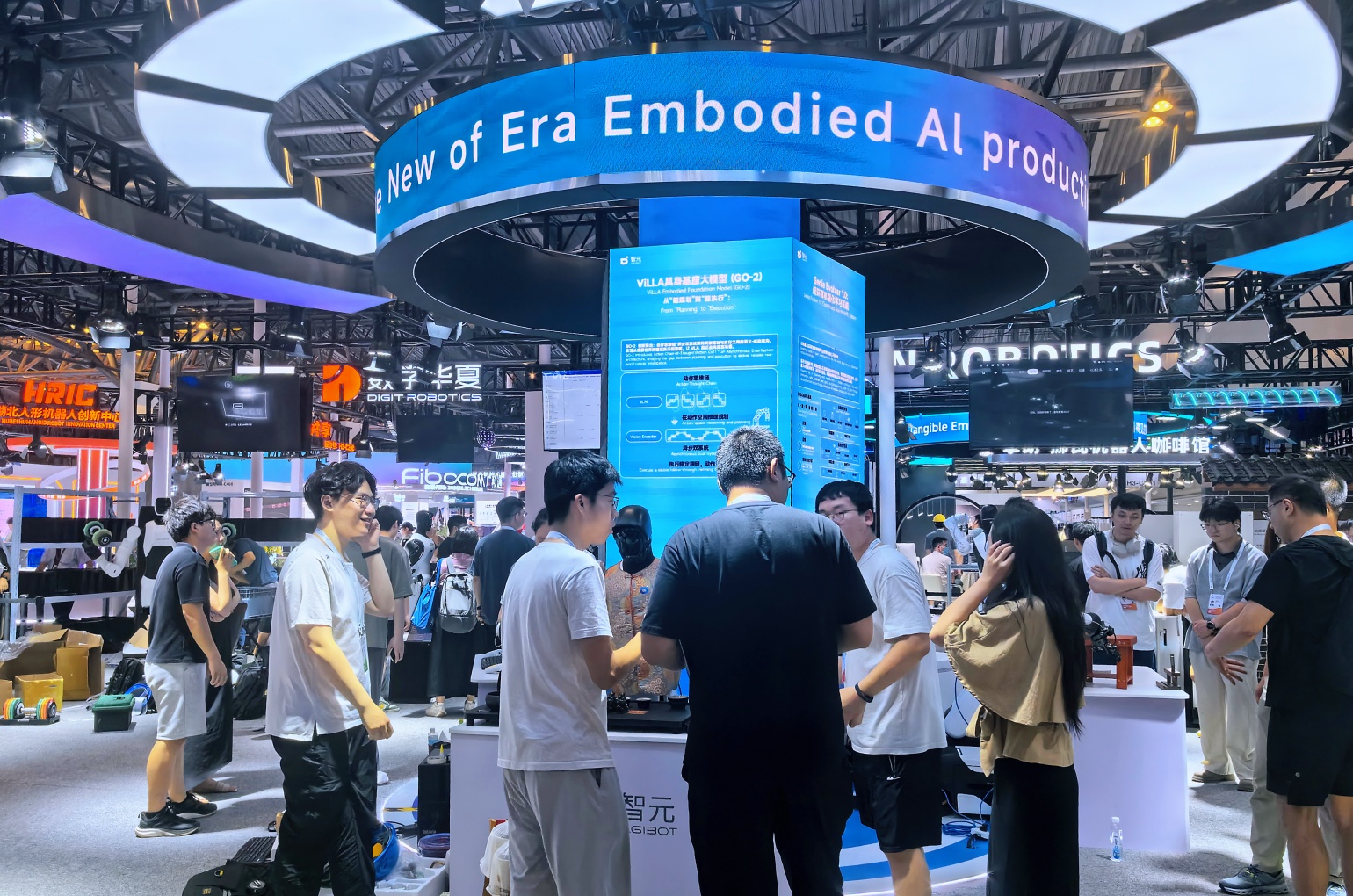
China's annual output of humanoid robots is expected to exceed 100,000 units this year, far surpassing the about 20,000 units shipped globally last year, the Ministry of Industry and Information Technology said at a press briefing for the 2026 World Artificial Intelligence Conference, which opens in Shanghai on July 17. Humanoid robots are increasingly moving into factories and production workshops, turning into an important pillar, with AI tech advancing from proof-of-concept to large-scale industrial deployment, it pointed out.
Chinese tech companies, which historically entered international markets as followers, have "no homework left to copy" in frontier areas such as embodied intelligence and must chart their own path, Pan stressed.
Because hospitals worldwide have converged on broadly similar layouts and standardized operating procedures after decades of development, Chinese firms expanding overseas could consider pairing robots with China's medical expertise and offering bundled solutions to vie globally, rather than competing purely on price, Pan noted. Regulatory approval and hospital procurement systems still differ between countries, posing a practical hurdle that companies expanding abroad cannot avoid, he said.
Chinese robotics companies going global should avoid copying existing designs, according to Gao. "China's robots must innovate independently and design around specific functions and applications rather than simply imitating what already exists when going global."
Parallel and hybrid collaborative robots are a category with the potential to overcome the precision, speed, and response-time limitations of conventional industrial robots, Gao said, calling it "a genuinely new track."
Chinese AI companies' globalization is moving beyond exporting products to collaborating on standards and protocols, including agent-interaction frameworks and the Model Context Protocol, an emerging standard that lets AI systems connect with external tools and data sources, Xu said. Standards cooperation is the next front of competition after product rivalry, he stressed.
The rise of embodied intelligence has also raised questions about its effect on employment, with Junping Zhang, a professor at Fudan University's School of Computer Science and Intelligence Innovation, invoking Moravec's paradox to frame the risk.
"Tasks humans find simple are often difficult for machines, while tasks humans find difficult are often simple for machines," Junping said. Jobs closely tied to data-driven, standardizable tasks face higher displacement risk, while those requiring fine motor control, service experience, or accumulated personal experience are harder to automate, he pointed out.
Drones are already being used to transport goods and apply fertilizer in agriculture, while AI has helped China's short-drama production industry boost its output, giving rise to new roles such as AI interpreters, or specialists who build a usable interface layer around the outputs of self-taught AI models, whose internal logic is often opaque, Junping noted.
In China, AI functions more as a shock absorber cushioning shifts in the labor market than as a wholesale replacement for human workers, Junping stressed. The country is building a "shock absorber," not a "bulletproof vest," he said.
Editor: Martin Kadiev