



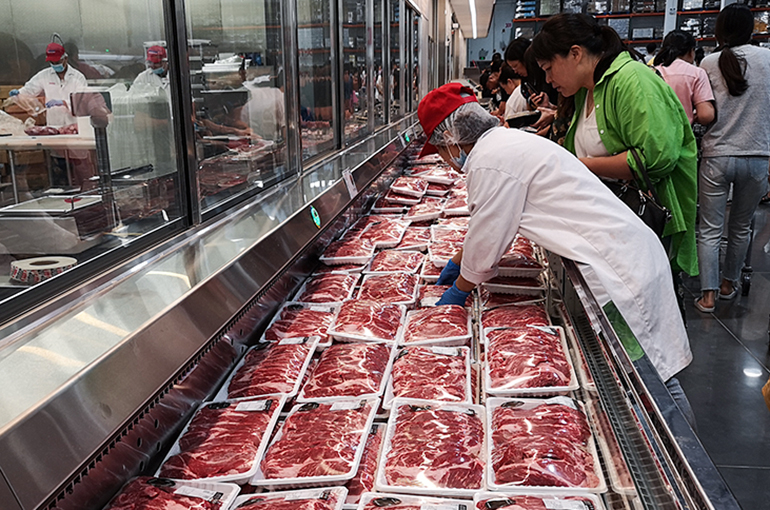
 China's Beef Prices Reach Two-Year High as Supply Tightens
(Yicai) Sept. 24 -- China’s beef prices have climbed to their highest level in more than two years following a major reduction in domestic cattle supply, with industry participants forecasting prices to go on rising into next year.
“Since early August, prices have increased five or six times, and another increase is expected in the next few days,” beef wholesalers at Shanghai's Xijiao International Agricultural Products Trading Center told Yicai.
The cost of beef sourced from Shanxi province and Inner Mongolia Autonomous Region is climbing, pushing up wholesale prices in tandem, they noted. Wholesale beef shank, for instance, has risen to about CNY90 (USD13.40) per kilogram from nearly CNY80. Data from Beijing's Xinfadi Agricultural Products Wholesale Market show a similar trend, with beef foreshank at wholesale rising to CNY80 per kg from CNY71.
The average wholesale price for beef nationally was CNY71.59 per kg as of Sept. 21, marking an increase of nearly 6 percent since early last month and a rise of nearly 9 percent from a year earlier, according to figures from the Ministry of Agriculture and Rural Affairs.
A wholesaler at Xijiao International said the main driver of the price increase is the severe losses suffered by cattle farmers in previous years, which led many to slaughter breeding cows. Since cattle need two to three years to mature, those decisions have now translated into a shortage of domestically produced beef, the person said.
The sector endured about three years of losses between 2023 and last year, according to Shao Qiaoqiao, an analyst at Zhuochuang Information, a market research and data services provider. The financial strain prompted many small and mid-sized farmers to cull breeding cows, shrinking production capacity and setting the stage for today's supply shortage, Shao said.
Herds shrank further in the first half of this year, she said, adding that some regions show reductions of 10 percent to 30 percent among small producers compared with peak levels in 2023.
Cattle inventory has been falling steadily since 2024, per data from the National Bureau of Statistics. The national headcount fell to 96.1 million animals at the end of last year and had sunk to 95.6 million as of June 30, a 4.3 percent year-on-year decrease.
Import Curbs
The downturn in China's cattle industry has been driven not only by normal livestock market cycles but also by intense competition from low-priced imported beef. In response, the commerce ministry introduced safeguard measures this January that combine country-specific import quotas with additional tariffs on imports exceeding those allowances. Those measures are also underpinning higher prices, Shao pointed out.
Among China's major suppliers, Australia has already exhausted its annual quota and now faces an additional 55 percent levy on all subsequent shipments. Brazil reached 90 percent of its quota on Aug. 10, while Argentina reached 50 percent on Aug. 5.
Import restrictions are narrowing the price gap between imported and domestic beef, making local supply conditions increasingly important in determining market prices, Shao said.
Seasonal demand is also fortifying the market. The fourth quarter is the main period for beef consumption, with demand typically running about 5 percent above third-quarter levels, Shao said, noting that this offers additional support for elevated beef prices.
Prices will stay high and the industry's recovery will likely continue into next year, Shao said. Given that calves need about two years to reach slaughter weight, she said favorable industry conditions may persist for more than two years before supply fully recovers.
With both domestic production and imports constrained, Shao expects beef prices to continue rising through next quarter and into the first half of next year.
Editor: Tom Litting





