



 Leapmotor’s Founder Says Chinese EV Maker to Hold Off on Raising Prices Even as Costs Climb
(Yicai) June 26 -- Leapmotor Technology, the best-selling electric vehicle startup in China, has no immediate plans to raise prices despite soaring raw material costs, according to founder Zhu Jiangming.
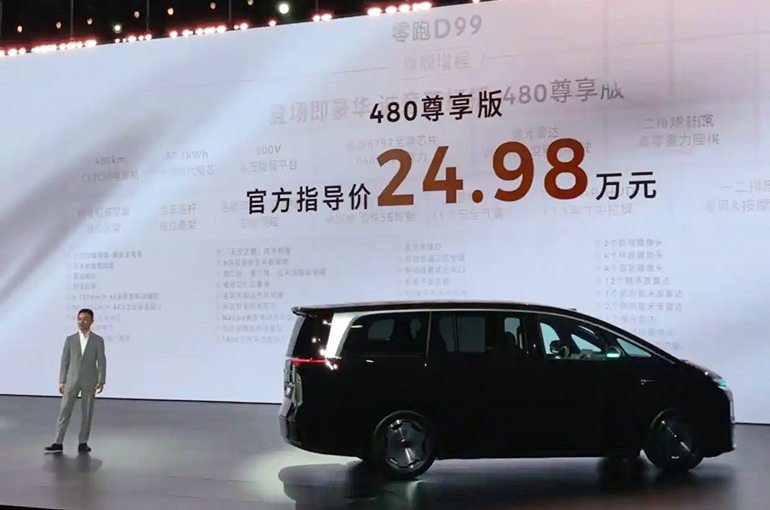
Leapmotor has absorbed cost increases driven by pricier lithium carbonate, copper, aluminum, and other raw materials through supplier negotiations and cost-cutting, Zhu said at a media roundtable yesterday after the carmaker launched its new flagship multi-purpose vehicle, the D99.
If raw material costs keep climbing, the Hangzhou-based company may adjust prices down the line, he noted.
While large-scale production has helped Leapmotor dilute certain fixed costs, rising material prices are already weighing on profitability. Its gross margin narrowed to 9.4 percent from 14.9 percent in the three months ended March 31 from a year earlier.
Second-quarter gross margin "will likely not be ideal, but remains manageable," according to Zhu.
Leapmotor delivered 596,600 new energy vehicles last year, including 67,000 overseas, ranking first among Chinese NEV startups in both categories. The carmaker had its first net profit in the second quarter of last year and stayed profitable over the next two quarters, resulting in an annual CNY540 million (USD74 million). It posted a CNY390 million loss for the three months ended March 31.
Leapmotor maintains close partnerships with leading suppliers to ensure consistent component quality and cost stability, Zhu said, adding that the firm’s 17 self-operated parts manufacturing facilities, together with its full-stack in-house research and development capabilities across the three-electric system (battery, motor, and electronic control), smart cockpit systems, and intelligent driving solutions, also help spread costs through internal integration.
Leapmotor uses a cost-based pricing approach, Zhu stressed. While the newly launched D99 carries a higher profit margin than the company’s entry-level models, its pricing remains within the cost-based framework, he noted.
Zhu said Leapmotor, which previously invested relatively modestly in intelligent driving technologies and largely pursued a follower strategy, should see meaningful improvements ahead in its smart driving capabilities, with more detailed updates scheduled for release next quarter.
The company has set a target to sell one million units this year, including between 100,000 and 150,000 overseas, as well as a net profit goal of CNY5 billion (USD686 million). It sold 263,100 vehicles in the January to May period, including 75,000 abroad.
Stellantis owns 19 percent of Leapmotor. The two parties jointly established Leapmotor International, in which the European auto giant has a 51 percent stake, with the joint venture managing Leapmotor's sales outside of the Chinese mainland.
Editors: Tang Shihua, Martin Kadiev





