



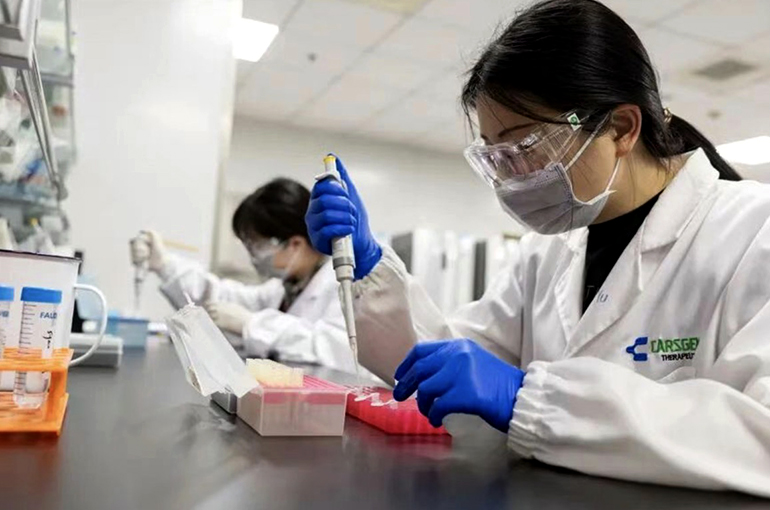
 China’s CARsgen Slides for Second Day on Hefty Price Tag for World’s First Solid Tumor CAR-T Therapy
(Yicai) June 24 -- Shares in CARsgen Therapeutics Holdings tumbled for the second consecutive day today after the Chinese innovative drug developer disclosed the price of its newly approved chimeric antigen receptor T-Cell therapy, which is the world’s first treatment of its kind targeting solid tumors, at close to CNY1 million (USD147,000) per dose.
CARsgen’s share price [HKG: 2171] plunged 11.7 percent to end the day at HKD13.91 (USD1.77) apiece, following a 6.4 percent drop yesterday. The Shanghai-based company’s market capitalization has roughly halved since it hit a four-year high of HKD28.60 on April 20.
CARsgen’s CAR-T therapy, called satribtagene autoleucel or satri-cel, was given the green light by the National Medical Products Administration of China on June 22. It is used to treat patients with advanced gastric or esophagogastric junction cancer who have failed at least second-line treatment. This is the world’s first approved CAR-T therapy for a solid tumor. Previous CAR-T products of its kind have only been used to treat blood cancers.
The price of satri-cel is CNY990,000 (USD145,500) per injection, which is basically the same as other CAR-T therapies on the market, CARsgen said at an investor briefing yesterday. The firm expects annual sales to reach CNY2 billion (USD294 million) within four to five years.
“This price is much higher than market expectations. We now need to see whether innovative payment methods such as commercial health insurance will be adopted to help cover part of the cost,” an industry insider told Yicai.
CAR-T therapy is one of the most closely watched areas in oncology. It works by genetically engineering a patient’s T cells to recognize and attack cancer cells. These modified immune cells are multiplied in a lab and then infused back into the patient.
Satri-cel can extend median survival in patients with advanced gastric or esophagogastric junction cancer who have failed second-line treatment from less than four months to nearly nine months, according to previously disclosed clinical data.
Because CAR-T therapies are very expensive, they are not included in China’s basic public health insurance scheme, meaning patients must bear the full cost on their own. However, late last year, the country’s medical insurance authority added a commercial health insurance innovative drug list and included several domestic CAR-T therapies for the first time.
Inclusion in commercial insurance means that patients can share part of the cost by purchasing private health insurance. However, implementation takes time and challenges remain such as hospital access and insurance reimbursement processes, another industry insider told Yicai.
Editors: Dou Shicong, Kim Taylor





