



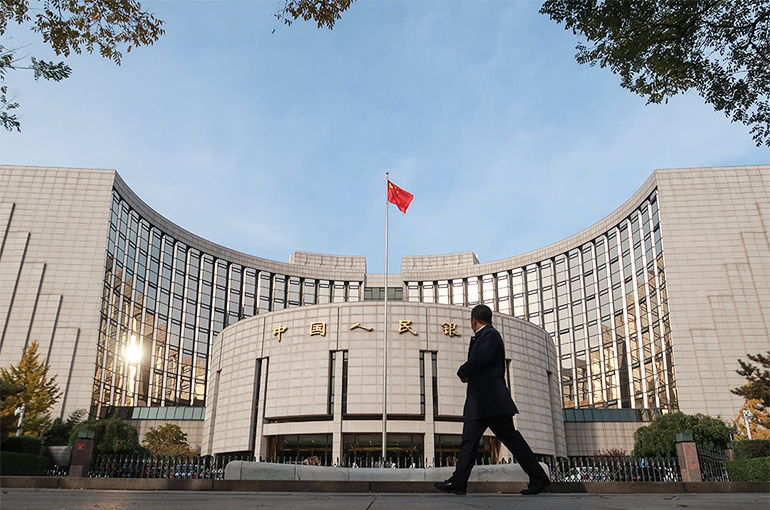
 China’s Central Bank Extends MLF Top-Up Streak to 13 Months as March Sees Net Liquidity Drain
(Yicai) March 25 -- The People’s Bank of China conducted a medium-term lending facility operation today that was larger than the amount maturing for the 13th straight month, but March still saw it pull a net CNY250 billion (USD36.3 billion) of mid-term liquidity when outright reverse repurchase operations are factored in.
The net liquidity drain is the first since October 2024. While the PBOC’s one-year MLF operation resulted in a net injection of CNY50 billion (USD7.3 billion), less than February’s CNY300 billion, outright reverse repos across two tenors this month have led to a combined net withdrawal of CNY300 billion, more than offsetting the MLF increase.
The central bank said yesterday that it would conduct a CNY500 billion one-year MLF operation today to maintain ample liquidity in the banking system. The operation entailed a fixed quantity through interest-rate bidding, with winning bids determined at multiple price levels. As CNY450 billion of MLF loans mature this month, it translated into a net addition of CNY50 billion.
Analysts said the net withdrawal does not mean that the PBOC is set to keep tightening medium- and long-term liquidity. Policy is likely to remain moderately accommodative, while the authorities balance the need to preserve ample liquidity with rising inflation risks linked to geopolitical tensions and higher global crude oil prices, they said.
The net drain largely reflects the CNY1.9 trillion (USD275.7 billion) pumped in in January and February and relatively loose money-market conditions this month, said Wang Qing, chief macroeconomic analyst at Golden Credit Rating International. It does not mean that the PBOC is preparing to tighten medium- and long-term liquidity on a sustained basis.
Going forward, Wang said, the central bank will continue to use the reserve requirement ratio, treasury bond trading, MLF operations, and outright reverse repos to maintain relatively stable and ample liquidity.
On whether the net subtraction signals an imminent RRR cut, Wang said developments in the Middle East have driven up international oil prices since the end of last month, while China’s overall price levels have risen strongly in March, which could hamper growth.
In the near term, with external uncertainties increasing quickly, China’s monetary policy is likely to stay focused on maintaining abundant liquidity and steadying market expectations, while the policy focus temporarily shifts toward curbing excessively fast price gains, Wang said, adding that cuts to the RRR and interest rates may be delayed a little.
Recent geopolitical conflict has lifted China’s imported inflation risk, and monetary policy may be set more flexibly to balance domestic and external considerations, with overall policy operations becoming steadier, according to Ming Ming, chief economist at Citic Securities. While policy is expected to remain moderately loose, investors should watch for marginal changes in key data and swings in global capital markets, he said.
Editor: Emmi Laine





