



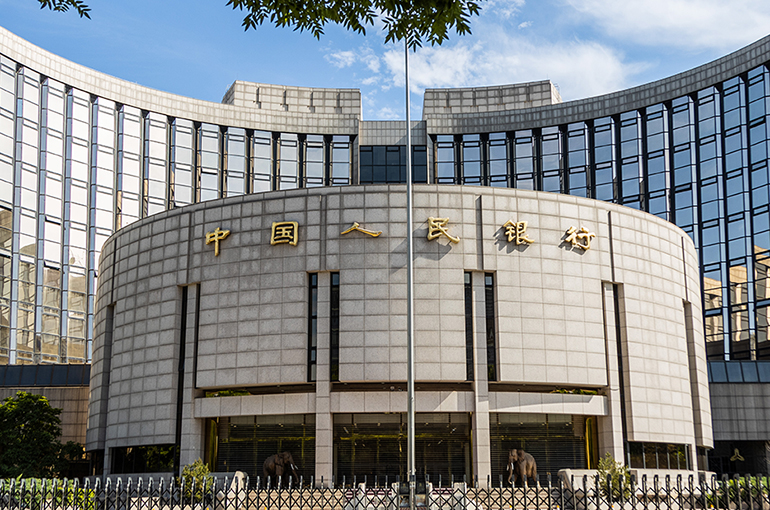
 China's Central Bank Insists on Keeping Moderately Loose Monetary Policy at This Year's First Meeting
(Yicai) Jan. 7 -- The People's Bank of China, the country's central bank, has reaffirmed its stance to maintain a moderately loose monetary policy this year during its annual work conference.
The PBOC will promote high-quality economic development and reasonable price recovery, flexibly utilizing monetary policy tools, including reserve requirement ratio and interest rate cuts, to ensure ample liquidity and bolster credit expansion, according to a statement released after the two-day meeting that ended yesterday.
The first round of interest rate and RRR cuts could occur before the Chinese New Year holiday -- which starts on Feb. 15 -- to stabilize macroeconomic expectations for the first quarter, said Wang Qing, chief macroeconomic analyst at Golden Credit Rating.
Prices will likely remain relatively low this year, and with the Federal Reserve's rate cut cycle easing external constraints, domestic monetary policy has ample room for adjustments, Wang noted. However, he believes that large rate cuts and large-scale quantitative easing are unlikely this year.
The PBOC will optimize structural monetary policy tools in 2026, with overall quotas rising and operating rates moderately falling after the interest rate cuts, Wang predicted.
The PBOC meeting also clearly defined China's exchange rate policy. The country will strive to maintain the Chinese yuan exchange rate stable at a reasonable and balanced level while preventing exchange rate overshoot risks.
The US dollar index is expected to remain weak this year, mainly because of the Fed continuing to lower rates, policy differences between the European Central Bank and the Bank of Japan, the US fiscal policy, and US President Donald Trump's potential interference with the Fed's independence, said Ming Ming, chief economist at Citic Securities.
The Chinese yuan's external environment appears generally favorable, with the US dollar's upside risks mainly tied to how the US economy recovers after the rate cuts, Ming noted.
The PBOC's tools to stabilize the yuan exchange rate aim to guide market expectations, preventing the formation of unilateral and self-reinforcing consensus in the foreign exchange market while maintaining a balanced approach to support the resilience of the yuan, Ming believes.
Under the assumption of no unexpected shifts in exports and a weaker US dollar, the Chinese yuan is expected to experience a moderate appreciation this year, he noted, adding that it would be unwise to bet on a unilateral trend, given potential uncertainties.
Prudently resolving financial risks in key sectors will be another of the PBOC's top priorities this year. The central bank outlined control measures for financing platform debt, small financial institutions, and financial markets, proposing to establish a mechanism to provide liquidity to non-bank institutions in specific scenarios.
'Specific scenarios' refer to situations when the market faces systemic pressure, normal liquidity channels are disrupted, a single or a group of institutions encounter liquidity crises, and there is a potential to trigger systemic risks, said Zeng Gang, chief expert and director of Shanghai Finance and Development Laboratory.
Even though a systemic non-bank liquidity crisis has not occurred in China, preemptive measures are still necessary, Zeng pointed out. Under the current framework, the PBOC's liquidity tools mainly target commercial banks, with non-bank institutions only relying on indirect bank support or their own asset monetization capabilities.
This indirect mechanism can function under normal circumstances but may fail under market stress scenarios due to banks' risk-averse behavior, Zeng explained.
Editor: Futura Costaglione





