



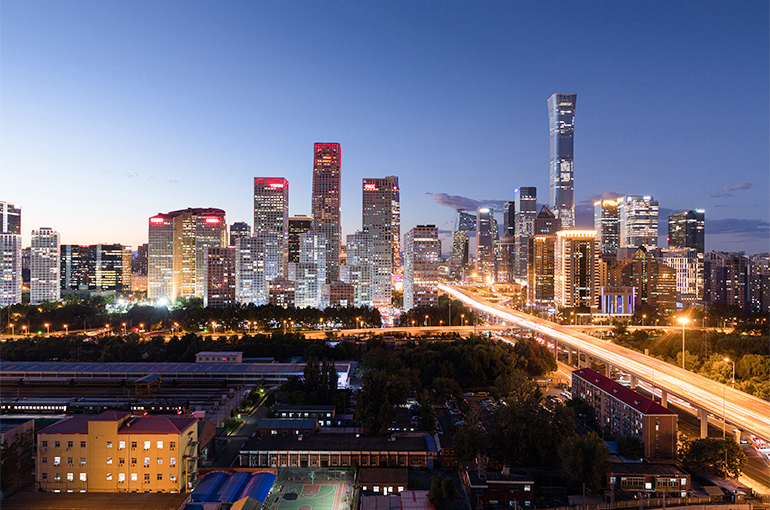
 China’s Central Business Districts Gain Global Edge, Report Shows
(Yicai) June 18 -- The gap between leading central business districts in China and the world's top business hubs is rapidly narrowing, with Chinese CBDs now achieving top-tier global standing across key development indicators, according to a new report.
China’s CBDs stand out in the latest Global Business Districts Attractiveness Report, compiled and published by EY and the Urban Land Institute, because of four powerful advantages, Lara Yu, consulting partner at Ernst & Young China, said on June 16, noting that these were highlighted and shared during the London Parallel Session of the 2026 Beijing CBD Forum, an international event themed “Exploring New Pathways for Global Business District Development.”
First, Chinese CBDs have a clear edge in attracting high-quality innovative talent, Yu said. Beijing and Shanghai are two of only three cities worldwide that have more than one million digitally skilled workers, giving domestic business districts a deep pool of digital and technology talent that many overseas counterparts cannot match, she added.
Second, China’s pioneering dual-center development model -- where hubs serve simultaneously as business centers and consumer centers -- creates vibrant 24-hour urban ecosystems that are more attractive to both companies and professionals, Yu noted.
Third, although finance, the headquarters economy, and professional business services remain important, sectors such as technology, the digital economy, artificial intelligence, and cultural industries are assuming an increasingly prominent role, she said. As a result, business districts are evolving from traditional office clusters into multifunctional platforms that support innovation, entrepreneurship, industrial collaboration, and the development of new productive forces, she said.
Chinese CBDs have also built comprehensive innovation support systems, including digital governance tools, smart district operations, data service platforms, and real-world testing scenarios, to accelerate the industrialization and scaling of cutting-edge technologies, Yu pointed out.
Lastly, CBDs in China have evolved from one-way gateways for inbound foreign capital into two-way global connectivity bridges, she said. In addition to attracting overseas capital, they now provide end-to-end cross-border support for Chinese companies going global, including cross-border capital management, overseas regulatory consulting, and international operations coordination.
Rather than simply keeping pace with global trends, China’s business districts are now creating original development models and practical experience for CBD transformation worldwide, she stressed.
Global Economic Growth Engines
Jointly hosted by the Beijing CBD Administrative Committee and the GBD Innovation Club, the London Parallel Session brings together global representatives from CBD management bodies, financial institutions, professional service agencies, investment firms, and urban development sectors, taking the GBD Attractiveness Report as a core research basis for cross-border dialogue.
Top GBDs jointly generate USD4.5 trillion of gross domestic product and sustain roughly seven million jobs, acting as vital engines for world economic growth, said Rohan Malik, managing partner of EY EMEIA & UKI Government & Infrastructure, citing data from the report. Modern business districts are transforming from simple office clusters into comprehensive ecosystems integrating talent, innovation, capital, and infrastructure, while future competitiveness hinges on adaptability to AI, low-carbon industries, and shifting market demands, he added.
Chen Dai, chair of the GBD Innovation Club and deputy mayor of Beijing's Chaoyang district, affirmed the forum's mission to facilitate cross-border CBD knowledge exchange and joint exploration of sustainable and innovative development paths for GBDs.
Marc Lhermitte, global lead for foreign direct investment and attractiveness at EY, and Simon Chinn, vice president of research and advisory services at the Urban Land Institute, jointly unpacked the full findings of the report, pointing out that GBDs are undergoing profound structural shifts amid hybrid working, rising operational costs, fierce talent competition, and stricter climate requirements.
The most competitive hubs no longer prioritize economic gains alone, but balance commercial output with livable urban environments, social value, and environmental sustainability, they said.
Unique Logic
China has a unique CBD transformation logic, built on joint research between EY and the China CBD Alliance, according to Jane Yang, government and infrastructure market segment leader of EY China and managing partner at EY Beijing Office. Traditional CBDs focused on banks, law firms, and multinationals’ HQs, while new-generation Chinese business districts feature AI startups, digital content studios, advanced tech firms, and domestic multinationals expanding overseas, she added.
For example, Guangzhou Tianhe CBD is home to 25,000 digital firms and achieved USD2.3 billion in digital service exports last year; Hefei Swan Lake CBD links local high-tech companies with the University of Science and Technology of China to realize lab-to-market tech incubation; Sanya CBD, a core part of the Hainan Free Trade Port, accounts for over 75 percent of the city's foreign investment in use; Jinan CBD operates low-altitude drones and autonomous delivery fleets as a live testing ground for smart logistics; and Beijing CBD relies on the Beijing International Big Data Exchange to slash data cooperation costs for enterprises, she noted.
Beyond industrial restructuring, Chinese CBDs redefine the core meaning of "CBD," with the letter B standing for "Bridging" domestic industries and global markets, as well as "Blending" work, daily life, culture, and innovation. Districts renovate office spaces with shared public zones, introduce cultural venues and international talent support programs, evolving from single workplaces into integrated urban communities.
Two themed panel discussions followed the keynote session at the forum, covering dynamic business ecosystem construction and green transition-driven innovation. Participants reached a consensus that competitive business districts must move beyond merely supplying high-standard office spaces by building sustainable, innovation-focused urban environments to attract emerging industries and top talent, which is becoming a shared priority for all global CBD operators.
The London Parallel Session successfully connected China's CBD development practices with worldwide insights, according to the organizers. Centered on authoritative research from the GBD Attractiveness Report, the event highlighted the country's pioneering progress in business district upgrading and offered valuable new references for global urban economic development.
Editor: Martin Kadiev





