



 China's Comtech Is 'Super Connector' for AI Industry, CEO Says
(Yicai) March 30 -- Comtech is building an ecosystem for the artificial intelligence supply chain that will hopefully serve Chinese robotics, autonomous driving, and drone companies, according to its chief executive officer.
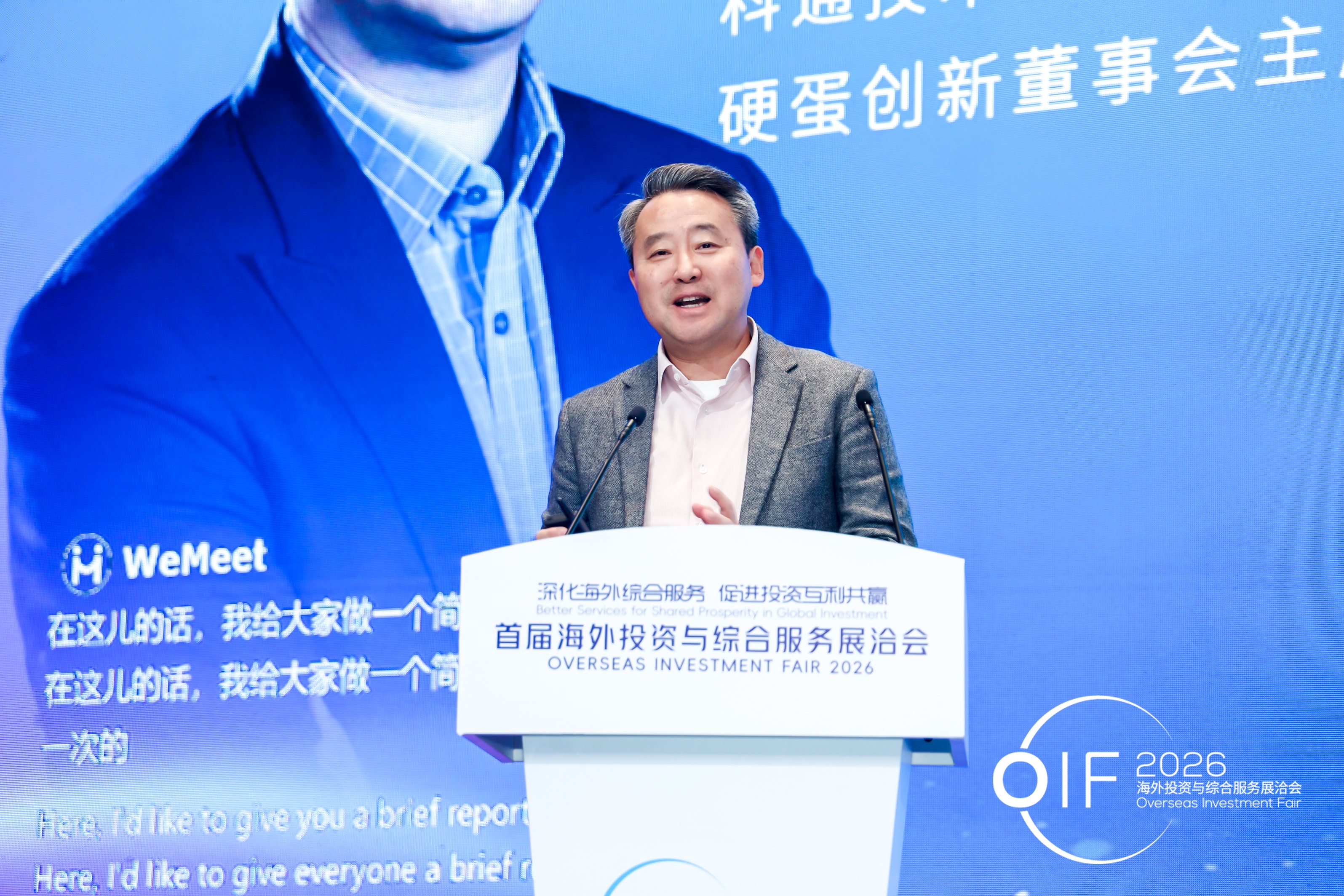
"We position ourselves as a super connector for the AI industry," Jeffrey Kang, who is also the founder of Comtech's parent firm Cogobuy Group, a leading electronic component distribution platform, said at the Comtech Robotics Industry Ecosystem Forum held on the sidelines of the inaugural Overseas Investment Fair in Shanghai on March 27.
"When we build a robot, it is not simply a matter of assembling hardware," Kang noted. "Whether you use Nvidia's Jetson chip as the foundation or a domestically produced GPU, it involves product simulation, 3D modeling, and embedding trained large models into individual robot units so they can enter the market and provide services.
"The whole process requires linking together the resources of the entire supply chain," he said.
Comtech's core positioning is as an authorized distributor and ecosystem developer for the Jetson edge AI computing platform in China, which has more than 6,000 customers and 1.7 million developers worldwide.
On the supply side, Comtech works with more than 100 global chip makers, including Nvidia, Intel, Advanced Micro Devices, and Xilinx. On the supplier end, it serves leading Chinese robotics firms, including Unitree Robotics, Agibot, Songyan Power Beijing Technology, and Fourier, across more than 150 industry verticals.
During the forum, Comtech signed deals with drone manufacturer Kbotic and Yicai Media Group, the financial news arm of Shanghai Media Group. At the exhibition area, it presented collaborations with Nvidia on robotics, with Kbotic on drones, with BrainCo on brain-computer interfaces and bionic intelligent interaction, and with Standard Robots on generalized embodied intelligence solutions.
Comtech's engineers work with clients step by step on integration, making it "a company that ultimately helps clients build capability," a person familiar with the firm's internal operations pointed out.
Going Global
Comtech signed an agreement with a US robot services company at the forum, aiming to help Chinese manufacturers establish marketing channels and after-sales service infrastructure in North America.
"In the embodied intelligence space, early demand tends to be fragmented, multiple product types, with relatively small initial volumes for any single product," Kang said. "To serve this kind of market, you have to be able to produce samples and prototypes quickly to meet customer needs."
Robooster, a 30-person Chinese company that focuses on multi-sensor time synchronization technology, secured an order from Canada through Comtech's ecosystem, said CEO Sun Bo. "We have limited resources on our own, but when Comtech, which has marketing resources, channels, and established credibility, deploys its market resources as an ecosystem, costs can be shared, significantly improving the overall efficiency."
China has no shortage of technology, production capacity, or application scenarios, said Liu Xiaoming, deputy chairman of the China Council for International Investment Promotion and former head of Hangzhou's commerce bureau. "What we lack is higher-level innovation platforms, more efficient overseas channels, and tighter industrial ecosystem coordination."
DJI is a benchmark for what Chinese robotics companies could achieve globally, Kang pointed out. "In the drone market, DJI and many other domestic drone makers have captured 80 to 90 percent of the US market because once the market reaches a degree of maturity, the cost and service advantages of Chinese firms are something no other country can match.
"Whether you are a two- or three-person startup or a large enterprise with thousands of employees, every robotics company is a global company from day one," he said. "Our goal is to leverage the world's best technology and China's supply chain to make products that serve the Chinese and global markets."
Commercial Viability
The ecosystem Comtech is building faces independent scrutiny from the industry's technology and capital sides.
Zhang Yimin, chief scientist of intelligent systems at Shanghai Jiao Tong University's Advanced Integration Research Institute and former chief scientist at Intel China Research Institute, offered a pragmatic benchmark for embodied AI deployment.
"If 60 to 70 percent of application tasks in a given domain can be solved and deployed in real environments, that is sufficient. There is no need to wait for artificial general intelligence," Zhang said, adding that cost is not currently the biggest obstacle, but data quality and engineering-to-delivery capability are.
The core advantage enabling Chinese component manufacturers to move quickly into the humanoid robotics sector is the rapid-response capability they built up during the electric vehicle era, noted Zhang Xin, a smart hardware analyst at Dolphin Research under Longbridge Securities. Data scarcity is the biggest barrier to commercialization, he stressed.
"Global NEV sales have already exceeded 20 million units, yet intelligent driving is still not fully mature," Zhang pointed out. "For humanoid robots, the data requirement is likely even greater, and right now, not many products are being sold or can be sold."
Last year, there were a record high 674 robotics fundraisers, according to an investment roundtable at the Comtech Robotics Industry Ecosystem Forum. More than 190 deals worth over CNY20 billion (USD2.9 billion) have already been closed this year as of March 27, while Unitree Robotics launching an initial public offering process on Shanghai's Nasdaq-like Star Market marked a milestone in the industry's move toward scale.
"When you actually enter a real industrial scenario, customers are extremely cost-conscious," said Chen Zhiling, chairman of Gongshang Investment, cautioning against inflated valuations in high-end embodied intelligence hardware. "If a robot can't pay back its costs within 18 months in an industrial setting, they simply will not do it," she said, adding that cases of robots being returned by factories have already emerged in early 2026.
The industry's valuation logic has shifted from future projected revenue to historical stable revenue, Liu Yang, vice president of autonomous driving tech PIX Moving. City services, with their high repetitiveness and structured nature, represent a realistic near-term entry point for embodied intelligence commercialization, Liu noted.
Upstream component localization remains the industrial foundation, with long-term value concentrated in technical breakthroughs in areas such as reducers and sensors, Chen Zhen, founding partner of Qianchuang Capital.
Editor: Martin Kadiev





