



 China’s Economy Grows 4.7% in First Half, In Line With Annual Goal
(Yicai) July 16 -- China's economy expanded 4.7 percent in the first half, keeping growth aligned with the country's full-year target, as emerging growth drivers strengthened and consumer spending showed signs of recovery.
“The growth pace is in line with the annual target,” Mao Shengyong, deputy director of the National Bureau of Statistics, said at a press conference yesterday. China’s steady economic performance has laid a solid foundation for achieving major annual targets, particularly the economic growth target, he added.
In March, the government set a goal of expanding gross domestic product by 4.5 percent to 5 percent in 2026. GDP grew 5 percent in the first quarter and 4.3 percent in the second to reach CNY69.57 trillion (USD10.28 trillion), according to NBS data. The first half’s year-on-year jump of CNY3.6 trillion (USD532 billion) was the most in five years, Mao pointed out.
Although growth slowed in the second quarter, Mao attributed that mainly to "short-term factors and external influences," noting the economy remained on a stable footing, with its underlying trend toward innovation-driven and high-quality development unchanged.
The economy may expand between 4.6 percent and 4.7 percent this year, remaining stable in the second half thanks to a gradual improvement in production, rising investment in infrastructure, and favorable comparisons with last year’s lower base, according to China Galaxy Securities. Second-quarter growth was likely this year’s slowest.
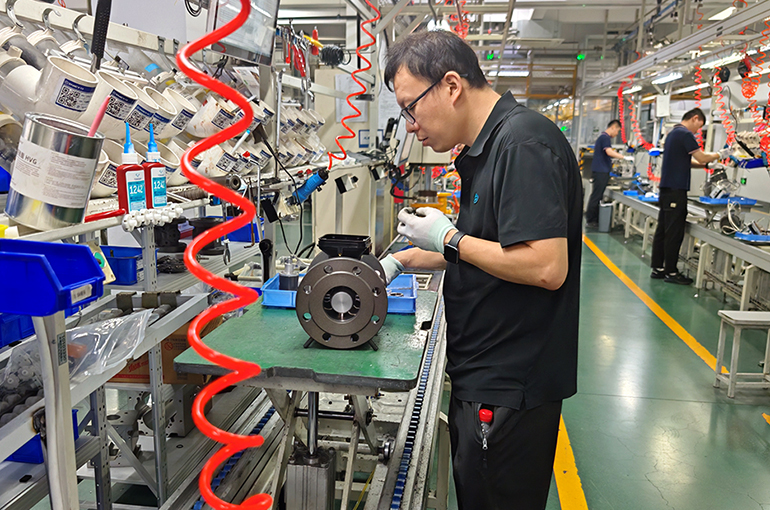
New growth drivers represented by high-end manufacturing, the digital economy, and modern services contributed more than 40 percent of economic growth int he first half, Mao noted, citing preliminary figures.
The added value of high-tech manufacturers above a designated size jumped 13.3 percent. Industries related to artificial intelligence, such as integrated circuit and intelligent vehicle-mounted equipment manufacturing, surged more than 30 percent.
New energy vehicles accounted for over 60 percent of autos sold through retail channels for three straight months, driving up the output of lithium-ion batteries to almost 40 percent.
Consumption Rebound
Retail sales of consumer goods and services climbed 2.7 percent in the period, with the former up 1.1 percent and the latter up 5.3 percent, NBS data also showed.
Faster growth in online retail and rural consumption reflect the expanding potential of the digital economy and deeper urban-rural market integration, said Pang Ming, a member of the China Chief Economist Forum. June’s rebound also showed that fiscal support and government policies to promote consumption are starting to take effect, he said, adding that while the recovery remains too modest to provide a powerful economic boost, consumption is playing a steadying role.
Further policy support for consumption is likely in this half, according to Wang Qing, chief macroeconomic analyst at Golden Credit Rating International. Authorities may boost funding for consumer trade-in programs while expanding measures such as childbirth subsidies and preschool-education support, increasing the likelihood that consumption will accelerate further in the months ahead, he said.
On July 12, China's State Council released its first-ever five-year plan for consumption, which included quantifiable targets, such as CNY60 trillion (USD8.84 trillion) in retail sales of consumer goods by 2030, and outlined specific measures to expand consumption. Last year, retail sales of consumer goods reached CNY50.1 trillion.
The urban surveyed unemployment rate fell to 5 percent last month from 5.1 percent in May, while averaging 5.2 percent over the first six months of this year, the NBS data showed. First-half per-capita disposable income was CNY22,981 (USD3,395), a nominal jump of 5.2 percent and an actual increase of 4.2 percent.
National fixed assets investment, excluding rural households, fell 5.7 percent to CNY22.64 trillion. Investment in real estate development tumbled 18 percent, while that in high-tech industries rose 4.6 percent and in internet and related services surged 40 percent.
Editor: Martin Kadiev





