 China’s Embodied AI Financing Jumps Five Times to Nearly USD14 Billion on IPO Hopes, LLM Progress
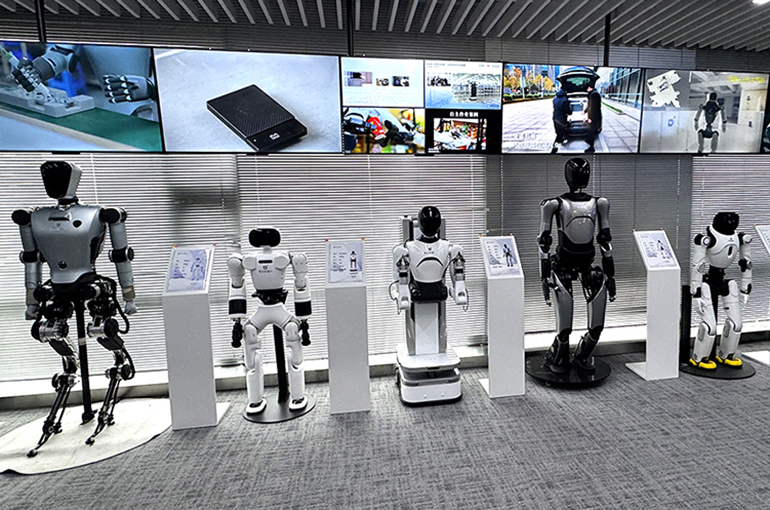
(Yicai) July 14 -- China's embodied artificial intelligence sector attracted CNY93.5 billion (USD13.8 billion) of financing in the first half, a fivefold jump from a year ago, as breakthroughs in large language models, expectations of initial public offerings by leading developers, and policy support fueled investor enthusiasm.
The sector, which develops AI-powered robots that can perceive, reason, and interact with the physical world, had 322 financing deals during the six months ended June 30, more than double that of a year earlier, according to ITJuzi.Com, a Chinese provider of investment data.
Funding has been concentrated in three key areas: the research and development of embodied AI LLMs, the large-scale collection of robot training data, and product delivery capabilities, according to Yicai's analysis of publicly available information.
The rapid pace of fundraising has also hastened the creation of unicorns in the sector, underscoring growing investor confidence despite lingering concerns over commercialization.
Unitree Robotics, AgiBot, and Galbot achieved valuations exceeding CNY10 billion (USD1.47 billion) each last year, becoming early embodied AI unicorns. This year, they have been joined by another 19 firms, including Deep Robotics, X Square Robot, AI² Robotics, Galaxea AI, and Spirit AI. Among them, Galbot, X Square Robot, AI² Robotics, and Galaxea AI have each surpassed CNY20 billion.
Ten robotics-related companies listed in Hong Kong in the first half, while another 16 have filed and are awaiting approval, according to figures from financial platform Choice. In the Chinese mainland market, Unitree, Deep, Dobot, and Leju Robotics Technology have all entered the IPO process.
State-backed and industrial investors have also stepped up financing in the sector. The National Artificial Intelligence Industry Investment Fund has invested in companies such as Galbot and Deep, while local government-backed investors, including Shenzhen Capital Group, have funded at least 12 companies. Businesses in the automotive sector, including SAIC Motor and BAIC Group Industrial Investment, have also financed embodied AI firms.
Among venture capital behemoths, HSG, formerly known as Sequoia Capital China, participated in 20 financing rounds involving 14 companies in the first half, while GL Ventures, the early-stage VC affiliate of Hillhouse Capital, took part in 18 across 14 companies.
Among China's internet giants, Meituan and its affiliates were the most active investors, backing seven companies, including X Square, Galaxea AI, and TARS Robotics. Tencent Holdings, Alibaba Group Holding, and JD.Com, also participated in multiple funding rounds. X Square has become China’s only embodied AI firm to get investment from Meituan, Alibaba, ByteDance, and Xiaomi.
Industry sources, however, caution that mass commercial deployment of robots remains some way off. But once a company successfully establishes a viable business model for real-world deployment, the industry could enter a major shakeout phase, they pointed out.
“If embodied intelligence remains limited to demonstrations, marketing, and research fields, it will only have short-term commercial value," said Liu Yinghang, a partner at Scale Partners, a financial advisory firm and investment consultancy. "As valuations continue to rise, the bubble will only get bigger."
Liu added that the market truly needs is for embodied AI to be deployed in real-world scenarios to solve actual problems.
Editor: Emmi Laine