



 China’s Fiber Giant YOFC Bets on Hollow-Core Fiber to Power the AI Era
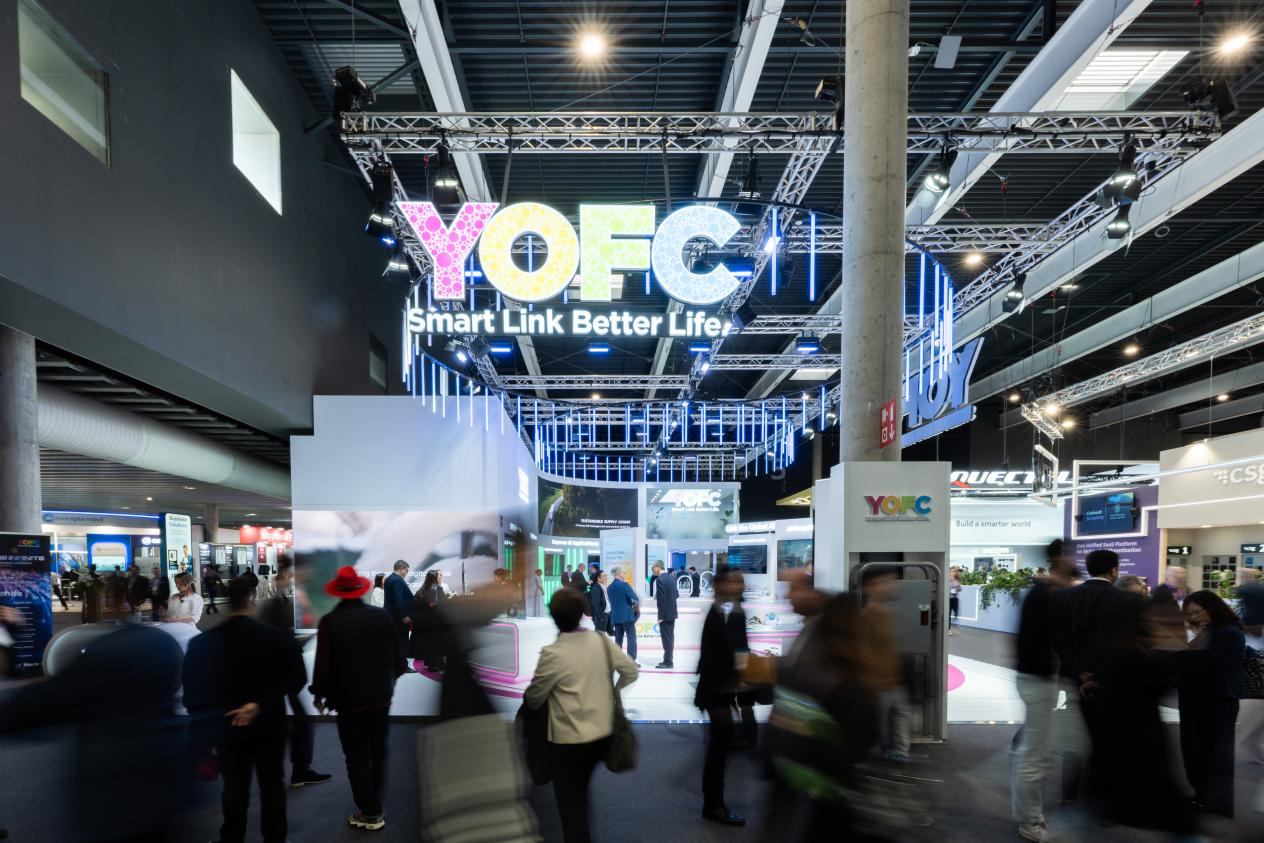
(Yicai) March 9 -- Yangtze Optical Fibre and Cable Joint Stock Limited Company, also known as YOFC, a leading global supplier of optical fibers, is showcasing technology at the Mobile World Congress in Barcelona that pushes the physical boundaries of light transmission.
As artificial intelligence models drive unprecedented demand for data throughput, the Wuhan-based firm’s presence at the MWC, the world's biggest annual trade show for the mobile and connectivity industry, under the theme “AI × Fibre: Leading an Intelligent Future” marks a pivotal shift in how the industry views the underlying architecture of AI.
YOFC's strategic response is its "AI-2030" initiative, unveiled last June, built around three core objectives for AI network infrastructure: ultra-large bandwidth, ultra-low latency, and ultra-low loss.
“If you have a hollow-core fiber, [light] travels through a vacuum so you don't have any attenuation,” Senior Vice President Jan Bongaerts said in an interview with Yicai at the company's MWC booth. “That means you have huge advantages in the speed of light. It's not blocked, and the latency is lower, and you can have an opportunity to send more signals through.”
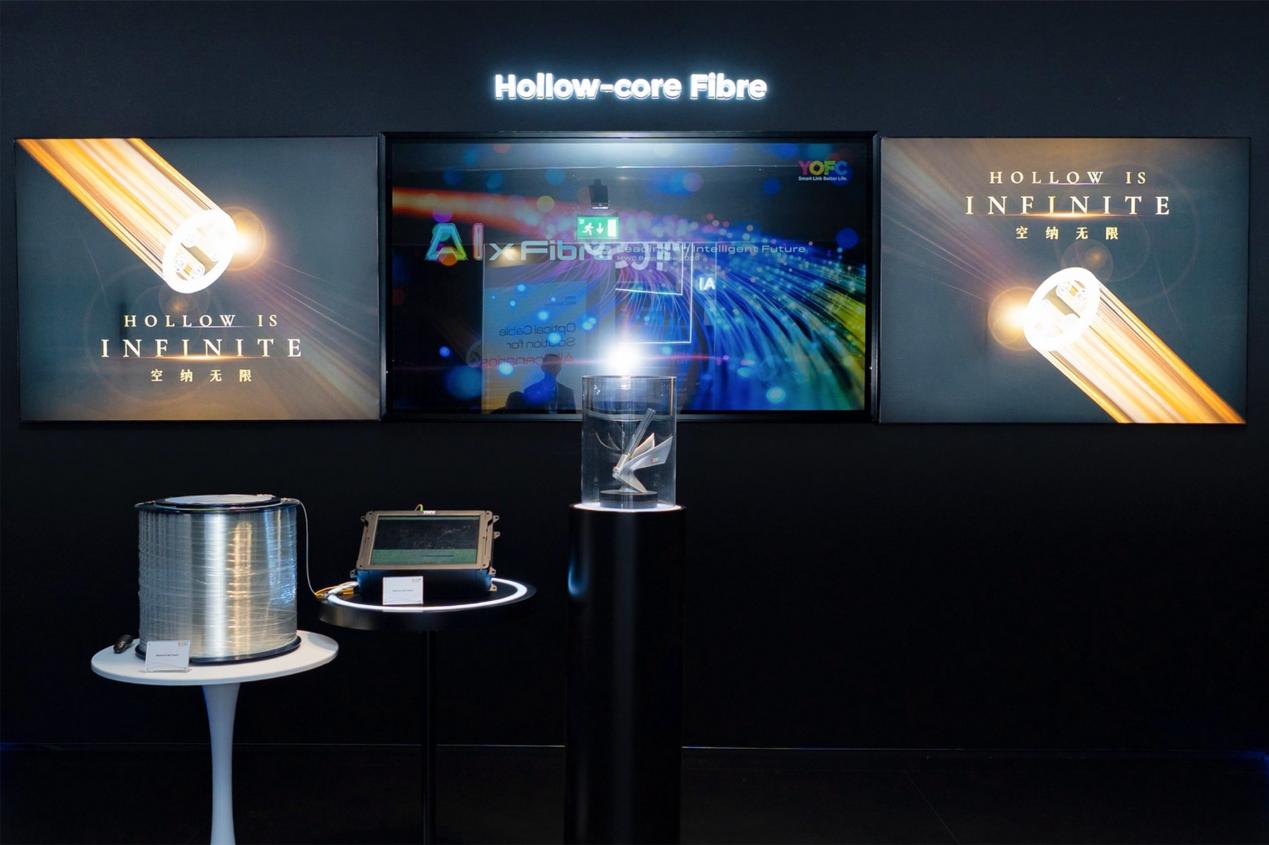
Conventional optical fiber channels light through a solid silica core, where attenuation and nonlinear optical effects degrade signal integrity, limiting channel capacity and effective transmission distance. Hollow-core fiber, or HCF, on the other hand, replaces that glass medium with a structured air core, enabling light to travel much closer to its theoretical maximum velocity. Hollow-core fiber also suppresses nonlinear optical effects by close to three orders of magnitude, a crucial advantage for dense wavelength-division multiplexing and high-power AI training workloads.
The performance metrics are striking. YOFC says HCF cuts transmission latency by about 31 percent compared with conventional solid-core fiber, while increasing propagation speed by roughly 47 percent.
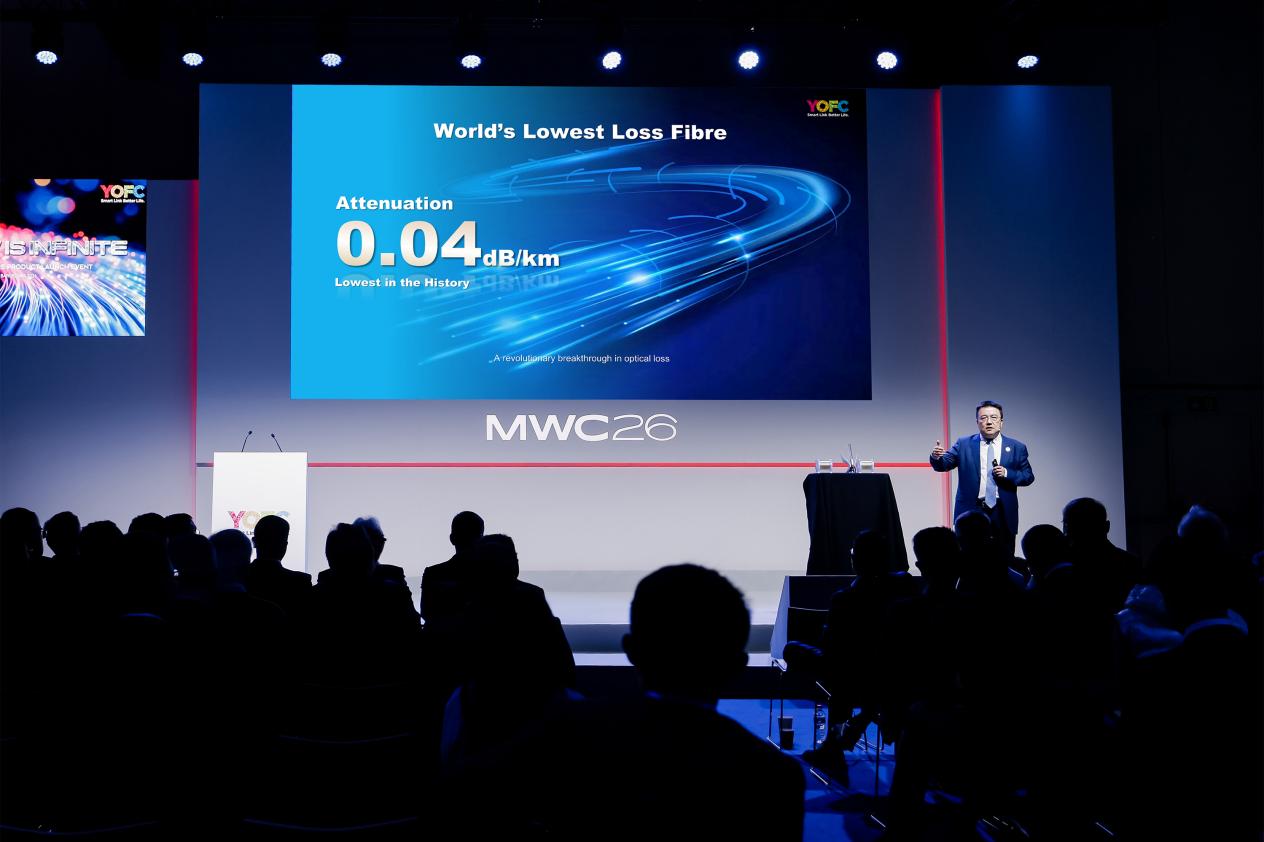
In laboratory conditions, YOFC has recorded a minimum attenuation of 0.040 dB/km—below the theoretical Rayleigh scattering floor of conventional silica fiber and a claimed world record—while commercial-scale production has achieved consistent sub-0.1 dB/km performance, placing YOFC among a small number of companies worldwide with proven commercialization readiness.
The installations speak for themselves. Notable projects include a high-frequency trading link between the Shenzhen and Hong Kong stock exchanges, which has reduced round-trip latency to less than one millisecond, and a 110-kilometer corridor connecting data centers in Dongguan and Hong Kong, the world’s longest commercial HCF deployment.
To ensure adoption, YOFC has addressed the “compatibility gap” by developing dedicated adapters that allow hollow-core segments to connect seamlessly with existing single-mode fiber networks, eliminating the need for wholesale infrastructure replacement.
A Portfolio Built for the AI Era
HCF sits at the frontier of a much broader portfolio that spans every layer of the connectivity stack. The AI boom is, at its physical core, a fiber boom, and YOFC has assembled its product lineup with that reality firmly in view.
At the backbone level, G.654.E large-effective-area fiber has become the de facto standard for 400G deployments among China's three major carriers. YOFC secured about half of China Mobile's G.654.E procurement last year, and the fiber is gaining international traction in the Philippines, Brazil, and Europe. Multi-core fiber, which multiplies the number of independent transmission paths within a single cable, is advancing through pilot deployments with upstream and downstream partners via YOFC's national key laboratory platform.
Inside the data center, the demand picture is stark. Analysis published by IEEE ComSoc in January found that AI-optimized data centers need two to four times more fiber cabling than traditional hyperscalers — and in some configurations more than ten times more — driven by massively parallel GPU architectures and surging east-west traffic. YOFC addresses this with high-end OM4 and OM5 multimode fiber and ultra-high-speed optical transceiver modules. The portfolio also extends into automotive fiber for vehicle-mounted applications and vehicle-to-everything connectivity, reflecting a deliberate push into vertical markets at the intersection of AI and mobility.
The demand outlook reinforces the urgency of the build-out. Spending on data center switches deployed in AI back-end networks is forecast to surpass USD 100 billion by 2030, driven by expanding deployments across scale-up, scale-out, and scale-across domains, according to a February report by Dell'Oro Group.
Global Expansion
YOFC's globalization story is as instructive as its technology roadmap. The strategy involves a delicate balance between leveraging its manufacturing roots in China and establishing a genuinely global identity.
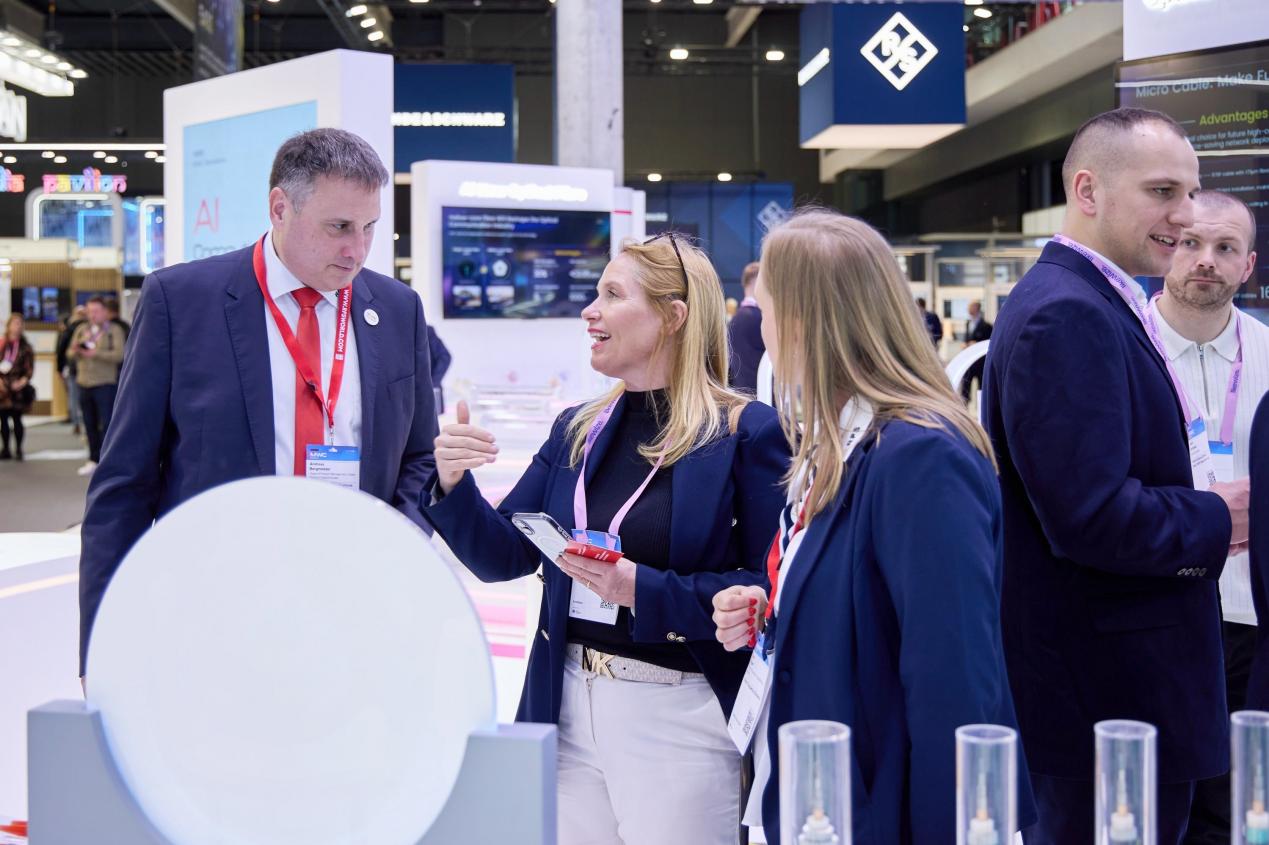
Since starting its international push around 2014, which coincided with its Hong Kong listing, YOFC has established eight production facilities across six countries: Indonesia, South Africa, Brazil, Poland, Germany, and Mexico.
Overseas revenue has topped 30 percent of total sales for four straight years and hit 42 percent in the first half of 2025. Management has set a 50 percent target, which Bongaerts said is the dividing line between an international business and a genuinely global company.
Indonesia illustrates both the philosophy and the payoff. YOFC recognized as early as 2015 that a single-country manufacturing base would be insufficient to serve a global customer base at scale, and the decision to build a major hub there was driven by a straightforward operational logic: proximity to customers, resilience in supply, and the ability to deliver locally wherever demand arises. The facility has since grown into a full-scale operation capable of manufacturing both optical fiber and cable. Last year marked YOFC's first decade in the country, during which the company has connected more than one million subscribers across more than 20 cities, with compound annual cable delivery growth in excess of 30 percent.
"You cannot put everything in one location," Bongaerts said. "You have to be global and have multiple platforms to serve customers."
The same logic shapes YOFC's other facilities. The firm’s Polish facility supplies European carriers; its German plant manufactures specialty radio-frequency cables for transit systems.
This multi-base strategy also reflects a deliberate branding choice. “We are a global company,” Bongaerts said.
Infrastructure as Mission
Of YOFC’s roughly 10,000 global employees, about 2,000 are based overseas, with more than 99 percent of them local nationals.
Talent is the key. “We need people with an international mindset, that can speak languages, that are willing to work for us overseas,” Bongaerts said. “The product, we master the technology, so we’re leading in that aspect.”
YOFC’s best expression of its long-term partner philosophy is the Peru National Broadband Project, completed this January. It links 1,600 towns across four regions, laid more than 9,000 km of cable, and provides internet access to over a million people. Navigating complex Andean mountain terrain, equipment integration, and full lifecycle operations marked YOFC’s transformation from product exporter to digital infrastructure provider — a model the company intends to replicate across Latin America and Africa.
Over 37 years, YOFC has cumulatively produced and delivered more than 1.1 billion fiber-kilometers, serving a global population of approximately three billion people and contributing to raising the worldwide fiber broadband penetration rate to 47.3 percent. With manufacturing capacity now distributed across four continents and next-generation fiber moving from pilot to deployment, the company’s AI-era strategy is less a declaration of intent than an accounting of work already underway.
Editor: Tom Litting





