



 China’s 2025 Trade Climbs 3.8% to Record USD6.52 Trillion
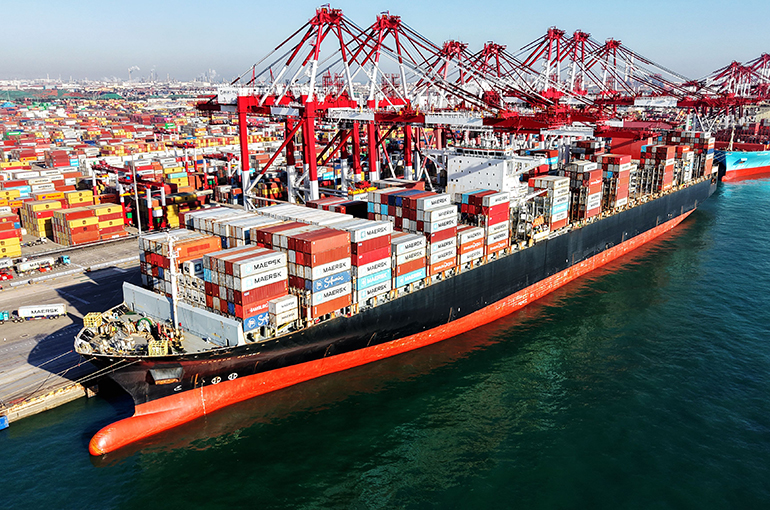
(Yicai) Jan. 14 -- China’s imports and exports rose 3.8 percent to a record CNY45.47 trillion (USD6.52 trillion) last year, maintaining the country’s position as the world’s largest trading nation.
Imports rose 0.5 percent to CNY18.48 trillion and exports climbed 6.1 percent to CNY26.99 trillion, according to data released today by the General Administration of Customs.
China maintained trade relations with over 240 countries and regions last year, and its imports and exports with 190 of them increased, said Wang Jun, deputy director of the GAC.
Trade with countries in the Belt and Road Initiative jumped 6.3 percent to CNY23.6 trillion, accounting for 52 percent of China’s total foreign trade. Trade with the Association of Southeast Asian Nations climbed 8 percent to CNY7.55 trillion (USD1.08 trillion), while that with Latin America and Africa grew 6.5 percent and 18 percent to CNY3.93 trillion and CNY2.49 trillion, respectively.
Exports of high-tech products surged over 13 percent to CNY5.25 trillion in the year, while those of the “new trio” -- electric vehicles, lithium-ion batteries, and photovoltaic products -- and wind power generators soared 27 percent and 49 percent, respectively. Exports of Chinese-branded products rose 13 percent, with their share of the total increasing by 1.4 percentage point.
Imports of mechanical and electrical products totaled CNY7.41 trillion, up 5.7 percent. Shipments of electronic components and computer parts soared 9.7 percent and 20 percent, respectively. Imports of crude oil and metal ores rose 4.4 percent and 5.2 percent, respectively, while those of fruits and edible vegetable oil increased 5.6 percent and 17 percent.
China has more than 780,000 business entities with foreign trade records. Imports and exports by private enterprises climbed 7.1 percent to CNY26.04 trillion, with their share of the total rising to 57.3 percent.
Exports will continue to support China’s economic growth this year, despite the uncertainty from trade friction with the United States, the rise in global trade protectionism, and last year’s high comparative base, said Denis Depoux, global co-chief executive at Roland Berger.
China’s export growth may slow to around 3 percent this year, due to factors such as a stronger Chinese yuan, trade frictions, and changes to export tax rebates, according to Zhang Ning, an economist at UBS. Despite that, the export sector, backed by high-quality products and competitive pricing, will remain a key economic growth driver, Zhang noted.
Editor: Futura Costaglione





