



 Chinese Market for Fresh Fruit Enters Premium Era as Consumers Seek More Than Taste
(Yicai) Aug. 31 -- Chinese consumers' fresh fruit demand has evolved from a daily necessity to one of "emotional and social" needs, with brand and product qualities becoming just as important as taste, according to experts.
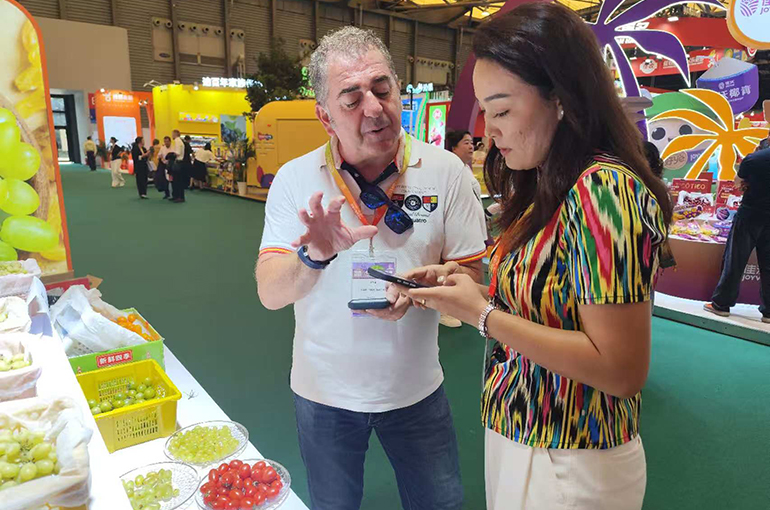
Rockit has defined a new category called "mini apples" in China, Zhang Chitao, general manager of the New Zealand apple brand's Chinese arm, told Yicai at the China International Fruit Expo, held in Shanghai from Aug. 26 through 28. Unlike in other markets where fruit is mainly consumed as a daily snack, a significant portion of local consumers buy it as gifts, caring not only about taste but also about the brand story, emotional significance, and social attributes, Zhang noted.
China is Rockit's largest market, making up over 50 percent of its revenue, Global Marketing GM Julian Smith said to Yicai. The Chinese market remains on a strong growth trajectory, with significant room for growth in the premium fruit category, he added.
Imported fruits account for over 95 percent of Shanghai Supafresh Trading's products, said Regional Manager Xu Ru, adding that overseas quality sources are transparent and accessible, allowing peers to obtain products from the same origin, which makes it challenging to differentiate purely based on sourcing. Therefore, the industry is gradually diverging into two groups: one pursuing a premium route, focusing on better packaging, intellectual property, and services, and another made up of high-end brands, relying on patented varieties, full supply chain control, and emotional brand value to move beyond simple source competition, Xu said.
Similar trends were also shared in the Insights Into China's Fruit Consumption Behavior and Trends report released at the expo, also known as CHINA FRUIT. This year's event drew nearly 300 exhibitors from over 60 countries and regions worldwide.
Despite macro-environmental pressures, consumers are still willing to choose healthy and nutritious fruits, Shi Hanwei, head of Goodfarmer Foods Holding Group, said to Yicai. Amid challenges posed by global supply chain uncertainties, a significant pressure on imports comes from shipping, with the stability of routes from Mexico, Ecuador, the Philippines, and others often affected by geopolitical factors, Shi added.
Current climate conditions are not favorable for fruit, noted Huang Li, publicity manager of Joy Wing Mau Fruit Technologies. Any quality fluctuations can directly undermine the consumer experience, so the company is actively adjusting its distribution layout, Huang pointed out.
For example, durian imports have shifted from relying solely on the port in China's southern Guangxi Zhuang Autonomous Region to using multiple ports to reach northern markets directly, Huang noted, adding that this change aims to shorten the distribution chain and reduce losses.
China's fruit retail market continues to expand steadily, growing to CNY1.5 trillion from CNY1.2 trillion (USD223.2 billion from USD178.9 billion) over the past five years, according to the Outlook on the Chinese Fruit Chain Retail Market and Investment Opportunity Analysis, released by the Qianzhan Industrial Research Institute. However, the growth rate has gradually slowed to between 5 percent and 6 percent from 2023 to last year, indicating that the market has entered a mature development phase.
China imported USD9 billion worth of fruit and related products in the first five months of this year, up 4.2 percent from a year earlier, according to customs figures. By volume, imports rose 2 percent to about 4.4 million tons.
Editor: Martin Kadiev





