



 China's Future Science Prize Honors Scientists for Advances in Cell Biology, Materials, Math
(Yicai) Aug. 13 -- China has awarded three scientists this year's Future Science Prize for breakthroughs in understanding how cells recycle waste, developing advanced porous materials, and tackling long-standing mathematical problems.
Hong Zhang, Dongyuan Zhao, and Xinyi Yuan won the Life Science Prize, Physical Science Prize, and Mathematics and Computer Science Prize, respectively. Each award carries a prize of CNY equivalent to USD1 million.
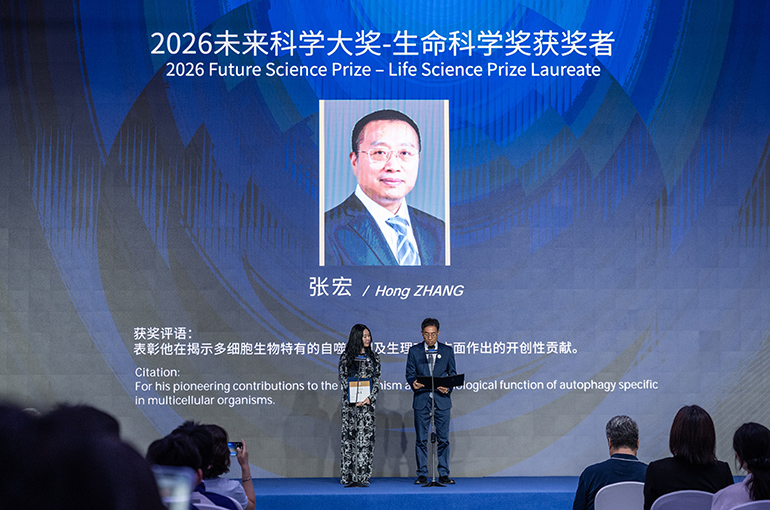
Zhang, an investigator at the Institute of Biophysics under the Chinese Academy of Sciences, won the Life Science Prize for a series of pioneering discoveries into the molecular mechanisms of autophagy that are unique to multicellular organisms, according to the organizing committee.
Using Caenorhabditis elegans (C. elegans), a tiny roundworm widely used in biological research, as a model, Zhang uncovered the molecular mechanisms of autophagy in higher organisms. Building on a landmark paper published in Cell in 2010 and subsequent research, he discovered a group of autophagy genes found only in multicellular organisms and named them EPG genes.
Advances in Materials, Mathematics
Zhao, an academician of the Chinese Academy of Sciences and a Fudan University chemistry professor, won the Physical Science Prize for pioneering advances in mesoporous materials, from their synthesis to industrial applications.
Zhao and his collaborators pioneered methods based on molecular self-assembly to make ordered mesoporous materials, which have pores between two and 50 nanometers. Their work enabled precise control over pore structure, size, composition, and shape, greatly expanding the scope of mesoporous materials and their potential applications.
Yuan, a professor at Peking University, won the Mathematics and Computer Science Prize for major advances in arithmetic geometry, a field that uses geometry to understand equations involving whole numbers.
Yuan developed new mathematical tools to study whether such equations have solutions and how those solutions are distributed. He used these tools to prove the uniform Bogomolov conjecture and later helped establish quantitative results for the uniform Mordell conjecture, advancing the understanding of these long-standing mathematical problems.
The Future Science Prize was established in 2016 by a group of scientists and entrepreneurs to recognize original basic scientific research. It comprises three awards: the Life Science Prize, Physical Science Prize, and Mathematics and Computer Science Prize.
Each award carries about CNY7 million (USD1 million). Since 2016, the Future Science Prize has recognized 49 laureates.
Editor: Emmi Laine





