 China’s Growth Strategy Is 'Strategic Calibration' Toward Higher Value, Roland Berger’s MD Says
(Yicai) Jan. 9 -- This year represents a “strategic calibration” for China’s economy toward higher value and quality, according to Denis Depoux, global managing director of international consultancy Roland Berger.
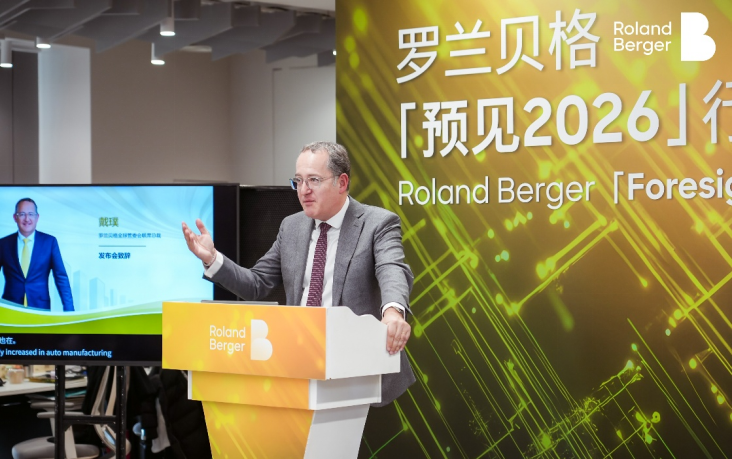
The world's second-largest economy is undergoing a deliberate shift that has greatly changed the playbook for businesses and investors, Depoux said at an event held in Shanghai yesterday to launch Roland Berger's Foresight 2026: China Annual Trends Report.
“What is at stake is a deep transformation of the Chinese economy,” he said, adding that the country’s moderate growth targeting is a "trade-off to achieve higher priority objectives.”
China’s government has aimed for growth of "around 5 percent” every year since 2023, lowering it from 5.5 percent for 2022 and around 6 percent for 2021. The target is usually announced in early March.
Mainstream forecasts put this year’s goal at between 4.5 percent and 5 percent. “But the figure itself is actually not that important,” Depoux pointed out. “The importance is understanding the transformation.”
A moderate target creates the fiscal and political space to drive reforms and address real problems in the Chinese economy without the pressure of chasing high growth at all costs, Depoux said.
Foresight 2026 is Roland Berger’s seventh consecutive annual report examining key industry trends across China’s automotive, consumer goods, materials, and investment sectors. The Munich-based firm has been present in China for over four decades.
Depoux illustrated the shift in China’s economy with investment data. In the January to September period of last year, fixed asset investment fell 2.6 percent from a year earlier, pulled down by a 15 percent drop in property and construction. Meanwhile, investment in auto manufacturing surged 15 percent, and that in transport equipment production jumped 22 percent.
“This is creative destruction at work,” Depoux said. “Some sectors are reducing scale and some sectors are actually massively building up scale … revealing that deep transformation.”
Consumption Puzzle
Although consumption contributed 54 percent of China’s economic growth in the first three quarters of 2025, household savings reached a record high of more than CNY160 trillion (USD22 trillion).
Depoux pointed out that just 5 percent of CNY160 trillion amounts to the gross domestic product of a medium-sized country. If even 1 percent to 2 percent of savings were spent, the impact would be enormous, he said, adding that such as shift, however, does not happen overnight.
Beyond trade-in subsidies, there are other hurdles that China must address, according to Depoux. He listed consumer confidence linked to income and employment stability, security based in social safety nets, and evolving consumer preferences.
Chinese consumers seek more than just value for money now, Depoux said. They also demand service, experience, and emotional connection, he said, describing this change as a “revolution” for multinational consumer goods companies.
Consumption in China is entering the 4.0 era this year, a period characterized by resilience, said Jiang Yunying, Roland Berger partner for consumer goods and retail. The entire offline retail sector underwent intense change last year, with new formats, such as instant retail platforms, gaining traction, she added.
Industry Transformation
Roland Berger's industry leads explained how these shifts are manifesting in specific sectors. Vehicle sales reached about 34 million units last year, including 7 million exports, with new energy vehicle adoption topping 60 percent last month, said Zheng Yun, senior partner and Asia head of auto practice at Roland Berger.
He identified six key “battlefields” that will define China’s auto industry in 2026: elimination races, cross-industry collaboration, international expansion, tech rivalry, capital efficiency, and artificial intelligence-driven intelligence. The sector is shifting from fast volume growth to improving quality, profitability, and brand strength, Zheng noted.
Sun Yanyin, who leads Roland Berger's China chemicals team, acknowledged global sector pressures while highlighting China’s competitive advantage. “Even though we see the entire chemical and materials industry facing pressure worldwide, China is the only region that can still be said to be growing strongly," Sun noted.
As global ethylene plants shut down, China continues massive capacity investments, Sun pointed out.
Dealmaking jumped 30 percent last year to over USD350 billion (USD50.1 billion), said Wu Zhao, the firm’s China-based partner for private equity and strategy. Overseas mergers and acquisitions by Chinese companies reached nearly USD20 billion in the first half of the year, an 80 percent increase.
“We believe that in the next two to three years, this continued recovery and growth sentiment will further accelerate," Wu pointed out.
Chinese businesses are switching to high-quality globalization from scale-driven international expansion, according to Zhou Mengxi, another partner based in China. In many sectors, failing to go global means “you'll be eliminated," Zhou said, pointing out that success requires moving beyond simply exporting to integrating fully into global value chains.
New Playbook
If legacy growth engines such as property development continue to be a drag on the economy, new drivers such as advanced manufacturing, green technology, digitalization, AI, and high-value services, are accelerating, Depoux said.
"China is not only a big market, it's actually now a source of innovation, a source of competitiveness," Depoux noted.
For multinational companies, China presents a major opportunity to enhance global competitiveness through innovation, he said. For domestic firms, the focus must shift toward boosting productivity, delivering greater value and quality, and prioritizing profitable operations, margin growth, cash flow, and operational excellence.
“China used to be characterized by execution excellence and still is, and that contributed a lot to ‘China speed,’” Depoux said. Now “we've come to a point where some Chinese companies need real strategic superiority with strong focus, precision, and determination to help navigate global complexity.”
Editor: Futura Costaglione