



 China’s Hydrogen Trailblazer Foshan Parks Fuel-Cell Buses as Costs Mount, Ridership Falls
(Yicai) Jan. 29 -- Foshan in southern Guangdong province once championed hydrogen energy as a key industry for local development, but today a large number of the city’s hydrogen fuel cell buses are sitting idle, sidelined by high operating costs, dwindling passenger numbers and fewer local subsidies.
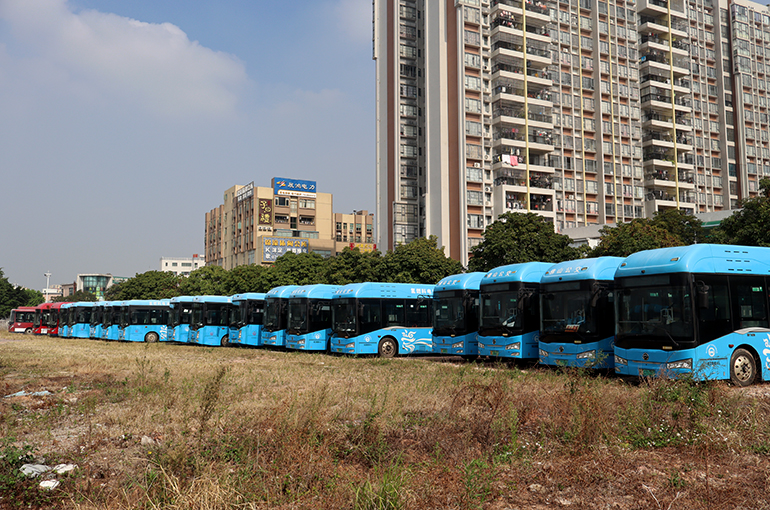
Yicai reporters saw more than 20 hydrogen buses parked neatly at the Danzao Coach Terminal in Foshan’s Nanhai district, each with a sign saying ‘temporarily out of service.’ A staff member at the bus terminal told Yicai that the buses are still in good condition, but putting them back on the road would only lead to greater losses for the public transport operator because hydrogen fuel is so expensive.
These buses are just a handful of the hydrogen buses in Nanhai district that are no longer in service. Of the more than 380 hydrogen buses in the district, only about half are still running, a source from the Foshan municipal government told Yicai. And other districts under Foshan’s jurisdiction have also suspended hydrogen bus operations.
Yicai contacted the Foshan Transportation Bureau for comment but had not received a response by the time of publication.
The large-scale shutdowns are a result of a combination of factors, including lower-than-expected demand for public transport, tight local government finances that limit subsidies, the high upfront cost of buying hydrogen buses and persistently high hydrogen prices, several people interviewed by Yicai, including the government source, said.
Foshan purchased most of its hydrogen buses, around 1,000 units, between 2018 and 2019, and no new purchases have been made since 2021, Yicai learned.
Each hydrogen bus had a price tag of around CNY1,800,000 (USD252,000) at the time, with subsidies from the central and local government amounting to nearly CNY800,000 (USD112,000), the government source said.
In 2018 and 2019, a pure electric bus with similar capacity was generally priced at less than CNY900,000 (USD126,000), industry insiders told Yicai. This means that Foshan’s hydrogen buses cost more than twice as much as electric buses at that time, and even after factoring in government subsidies, they were still more expensive.
Profit Squeeze
High hydrogen fuel prices have directly driven up operating costs. Except for Nanhai district, which offers subsidies, hydrogen refueling in other parts of Foshan are at market rates, which is around CNY50 (USD7) per kilogram, the government source said. This is well above the roughly CNY35 (USD4.90) per kg mark for fuel hydrogen, which is on par with the fuel cost of diesel buses.
Nanhai district has been providing hydrogen refueling subsidies for buses since 2018, according to Yicai’s review of local government documents. The subsidy was CNY20 (USD2.80) per kg between 2018 and 2019, and CNY18 (USD2.52) per kg in subsequent years.
Lower-than-expected passenger numbers have further squeezed profitability. The government source said that in 2018 and 2019, when Foshan was buying hydrogen buses in large numbers, local bus ridership was still strong and the city was even planning to expand its conventional bus fleet. But after 2020, as multiple rail transit lines opened, bus passenger numbers began to decline.
Against this backdrop, it was only logical that public transport operators started to suspend hydrogen buses with their high running costs.
Favorable Scenarios
Large-scale projects such as hydrogen fuel cell buses helped kick start Foshan’s hydrogen industry, local interviewees said. “Many companies choose to invest in Foshan because of its favorable application scenarios,” one industry participant said.
Nanhai district is home to the Xianhu Hydrogen Valley which hosts 160 hydrogen energy companies and platforms. Total investment in the hydrogen industry across the district has exceeded CNY60 billion (USD8.6 billion).
Compared with solar and wind energy, which have lower development costs, hydrogen remains less competitive, a Guangdong province-based academic who has studied Foshan’s hydrogen sector told Yicai. Without sustained government subsidies, pushing the industry forward will be difficult.
Editors: Tang Shihua, Kim Taylor





