


 China's JD.Com, Meituan, Alibaba Speed Discount Supermarket Expansion
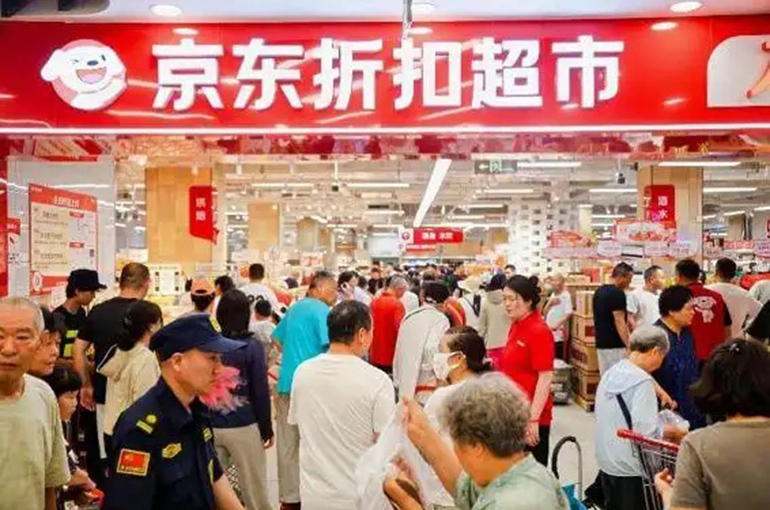
(Yicai) Aug. 17 -- JD.Com, Meituan, and Alibaba Group Holding have accelerated the opening of new discount supermarkets across China, with the three domestic internet giants keeping pace with one another after all entering the segment in recent years.
JD.Com will open its first discount supermarkets in Yancheng, Jiangsu province, and Yanjiao, Hebei province, next month, the Beijing-based company announced recently. The firm runs 11 such stores across various provinces and cities after opening its first in Hebei's Zhuozhou in August last year.
Meituan has been expanding its Happy Monkey discount supermarkets even faster, growing their number to 58 despite opening its first in Hangzhou the same month as JD.Com. In addition, it has another 27 under renovation.
Alibaba's grocery arm Freshippo opened six new supermarkets in Chengdu under its discount-focused neighborhood business on July 24, having opened two other such spots earlier that month. The brand owns almost 560 discount supermarkets, despite only starting in June 2024.
The discount supermarket expansion of JD.Com, Meituan, and Alibaba is primarily driven by the high-frequency demand for fresh food in community retail, Zhuang Shuai, founder of Bailian Consulting and an expert in the retail e-commerce industry, told Yicai. The three aim to rapidly dilute backend supply chain and fulfillment costs by densely setting up such stores, driving performance growth in their new business ventures, Zhuang added.
On the other hand, the three companies have introduced numerous private brands to fill the shelves of their discount supermarkets, Zhuang pointed out. For example, JD.Com's chain features its Jingxianfang, Jingyue, 7Fresh, and other labels, offering hundreds of products covering daily necessities like grains, oils, and cleaning supplies, while private stock-keeping units at Freshippo neighborhood business reportedly make up about 60 percent of its offerings, Zhuang noted.
The introduction of private brands in discount supermarkets is a key driver for achieving extreme cost-performance ratios and profit contribution, Zhuang stressed. E-commerce platforms and physical stores provide market scenarios for private labels, which in turn offer differentiated products and pricing power, Zhuang added.
For discount supermarkets, delivering extreme cost-performance is a fundamental capability, Zhuang noted, but added that operators need to build a competitive edge by developing strong recognition and loyalty for their private brands or risk falling into a meaningless price war.
Supermarkets in China remain in a phase of adjustment and transformation while e-commerce giants continue to open new discount stores. Only 23 percent of the 92 domestic supermarket operators with over 15,000 locations saw a year-on-year increase in first-half net profit, while 51 percent logged a decline, according to data released by the China Chain Store and Franchise Association last month.
Editor: Martin Kadiev