



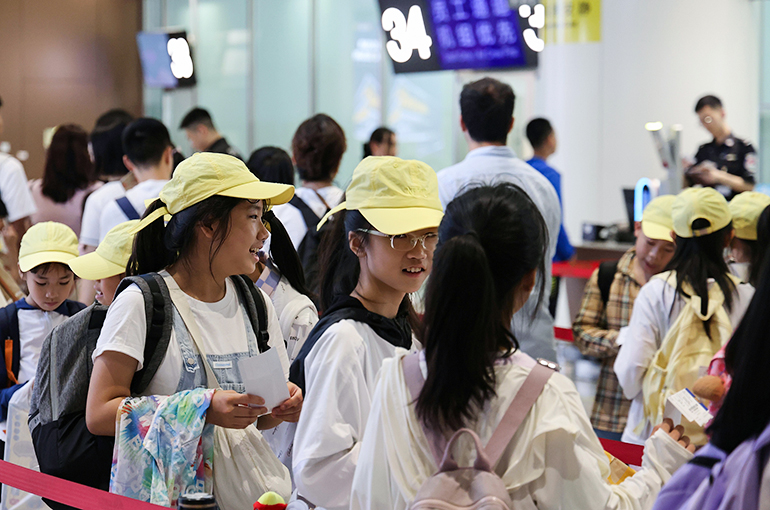
 Pilot Spring Break for Schools Gives China's Travel Sector a Boost
(Yicai) March 24 -- Several Chinese provinces have introduced a spring break for primary and secondary school students, which is reshaping the travel industry by sparking demand for transportation and accommodation.
Ten Chinese provincial-level regions are piloting a spring break for primary and secondary schools this year, four of which are province-wide pilots. Some chose to have it from April 1 to 3 to connect it with the three-day Tomb Sweeping Festival holiday starting on April 4, while others set it for later on, such as at the end of April to link it to the five-day Labor Day holiday.
Bookings for air tickets, hotels, homestays, and scenic spots from April 1 to 6 have more than doubled from a year earlier, according to data from online travel agency LY.Com.
The average flight ticket around the Tomb Sweeping Festival holiday, including taxes and fees, is CNY718 (USD104), up 5.8 percent from a year earlier, back to the same level as before the Covid-19 pandemic, according to civil aviation data platform DAST.
Moreover, as the introduction of the spring break has lengthened the Tomb Sweeping Festival holiday to six days, travelers can reach further destinations. In fact, while last year most tourists were only traveling to nearby cities, this year they are choosing to visit more distant cities.
Domestic flight bookings surged 24 percent to 1.5 million, and those for outbound flights climbed 14 percent to around 560,000 for the period around the Tomb Sweeping Festival from a year earlier, according to flight information website Umetrip.
To meet rising demand, airlines have increased their capacity for the Tomb Sweeping Festival holiday. The number of flights scheduled from the pilot cities between April 1 and 6 climbed from a year earlier, with growth of 32 percent for Changzhou and 18 percent for both Chengdu and Nanjing, DAST data also showed.
The data confirms that introducing a spring break is directly boosting demand for air transport capacity, helping transform April from a low-demand period into a new peak season for air travel, DAST said in a research report. The spring break not only stimulates short-term growth in passenger flows and ticket prices but also reshapes the seasonality of the civil aviation sector, it added.
Moreover, the spring break will also help divert the passenger flow from the Labor Day holiday peak season to some extent, avoiding the temporary shortage of transport capacity resources and fluctuations in service quality, the DAST report noted. Even though the sharp rise in oil prices may curb some travel demand this year, the spring break has still driven travel demand for short international routes and long-distance inter-provincial trunk lines.
DAST also believes that the spring break pilot will encourage airlines to increase capacity on regional and short-haul routes, promoting more air travel consumption by residents of small cities and opening long-term growth space for the civil aviation market.
Some regions of China have been piloting a spring break for primary and secondary school students since last year, which lasted two to three days.
Editors: Tang Shihua, Futura Costaglione





