



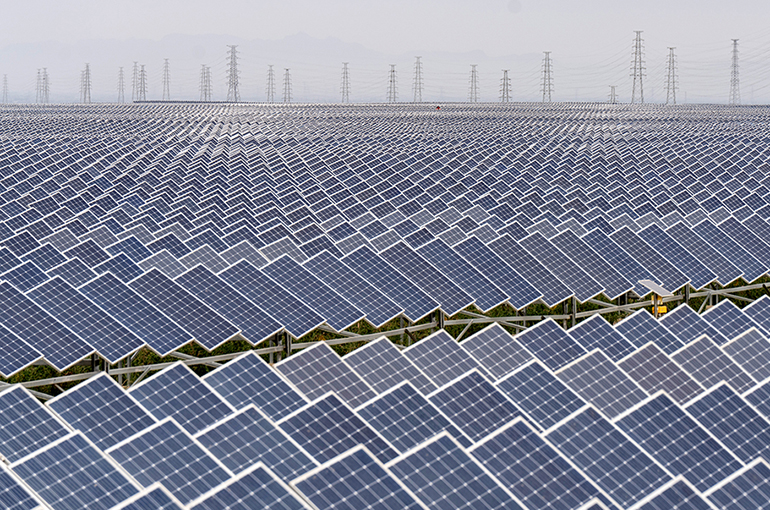
 China’s Solar Installations to Drop in 2026, CPIA Honorary Chairman Says
(Yicai) Feb. 6 -- China’s solar power installations may tumble this year, as the industry adapts to last year’s new policies aimed at regulating the sector and introducing more market‑based pricing, the honorary chairman of the China Photovoltaic Industry Association said.
China may add from 180 gigawatts to 240 GW this year, compared with a record 315.07 GW last year, Wang Bohua said at the CPIA’s annual conference in Beijing yesterday. Installations will return to a growth trend next year, reaching between 270 GW and 320 GW by 2030, he said.
Over the course of China’s 15th Five-Year Plan period, which started this year, annual installations in the country will average between 238 GW and 287 GW, while the global mean is expected to range from 725 GW to 870 GW.
The new policies Wang referred to included the Distributed Photovoltaic Development and Construction Management Measures implemented on Jan. 17 last year and the market-oriented reform of grid connection tariffs that followed on Jan. 27.
“2026 will be a crucial year for governance of the PV industry, and addressing industry infighting will be the top priority,” Wang Shijiang, deputy director of the electronic information department at the Ministry of Industry and Information Technology, told the conference.
The PV industry is in a new round of deep adjustment, Wang Shijiang said, and the underlying supply-demand mismatch has yet to be resolved, posing significant challenges for most solar firms.
The MIIT’s e-information department will work with other agencies to speed the issuance of mandatory national standards covering quality and safety, labelling norms, and energy-consumption limits, Wang said. It will also strengthen product quality supervision and spot checks as well as foster a market of fair competition and value-based pricing.
The department will also push for the commercialization of advanced PV technologies, especially in frontier areas such as perovskite tandem cells. The goal is to speed tech progress and build competitive advantages for next‑generation products, helping to reduce destructive competition within the industry.
Editor: Tom Litting





