


 China’s X Square Launches Home Cleaning Robot Service in Beijing, Shenzhen
(Yicai) May 28 -- Chinese startup X Square Robot has begun offering a paid home cleaning robot service in the cities of Beijing and Shenzhen, but the machines remain limited in what they can do and are still no match for human cleaners.
The Smart Partner Whole-House Cleaning service costs CNY148 (USD21.80) for a three-hour package through 58 Daojia, about the same as hiring a regular cleaner on the daily life services site.
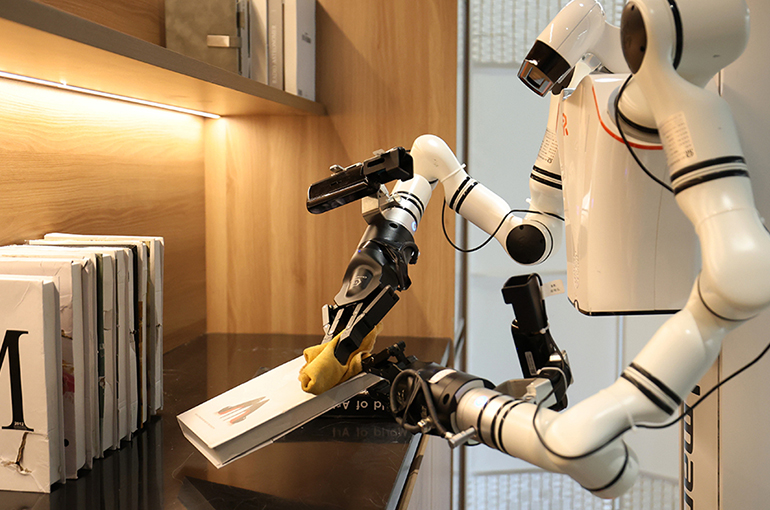
Yicai placed an order. A 1.6-meter-tall wheeled robot with a pair of long mechanical arms arrived accompanied by a human safety supervisor.
X Square had deployed dozens of robots in Beijing for this service, the person said. Since launching last month, it has received more than 400 orders, he said, noting that most customers are interested in robots, such as content creators who want to film videos and families who want their children to see a robot at work.
According to the service manual, the robot operates in open areas, including living rooms, dining rooms, and entryways. The process includes understanding the environment, tidying tabletops, folding clothes, putting away shoes, arranging the sofa, and disposing of garbage.
Yicai observed that the robot is much less efficient than human cleaners. For example, it took about six minutes to neatly arrange four books, and it appeared unsure of what to do next when encountering unexpected situations.
Apart from being slow, the robot can only do a limited range of tasks. It still cannot perform everyday cleaning work such as sweeping, mopping, or cleaning into hard-to-reach corners. In addition, if the network connection is poor, the robot’s movements can become shaky.
Though the robot can do only a limited range of household tasks, the supervisor said the home service can help popularize robots with the public and teach the machines how to interact with people. X Square also collects the operational data to further optimize its algorithms, the person added.
The booking page states that data will be collected during the service, with user data protected.
Because every client’s home environment is different, the data collected is more valuable than that obtained from training in factories, the supervisor noted.
Much remains to be done before service robots can be widely used for household chores, said Zhou Di, a senior engineer at the Ministry of Science and Technology. Existing home service robots still have much room for improvement in both hardware and algorithms, according to Zhou.
Editors: Tang Shihua, Martin Kadiev