



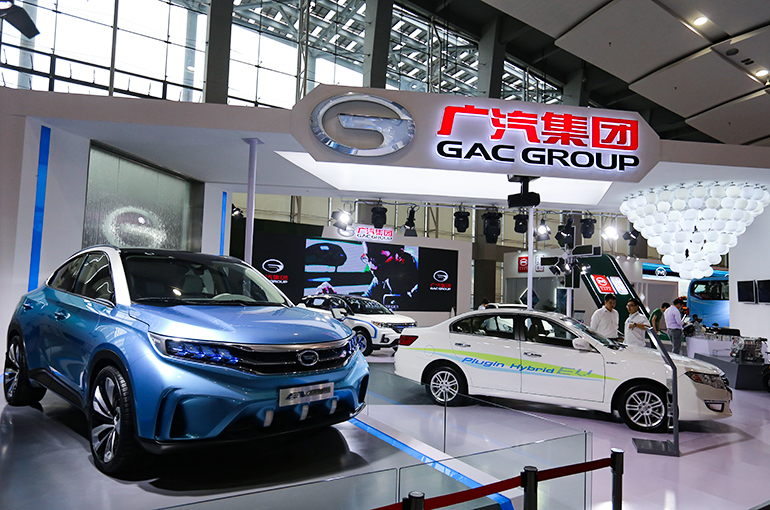
 GAC Rises After Chinese Carmaker Reveals Plan to Take Stake in FAW JV, Bringing State Auto Giants Closer Together
(Yicai) Sept. 15 -- GAC Group’s shares rose after the company said it plans to take a stake in a joint venture of FAW Group via a share issuance, deepening the integration between two of China’s largest state-owned automakers.
GAC’s shares [HKG: 2238] resumed trading in Hong Kong today following a one-day halt, closing 2.6 percent higher at HKD2.38 (31 US cents), after surging by as much as 16.4 percent intraday. Trading of GAC’s Shanghai-listed stock [SHA: 601238] was also halted yesterday for up to 10 days.
GAC has signed a letter of intent with China FAW, a subsidiary of FAW Group, to acquire part of its stake in an unidentified JV, the Guangzhou-based company announced late yesterday. The JV’s name has been withheld temporarily because the transaction involves an overseas-listed company, GAC said, noting that it will be revealed in a subsequent restructuring plan.
After the deal is completed, FAW will become GAC's second-largest shareholder with strategic influence, it said, adding that the move is expected to constitute a major asset restructuring and a related-party transaction under Chinese securities regulations, although it would neither change GAC’s ultimate controlling shareholder nor constitute a backdoor listing.
The rapid rise of private Chinese carmakers such as BYD and Geely Automobile Holdings is pushing state-owned players to improve efficiency through consolidation, with survival of the fittest at its core, according to industry insiders. Brands that lack competitiveness and innovation are likely to exit the market through restructuring, acquisition, or closure, freeing resources for stronger industry leaders, they said.
The GAC-FAW deal is still in the planning stage and is subject to uncertainties, GAC said.
Established in 1997, GAC has JVs with Japan's Toyota Motor and Honda Motor, and it also owns the GAC Trumpchi passenger car brand and the GAC Aion electric vehicle brand. FAW's JVs include FAW-Volkswagen, FAW Audi, and FAW Toyota. It owns FAW Jiefang Group and luxury car brand Hongqi.
GAC Toyota's management had already changed ahead of the restructuring announcement, with Executive Deputy General Manager Wen Dali transferred back to GAC's headquarters and Deputy GM Wang Jun appointed GM of GAC Components.
Toyota's China sales fell 18 percent to about 809,400 vehicles in the seven months ended July 30 from a year earlier. GAC Toyota sold about 341,100 units in the first half of this year, down 6.3 percent from a year ago, while FAW Toyota's sales plunged 27 percent to around 273,700 units.
GAC's first-half net loss widened 76 percent to CNY4.5 billion (USD670.6 million) year on year, while revenue rose 9.4 percent to CNY46.1 billion (USD6.4 billion).
FAW's sales fell 15 percent to 1.52 million units in the period. In addition, the penetration rate of its NEV brands was about 14 percent, indicating a relatively slow transition toward electrification.
GAC and FAW could complement each other in several areas, auto industry analyst Mei Songlin told International Finance News. First is market coverage, with FAW focusing more on northern China and GAC on the south; and second is corporate structure, as FAW is a central state-owned enterprise, while GAC is a municipal SOE, Mei said.
Third is technology and product portfolios, where FAW has strengths in commercial vehicles under FAW Jiefang and premium passenger vehicles under Hongqi, while GAC has advantages in new energy vehicles thanks to GAC Aion and magazine battery, Mei pointed out.
Editor: Martin Kadiev





