



(Yicai) Jan. 21 -- Chinese chief executive officers are particularly optimistic about the future of artificial intelligence, according to the global chairman of UK accounting giant PricewaterhouseCoopers.
This optimism is closely linked to China's heavy investment in the AI sector, Mohamed Kande told Yicai in an interview yesterday.
Confidence among the over 4,000 global CEOs surveyed by PwC about their companies' business growth has dropped to a five-year low this year, mainly because of technological changes and shifts in the geopolitical landscape, according to a report released by the UK auditing giant on Jan. 19.
Excerpts from the interview are below:
Yicai: What's the most frequently asked question you get from CEOs around the world?
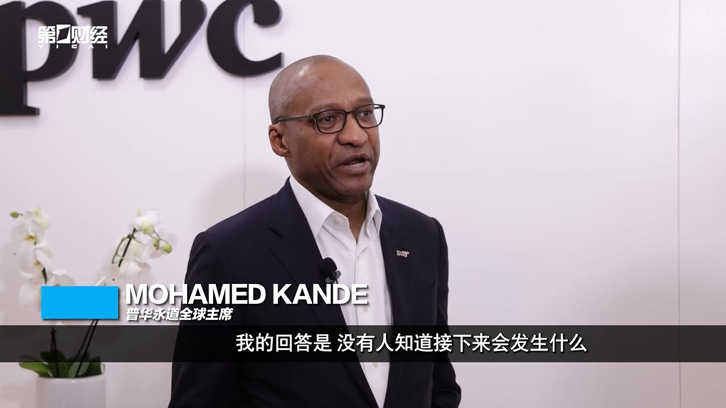
Mohamed Kande: 'What do you think is going to happen next?' My answer is that nobody knows. But then we can think about the behavior that needs to be embedded with leadership teams and CEOs to deal with the current times. None of us has the ability to predict the future now, but we can co-create the future based on the changes we see today.
Yicai: The 2026 Global CEO Survey shows that the CEO confidence in their companies' revenue prospects has fallen to the lowest level in five years this year. What happened?
Kande: We believe that what happened to the CEOs' confidence to drop to that level, where 30 percent of them are saying that they are seeing a path to growth in 2026, is because of the amount of changes that are happening. Many of the CEOs are used to having control over the business -- if they take certain initiatives, they can predict what the results are going to be.
Now, we are in an environment where you have a lot of changes across two dimensions. The first one is artificial intelligence. The speed of the change and adoption within companies, and they do not necessarily see the results happening. The second one is geopolitical turmoil: the speed of change when it comes to tariffs, the new coalitions that are being built around the world, the news that is happening every day or week. So, the level of uncertainty has impacted the level of confidence of the CEOs.
Yicai: So far, the tangible returns of AI adoption are still struggling, based on your survey. So, what should CEOs do?
Kande: When we say that the technology is working or should work, it is because of the fundamentals; you have enough technology that exists around the world, so you have access to the technology. The adoption of the technology and the benefit of using AI are driven only when you move from experimentation, from use cases to business transformation.
When we say that it's not only about the technology, the technology works because to get the returns from investing in AI, you need business transformation. It's not about doing the same things that companies do today with AI; it's about doing things differently, running the business differently, but also working with your own people differently.
How do they change the business process or the business model? How do they train the people differently? It's not just about giving AI to people, using the same way of running the business, and then assuming you will see a benefit. It does not work that way.
Yicai: When it comes to geopolitical tensions, how are you going to advise your clients to navigate this kind of unprecedented uncertainty?
Kande: To your point, this is unprecedented. So, the first thing that we're advising our clients to be able to navigate the current environment is that they need to learn about what's happening, which means that they need to ask the right questions, pay attention to what's happening around the world, because everything is connected.
The second thing we are telling our clients to do is to do more scenario planning so that they can understand what options they have in front of them. Third, they have to continue to execute the strategy. Do not stop, execute the strategy, but be very agile if you have new information to evolve or change the strategy.
That is what we're advising our clients today. Optionality, scenario planning, and agility combined with learning about the environment, it's a good recipe for execution in the future, in the current times.
Yicai: Your survey covered over 4,000 companies. I'm sure many of these CEOs are from China. So in your survey, what makes Chinese CEOs different? In what area are they more cautious, in what area are they more confident?
Kande: They're more optimistic about the future with AI, especially. That's what we have seen from Chinese CEOs who are very optimistic about the future when it comes to AI. And having been to China quite a few times, I can see why the optimism is manifesting itself because of the level of investments that you see that have been made in China in AI.
Editor: Futura Costaglione





