



 Chinese Cities With Over One Million College Students Unveil Measures to Boost Back-to-School Spending
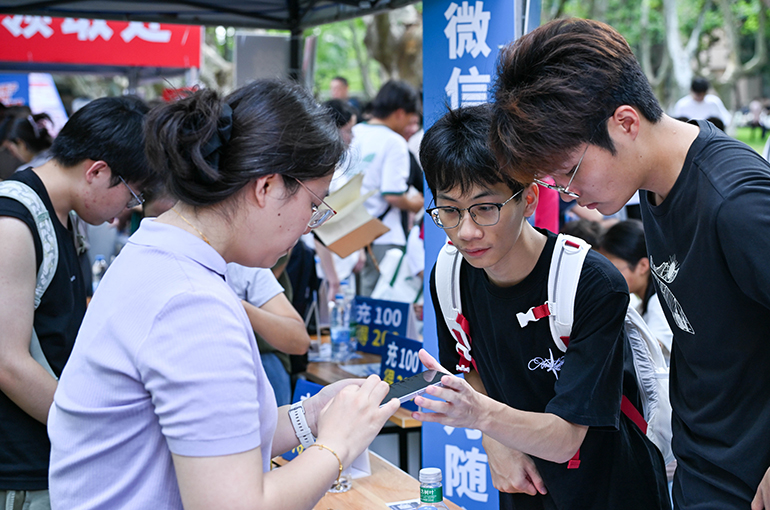
(Yicai) Aug. 31 -- With the new school year arriving, Guangzhou, Wuhan, and other Chinese cities that have college student populations of more than one million each have announced measures to boost consumer spending among new and returning students.
Guangzhou, the capital of Guangdong province, is concentrating its efforts on 3C (computers, communications, and consumer) electronics. By implementing national subsidy programs, certain devices qualify for a 15 percent discount, capped at CNY500 (USD74) per item. Combined with exclusive discounts and complementary gifts offered by brands such as Vivo, Xiaomi, Huawei Technologies, total savings can exceed CNY1,000 (USD148) per purchase, helping to drive back-to-school spending on technology.
Wuhan launched four campaigns on Aug. 29 covering shopping, dining, entertainment, and gifting at a ceremony to welcome new college students. The capital city of Hubei province also used the event to showcase its tech innovation, entrepreneurship, and employment policies, along with measures such as a tax refund map for departing visitors and expanded access to local government services.
Ranked by the number of university students, Guangzhou leads with 1.78 million, followed by Zhengzhou with 1.53 million and Wuhan with 1.44 million. Chengdu, Chongqing, Beijing, Xi'an, and Nanjing are the only other cities with over one million college students.
This year's back-to-school spending highlights three trends, said Pan Helin, co-director and researcher at the Research Center for Digital Economy and Financial Innovation at Zhejiang University's International Business School. Spending on digital products has expanded beyond computers, phones, and tablets to devices like cameras, while experiential consumption -- such as do-it-yourself crafts, intellectual property merchandise, fitness, and travel -- is growing, and social spending, including on dining out, has also grown, he noted.
Students are also making purchases across city boundaries as their geographic activity expands, Pan pointed out.
Chengdu has launched an all-in-one experience card covering food, lodgings, transport, sightseeing, shopping, and entertainment that allows new students to enter 27 major scenic sites and museums for free on their first visit, along with two accompanying family members or friends ay half price. It has also introduced 10 “city roaming” tour routes.
Nanjing has adopted district-specific subsidies, with Qixia district, home to a cluster of universities, partnering with on-demand services giant Meituan to distribute CNY1 million (USD148,660) in dining vouchers, while Xuanwu district has rolled out a six-month digital purchases subsidy covering laptops, tablets, and artificial intelligence devices.
As competition for young consumers intensifies in China, the core of back-to-school economics has shifted from "selling goods" to "showcasing the city," with a focus on service capacity and development opportunities, Pan said, adding that a city's ability to turn students' first impressions into lasting emotional ties and provide sufficient high-quality employment opportunities will be key to whether they stay on.
The availability of student accommodation has emerged as an important concern in several cities. Shenzhen University recently announced plans through the Chinese government’s procurement website that it will likely buy residential properties for student accommodation next month, allocating a budget of as much as CNY533.6 million (USD79.3 million). In addition, Hubei University's Yanglou campus, Hefei University of Technology, China University of Mining and Technology, and Central South University have already done the same.
Editor: Martin Kadiev





