



 Are Orbiting AI Data Centers China's Next Commercial Space Opportunity?
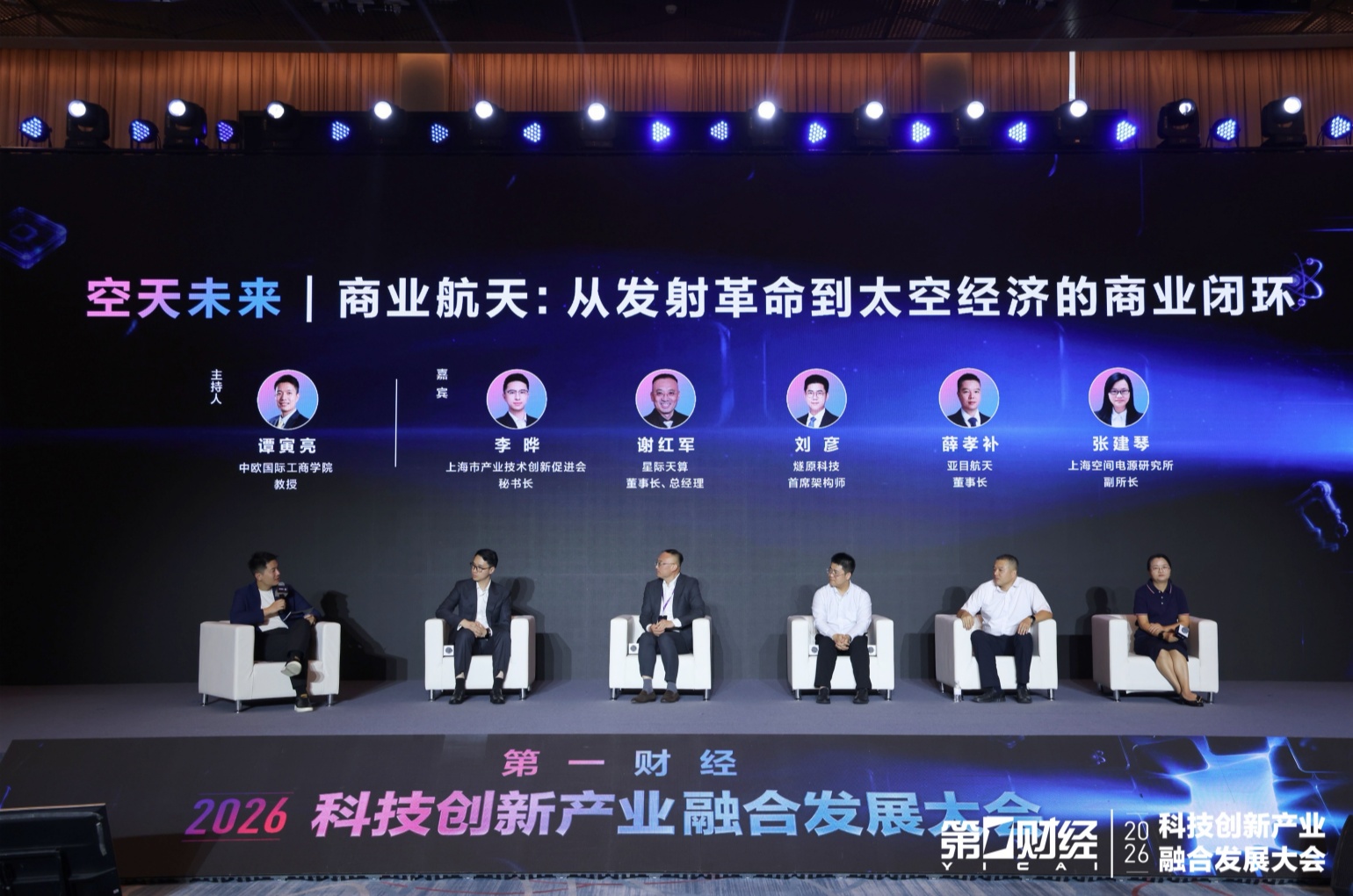
(Yicai) July 31 -- At a recent roundtable hosted by Yicai, executives from China's rocket, satellite, chip, and energy sectors examined whether deploying artificial intelligence date centers in orbit could become the next growth driver for the country's commercial space industry.
The gathering followed last December’s establishment of a dedicated commercial space department by the China National Space Administration. The agency later issued an action plan aimed at achieving high-quality development of the commercial space sector by 2027.
More recently, Elon Musk’s SpaceX -- which is pursuing space-based AI data centers -- dominated headlines by listing on the Nasdaq, raising about USD75 billion in the world’s biggest-ever initial public offering. Starlink, its satellite internet service that has vast network of low-Earth-orbit satellites, has nearly 9 million users globally and its revenue jumped 50 percent to about USD11.4 billion last year, making it SpaceX's only profitable business so far, the IPO prospectus showed.
There are a number of reasons for putting computing power in space, Li Ye, secretary-general of the Shanghai Industrial Technology Innovation Promotion Association, said at the roundtable. The first is the scarcity of orbital slots, with only about 100,000 usable low-Earth-orbit spots worldwide, he noted, adding that China has just hundreds, while Starlink has more than 10,000.
Since slots are allocated on a first-come, first-served basis, early deployment amounts to a strategic value, Li pointed out. It also creates a new way to monetize satellites whose commercial value would otherwise be limited to remote-sensing activities, he said.
Second, space-based computing is not meant to replace terrestrial computing but complement it, providing backup in situations such as natural disasters or network disruptions where ground systems may fail, he added. Deserts, the open ocean, unpopulated areas, and mountainous, forested terrain -- places that ground-based stations cannot reach -- also have computing needs, he said.
The final driver is energy, Li noted. Power consumption and the availability of green electricity are hard constraints for terrestrial data centers, with this bottleneck especially acute in Shanghai given the city's limited supply of renewable energy.
Shanghai should develop space-based computing, according to Li. The Shanghai Academy of Spaceflight Technology is one of China's two primary spacecraft design centers, with the city having accumulated talent and supply chain resources that make it, alongside Beijing, one of the few Chinese cities with a full commercial space industrial ecosystem, he stressed.
Who Foots the Bill?
The biggest question, however, is who will pay for space-based computing and how to bill it, Li noted. He acknowledged that the token-based pricing models widely used in terrestrial cloud computing may not be directly applicable to orbit computing, which involves a mix of short-duration burst workloads, intermittent tasks, and long-duration workloads. The industry has not yet established a unified pricing standard, he said.
Xie Hongjun, who heads the space computing business at rocket maker i-Space, used several recent landslides in China to illustrate his company's approach. A radar satellite capable of on-board processing could analyze terrain changes directly, issuing warnings potentially hours earlier than the usual approach of first transmitting raw data to the ground for processing.
That would be a meaningful advantage in areas that typically lack ground communications and have no alternative, he said, pointing out that Beijing-based I-Space plans to enter the market for these kinds of usage scenarios.
Li suggested extending China’s existing subsidy programs, such as “computing vouchers” and “AI model vouchers,” which support terrestrial AI infrastructure, to the early development stages of space-based computing, while also formulating rules for cross-border data governance.
Commercial space customers may come increasingly from regions such as the Middle East and Southeast Asia, he said, stressing that how data is cleaned, processed, and returned across different countries' regulatory regimes needs to be resolved before it is ever put into orbit.
Can the Technology Deliver?
China has already produced proof-of-concept examples. Last November, a team from commercial space company ADA Space, also known as Guoxing Aerospace Technology, deployed Alibaba Group's Qwen3 large language model in the Three-Body Computing Constellation, its space computing project jointly developed with Zhejiang Lab, completing an end-to-end in-orbit inference task in under two minutes.
Chengdu-based ADA Space's broader Star-Compute plan envisions scaling the constellation to 2,800 computing satellites.
The biggest challenges facing satellite platforms center on power supply and heat dissipation, where the heat-dissipation density of computing satellites has already reached about 10 times that of conventional satellites, said Xue Xiaobu, chairman of satellite maker Qingdao Shanghe Feisuo Space Technology.
On the semiconductor side, radiation levels in orbit can be 10s to hundreds of times higher than on the ground, with high-energy particles capable of flipping bits and causing computing errors or even destroying chips outright, noted Zhang Yalin, founder and chief operating officer of AI chipmaker Enflame. The more advanced process nodes needed for competitive performance tend to be more vulnerable to radiation, meaning radiation-hardened design has to be paired with system redundancy and software-level error correction, he stressed.
Launch Costs Are Key
SpaceX plans to integrate data-processing modules into its next-generation Starlink satellites, while Google unveiled Project Suncatcher earlier this year, aiming to launch a prototype satellite carrying tensor processing unit chips by next year. The two US companies are taking different technical routes, but face the same underlying challenge of chip reliability under radiation.
The cost of reaching orbit remains critical. The Long March 10B rocket completed China's first controlled recovery of a first-stage booster using a net-capture device at sea on July 10, which was a world first for this recovery method, while also making China the second country after the United States to master reusable rocket tech for large payloads.
A launch cost of around USD200 per kilogram is likely the key threshold for the broad commercialization of space-based computing, according to several institutions, with many expecting that to be reached between 2030 and 2035. SpaceX's Falcon 9 costs around USD3,000 per kg to launch, while China's next-gen reusable rockets are targeting about CNY20,000 (USD2,960) per kg in the near term.
A traditional ton-class communications satellite costs CNY200 million to CNY300 million (USD28 million to USD42 million) to build, a price point that can support a constellation of a few dozen satellites but is incompatible with the tens-of-thousands-of-satellite constellations discussed in China, Xue said.
The industry's near-term target is to bring the cost of a single satellite down to the tens of millions of yuan, with a longer-term goal in the single-digit millions, Xue noted. Reaching that will require breaking away from the traditional aerospace supply chain and instead borrowing from the electric vehicle industry's playbook, standardizing satellite subsystems, he added.
Thermal management accounts for close to 30 percent of the total cost of building a computing satellite, compared with 10 percent to 15 percent for a conventional one, Zhang pointed out.
Unlike communications, navigation, and remote sensing, the space-based computing business is trying to sell not connectivity but computing power, several executives said. This means China's commercial space industry is attempting to open up a new market, but what will ultimately determine whether the approach works is not whether satellites can compute in orbit, but who is willing to keep paying for it, they added.
Editor: Martin Kadiev





