



 China's Embodied AI Firms Unveil New Robots at Beyond Expo, Warn Industry's 'ChatGPT Moment' Is Far Off
(Yicai) June 3 -- Several Chinese embodied intelligence companies displayed their latest robots and set out global expansion ambitions at the recent Beyond Expo, but their chiefs and industry experts cautioned that a sector-wide breakthrough remains years away.
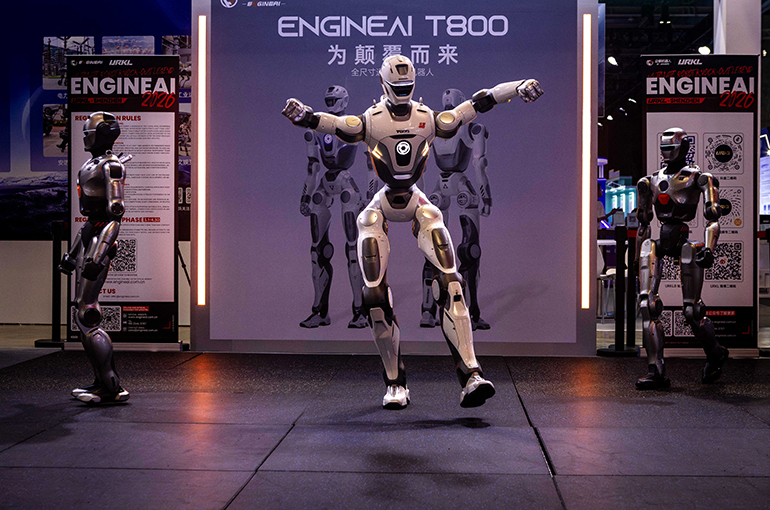
Qingxin Innovation Technology brought its embodied intelligence robot Amoo to the expo, held at the Venetian Macao Cotai Expo from May 27 through 30, while Pudu Robotics, Matrix Robotics, and Noematrix unveiled their product lineups. Lenovo Capital also attended the event alongside portfolio firms Lenovo New Vision and VitaDynamics.
"China and the United States are the main players in embodied intelligence," said Steven Hu, founding partner of Ince Capital. “If we talk about the advantages of going overseas, the first is definitely the supply chain. Whether we are collecting data, building the body itself, or making core components, the cost advantage is enormous.”
Chinese firms lead US peers in some research and development areas, and hardware will "without question, for the most part, still come from China," he noted.
Overseas buyers respond to the price of Chinese robots very differently from domestic customers, according to Zhang Haixing, founder and chief executive of Matrix Robotics. “Our price per unit is from USD50,000 to USD100,000, and overseas users don't find that particularly expensive.”
"In China, people might think you've lost your mind if you pay CNY300,000 to CNY500,000 (USD44,360 to USD73,935) for a robot, but overseas, they feel it is very much within the limit," he pointed out.
The price receptivity is due to labor market conditions in developed economies, where annual wages for certain skilled manual roles can reach USD100,000 to USD200,000, combined with high turnover and training costs, Zhang said. “Their demand for the labor gap and for automation is more urgent.”
Despite that, Matrix Robotics is taking a deliberate approach to its overseas rollout, Zhang stressed. "We want to use China to polish our product and solution first, and then slowly, perhaps through the Belt and Road, followed by the Middle East and Southeast Asia, gradually expand outward," he noted.
Taiwan-based Matrix Robotics plans to build capacity to produce 5,000 trial commercial units within this year, targeting an output of 100,000 units by the first half of next year, according to Zhang.
'ChatGPT Moment' Hasn't Arrived
Against their ambitions, the embodied intelligence companies offered a consistent and cautious assessment of where the technology stands.
Zhang Tao, founder and CEO of Pudu Robotics, which expanded from food delivery robots into industrial handling and humanoid robots in 2016, said the sector's generalization capability remains insufficient for a defining inflection point. "The 'ChatGPT moment' for embodied intelligence has not yet arrived," and it may take a minimum of three to five years, he noted.
Drawing on a comparison with autonomous driving tech, which Zhang described as a low-degree-of-freedom robot, he said that reliable self-driving systems typically require over 10 million hours of real-machine data to work well. Robots are far more complex than cars, he stressed, and the sector will need tens to hundreds of millions of hours of real operational data before a comparable breakthrough can occur.
The consumer market explosion in the embodied intelligence sector will be between 2028 and 2030, according to Matrix Robotics' Zhang Haixing. This will depend on how fast supply chain costs can be reduced and on improvements in the generalization ability of robot intelligence systems, he said.
Humanoid robots represent one of humanity's greatest opportunities, Deepu Talla, vice president of robotics and edge AI at Nvidia, said at the Beyond Expo opening ceremony. The number of robots could reach tens of billions within 10 to 20 years, once precision challenges are resolved, he pointed out.
Editor: Martin Kadiev





