



 Chinese Mainland AI Firms See Hong Kong as Springboard to Go Global, Cyberport Chair Says
(Yicai) July 2 -- More and more artificial intelligence companies from the Chinese mainland are choosing Cyberport, Hong Kong's digital technology hub and AI accelerator, as a launchpad for their overseas expansion, according to the chairman of Hong Kong Cyberport.
Chinese mainland AI firms see Cyberport as an international platform where they can build regional headquarters and launch their plans to expand in Southeast Asia and the Middle East, Simon Chan told Yicai ahead of LEAP East, the inaugural international edition of LEAP. “Their goal is to use Hong Kong as a platform to go global.”
LEAP is a major tech event held in Riyadh, Saudi Arabia. LEAP East will be the first time the event is held abroad, and will take place at the Hong Kong Convention and Exhibition Center from July 8 to 10. Around 20 Cyberport-based companies will exhibit at the event.
"Chinese firms are increasingly looking at the Gulf Cooperation Council as a destination for business expansion, commercial partnerships, and regional market entry," said Mike Champion, chief executive officer of Tahaluf, the organizer of LEAP East.
Chan explained that Hong Kong has long played the role of a "super-connector" between the Chinese mainland and the rest of the world, a role built through two waves of growth: an early fintech and Web3 boom, which created a cluster of more than 400 fintech and over 310 Blockchain, Digital Assets and Web3.0 companies at Cyberport, and a recent rapid influx of AI firms.
An increasing number of AI firms from the mainland are becoming tenants at Cyberport, including industry leaders such as iFlytek, Baidu Apollo, D2 Intelligence, Yunji Tech and Inspur Cloud Information Technology, Chan said.
Hangzhou-based brain-computer interface startup BrainCo set up its Asia-Pacific HQ and research and development center at Cyberport in September last year and filed for an initial public offering in Hong Kong in January. BrainCo is collaborating with the Hong Kong Polytechnic University to jointly develop smart prosthetics in Hong Kong, according to Chan.
Rising computing capacity has been key to attracting these companies, Chan noted. Cyberport's AI Supercomputing Center, the largest of its kind in Hong Kong, delivers 3,000 petaflops of computing power. The number of AI and big-data companies based there up to more than 500 from about 330 when the center opened in December 2024.
Customized Support
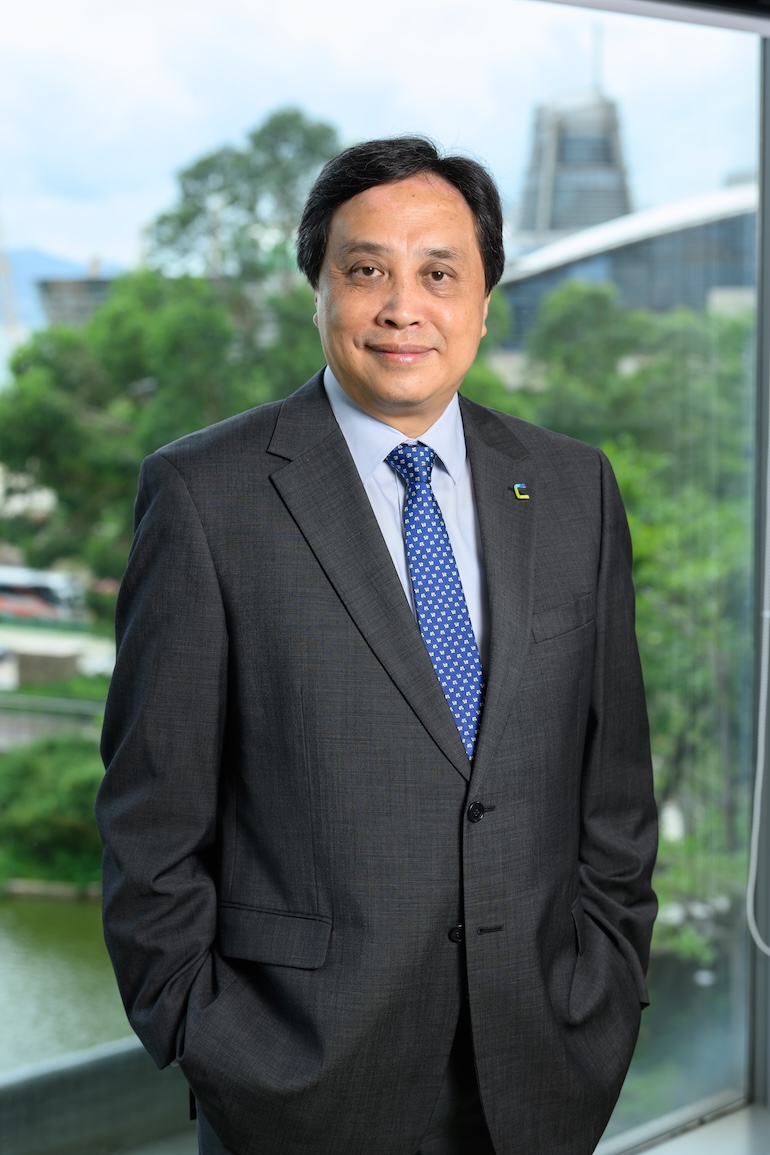
Chan explained how Cyberport supports mature Chinese mainland companies and Local incubatees in very different ways.
There is not much need for Cyberport to help large mainland companies on the technical side, but it can support them in using Hong Kong as a launchpad to reach overseas markets, Chan said. That includes helping firms adapt products and partnership models to foreign markets' specific needs and connecting them with more than 220 global investors through the Cyberport Investors Network.
On the other hand, Chinese and international incubatees get a more comprehensive one-stop incubation model covering R&D support, funding connections, and proof-of-concept trials. This model was behind over 1,500 companie Cyberport has incubated over the past decade.
When asked about Hong Kong's core competitiveness as an outbound platform, Chan said that his background in the banking industry helps with promoting integration of technology and finance for financial innovation, but “what matters most is still Hong Kong's environment, as the city is an international financial center.”
Chan pointed to Hong Kong's common-law legal system, low and simple tax regime, free capital flows, and efficient, transparent regulation as the real draws for investors. He also mentioned that the city has improved its position in the IMD World Competitiveness Ranking for three consecutive years, securing second spot this year, marking its best result since 2019.
A Window to the Middle East
Chan personally traveled to Saudi Arabia, Qatar, and other Gulf states multiple times in recent years to build relationships with local governments and industry partners, he told Yicai when discussing Cyberport-based companies' expansion in the Middle East.
Cyberport has signed cooperation agreements with Saudi Arabia's King Abdulaziz City for Science and Technology, the Dubai Future Foundation, and the United Arab Emirates' Hub71 to establish "hub-to-hub connections" designed to give expanding companies a foothold in Gulf markets.
More than 30 Cyberport firms have already expanded into Middle Easternmarkets, Chan said, citing global digital asset company Hex Trust, the first virtual asset custodian to provide services in Dubai as it fast becomes a global hub for the sector. He also highlighted digital asset insurance provider AIFT which, following an investment and partnership with Dubai Insurance, secured UAE Central Bank approval to launch its digital asset custody insurance. Other Cyberport companies are involved in environmental and infrastructure projects tied to Saudi Arabia's satellite-city developments.
When asked whether regional tensions had made companies more cautious about the Middle East, Chan said that short-term uncertainty is a factor they weigh, but not a decisive one for planning long-term expansion.
"Building an industrial presence and establishing a business cluster somewhere takes a long time, you can't judge it by what happens over a few weeks," he noted, adding that based on his contacts in the region, the Gulf's financial system and investment environment remain very robust, with no shortage of opportunity.
Editor: Futura Costaglione





