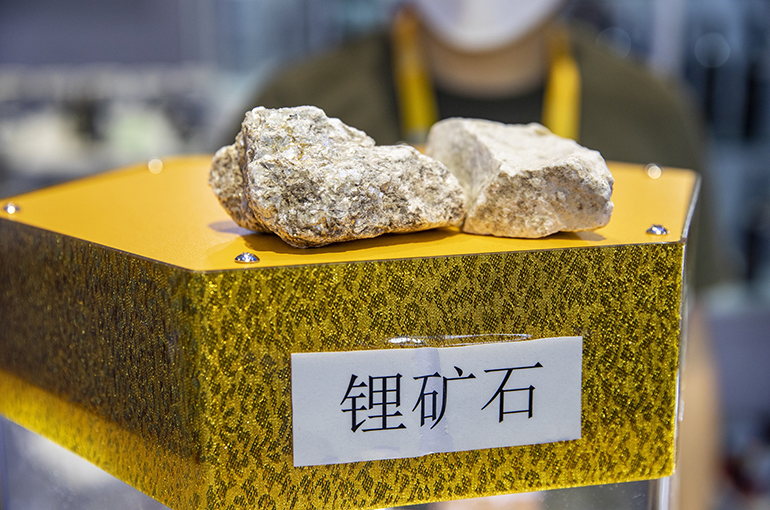
 Chinese Lithium Miners Say Impact of Zimbabwe's Sudden Export Ban Will Be Minimal as Shares Slide
(Yicai) Feb. 26 -- Shares of several listed Chinese firms with lithium mining operations in Zimbabwe fell after Africa's top lithium producer abruptly halted all exports of the metal’s ore and concentrate a year earlier than planned, though the miners said the development would have limited impact on their businesses.
A spokesperson for Yahua Industrial Group told reporters today that the Sichuan province-based miner has already shipped out its lithium concentrate from Zimbabwe, and so it does not expect the Zimbabwean government’s sudden export halt to affect near-term production. Yahua’s shares [SHE: 002497] sank 8.8 percent to close at CNY26.44 (USD3.86) each in Shenzhen.
Zimbabwe’s mines ministry said yesterday that only entities with valid mining titles and approved processing plants will be authorized to export minerals. Agents and third-party traders will not be permitted to export on behalf of title holders, and applicants must include a provincial mining office recommendation letter certifying processing capacity, regulatory compliance, and the mineral composition of the consignment, it added.
Yahua’s spokesperson noted that traders and agents without local mining licences or processing qualifications are now ineligible to make exports, but stressed that the company can still apply for export permits if it provides supplementary documentation, something the firm has already begun to address.
All Chinese exports of lithium concentrate from Zimbabwe are on hold pending policy clarification, a spokesperson for Sinomine Resource Group said, adding that the Beijing-headquartered miner has virtually no locally processed lithium products in Zimbabwe and is considering options to extend its supply chain. No plans were ready for disclosure, the person said.
Sinomine’s stock [SHE: 002738] ended the day 4.8 percent lower at CNY87.59.
Zimbabwe’s lithium exports "ban" is essentially aimed at curbing unauthorised exports, a spokesperson for Huayou Cobalt told the media. The Zhejiang province-based firm’s license was issued by the mines ministry, and the full extent of any impact is still being assessed, the person said. Huayou Cobalt [SHA: 603799] fell 0.8 percent to finish at CNY76.88 in Shanghai.
Chinese miners have made substantial investments in Zimbabwe’s lithium sector. Bikita, fully owned by Sinomine, is one of Africa’s largest operational lithium mines, with an annual production capacity of about 600,000 tons of concentrate.
Chengxin Lithium Group has a majority stake in the Sabi Star mine, which produces roughly 300,000 tons of concentrate a year. Huayou Cobalt controls the Arcadia project, an integrated mining-and-processing operation that includes a 50,000-ton-per-year lithium sulfate facility. Yahua, meanwhile, has an interest in the Kamativi mine, which can produce 350,000 tons of concentrate annually.
Chengxin’s stock [SHE: 002240] gave up 6.5 percent to end at CNY42.26, while Zijin Mining Group [SHA: 601899] -- one of China’s biggest miners -- lost 0.7 percent, closing at CNY39.37.
The export halt is intended to force leading miners to build local processing plants and create more value domestically, Citic Securities said in a research note. Until new lithium-salt smelting capacity comes online, the brokerage said, the government may still allow limited export windows for large, compliant miners while excluding unlicensed traders and artisanal miners, which will raise export thresholds, boost the industry’s concentration, and benefit Chinese miners already in Zimbabwe.
Before the ban is lifted, China’s short-term supply of lithium carbonate is likely to tighten and lithium prices could surge, Citic Securities noted.
A number of Chinese lithium miners without exposure to Zimbabwe rallied. Jinyuan EP [SHE: 000546] surged by its 10 percent daily trading limit to CNY6.83 (USD1), Jiangxi Special Electric Motor [SHE: 002176] added 1.9 percent to CNY10.68, Yongshan Lithium [SHA: 603399] rose 0.9 percent to CNY11.82, [SHE: 001203] and Youngy [SHE: 002192] climbed 3.8 percent to CNY41.34 and CNY58.38, respectively. Yongxing Special Materials Technology [SHE: 002756] gained 3.5 percent to CNY59.
In recent years, countries rich in lithium, cobalt, nickel, tin, and other strategic minerals have tightened their control, Citic Securities noted, pointing to tin-mining restrictions in Myanmar, cobalt export curbs in the Democratic Republic of the Congo, and sharp reductions in nickel-ore quotas in Indonesia.
Amid a broader wave of resource nationalism and intensifying competition between the United States and China over control of critical minerals, further abrupt policy shifts by producer nations are likely, raising the risk of renewed supply disruptions, the brokerage said.
China imported about 7.75 million tons of lithium concentrate last year, up more than 39 percent from the previous year, mainly from Australia, Zimbabwe, and Nigeria, according to customs data.
Editor: Martin Kadiev