


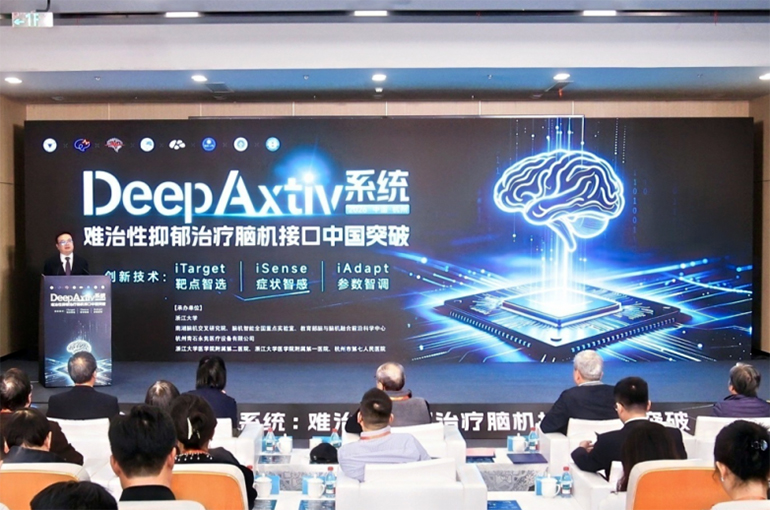
 Chinese Research Team Unveils Brain-Computer Interface Device for Hard-to-Treat Depression
(Yicai) Nov. 26 -- DeepAxtiv, an invasive brain-computer interface system designed to deliver precision treatment for patients with treatment-resistant depression, has been launched by a research team led by Zhejiang University’s College of Computer Science and Technology and its Frontier Science Center for Brain Science and Brain-Machine Integration in collaboration with several partner institutions.
Treatment-resistant depression accounts for about 30 percent of all depression cases, a senior expert in neuroscience told Yicai. Patients are generally classified as having treatment-resistant depression if they fail to respond adequately to at least two antidepressant medications administered at appropriate doses and for an adequate duration,
Existing treatment options for the condition all have certain limitations, the expert said. For example, deep brain stimulation, which involves surgically implanting electrodes into the brain to deliver electrical stimulation, has shown limited efficacy. This is partly because brain activity patterns and responses to stimulation vary considerably from one patient to another, making it difficult to apply a standardized treatment protocol across patients.
Studies have found that deep brain stimulation has an average response rate of around 54 percent and a symptom remission rate of about 41 percent, the expert said, citing clinical data. Patients typically take one to two years to respond to treatment.
By contrast, the DeepAxtiv system has a 100 percent response rate and a symptom remission rate of 83 percent, the development team said, citing the results of prospective clinical trials conducted on six patients with treatment-resistant depression. Treatment effects emerged within one to eight weeks after the therapy began, the team said.
The system’s key advantage lies in its ability to personalize deep brain stimulation by selecting treatment parameters tailored to each patient’s individual condition, Zhang Hongjian, assistant to the dean of the Oriental Pan-Vascular Devices Innovation College at University of Shanghai for Science and Technology, told Yicai.
Clinical Breakthroughs
“The DeepAxtiv system utilizes three core technologies to provide individualized, closed-loop neural regulation for treatment-resistant depression,” Yang Yuxiao, a researcher at Zhejiang University’s Frontier Science Center for Brain Science and Brain-Machine Integration and a member of the DeepActiv research team, told Yicai.
The three technologies are iTarget, which identifies the optimal treatment target for each patient, iSense, which translates brain activity into quantifiable neurophysiological indicators to monitor depressive symptoms, and iAdapt, which precisely optimizes stimulation parameters through adaptive adjustments.
The biggest advantage of DeepAxtiv is that it takes effect rapidly, said Sun Rong, consulting director at US business consultancy firm Frost & Sullivan's China branch. Conventional deep-brain stimulation devices often take one to two years to produce noticeable results, during which time patients may have a high risk of suicide.
“The development team plans to begin registration clinical trials next year,” Hu Xiongjie, general manager of Hangzhou Qingshi Yongjun Medical Equipment, one of the companies involved in launching the DeepAxtiv system, told Yicai.
"The team aims to obtain what it hopes will be the world’s first medical device registration approval for a brain-computer interface system designed for precision treatment of treatment-resistant depression, potentially providing an approved clinical treatment option for nearly 100 million patients worldwide including close to 30 million in China,” he added.
Editors: Tang Shihua, Kim Taylor