



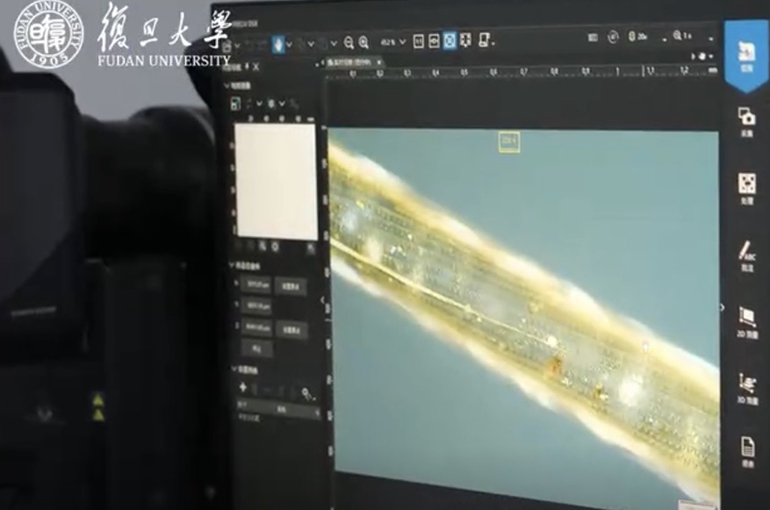
 Chinese Researchers Create World’s First Fiber Chip, Paving Way for Wearable Electronics
(Yicai) Jan. 22 -- A team of Chinese researchers has become the first in the world to develop a ‘fiber chip,’ packing high-density integrated circuits into a fiber thinner than a strand of human hair and marking a radical shift from conventional silicon chips, according to findings published in scientific journal Nature today.
The fiber chip, which was developed by a Fudan University team led by Peng Huisheng and Chen Peining, boasts 100,000 transistors per centimeter of fiber. Its information-processing capability rivals that of most classic commercial chips while offering unique advantages such as extreme flexibility as well as the ability to stretch, bend and twist and to be woven. The technology could provide critical support for future industries such as brain-computer interfaces, electronic textiles and virtual reality.
The research team, from Fudan University’s State Key Laboratory of Molecular Engineering of Polymers and its Laboratory of Advanced Materials under the Institute of Fiber Materials and Devices’ Department of Macromolecular Science, is the first in the world to propose the concept of ‘fiber devices’ and has developed over 30 types so far.
Wearable technology will be a key field in the future, and fibers are an ideal platform for it, said Chen.
Because fiber chips do not require an external processor, they can be woven directly into soft, breathable electronic fabrics. This opens up vast commercial possibilities. Clothing, for example, may one day double as a ‘smart display,’ while in scenarios such as remote robotic surgeries, fiber chips could be made into tactile gloves that precisely simulate the feel of different objects and significantly enhancing human-machine interaction.
Fully flexible, fiber-based smart gloves might give doctors a much more sensitive sense of touch during remote surgical procedures, said Wang Zhen, a doctoral student at the Laboratory of Advanced Materials. Looking ahead, once brain-computer interfaces are implanted, no external equipment would be needed to collect, process or analyze data.
This breakthrough has also excited developers of medical devices. “Fiber chips could eventually rewrite the rules for implantable medical devices. Integrating circuits and signal transmission onto a single fiber will dramatically shrink the size of devices, making the technology tailor-made for implants inside the human body,” Zhu Rui, founder and chief executive officer of Shenzhen-based medical device firm Vivolight, told Yicai.
The team’s work has been featured in Nature seven times and some technologies have already been transferred to leading domestic firms. These companies have built production lines for light-emitting fibers, fiber lithium-ion batteries and other products with early applications in the automotive and clothing fields.
Editor: Kim Taylor





