



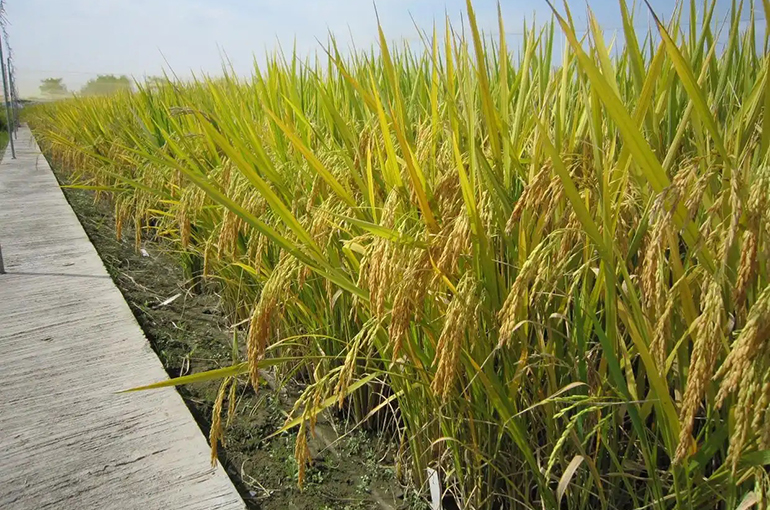
 Chinese Scientists Crack Genetic Code Behind Rice’s Heat Tolerance
(Yicai) Dec. 3 -- Chinese scientists have deciphered how rice senses heat stress and have identified genes that help the crop tolerate high temperatures, providing a new solution to counter yield losses caused by climate change as global warming mounts an increasing threat to international food security.
A research team led by Lin Hongxuan, an academic at the Center for Excellence in Molecular Plant Sciences under the Chinese Academy of Sciences, have unlocked the dual passwords of the heat alarm system that rice uses to detect and respond to high temperatures, according to the research results published in experimental biology journal Cell today.
The study, which was also conducted with research teams led by Lin Youshun from Shanghai Jiao Tong University and Li Yixue from Guangzhou Laboratory, reveals a step-by-step co-ordinated heat-sensing mechanism in rice plants. By genetically fine-tuning this system, the researchers developed new rice lines with different levels of heat tolerance, paving the way for molecular breeding of more heat-resistant crops.
Scientists can now not only enhance a crop’s ability to withstand heat, but can also design the exact level of heat tolerance, like adjusting a sound volume knob, to suit different regional climates and maintain stable yields in hotter environments.
High temperatures hurt rice yields and crop quality by damaging pollen vitality, disrupting pollination and grain filling, Lin told Yicai and other media outlets. This weakens the production potential of major grain-producing areas. It has become one of the most serious and immediate threats to global food security.
After years of effort, the teams have identified two key regulatory factors in rice that solve a long-standing scientific puzzle. In field experiments simulating extreme heat, the improved rice lines produced between 50 percent and 100 percent more grain, without sacrificing yields under normal conditions.
Editor: Kim Taylor





