



 Chinese Scientists Develop AI Model to Decode Star Data Across Telescopes
(Yicai) Feb. 27 -- A Chinese research team has developed an artificial intelligence model that can interpret stellar spectral data from different telescopes, highlighting the great potential of the technology in astronomical research.
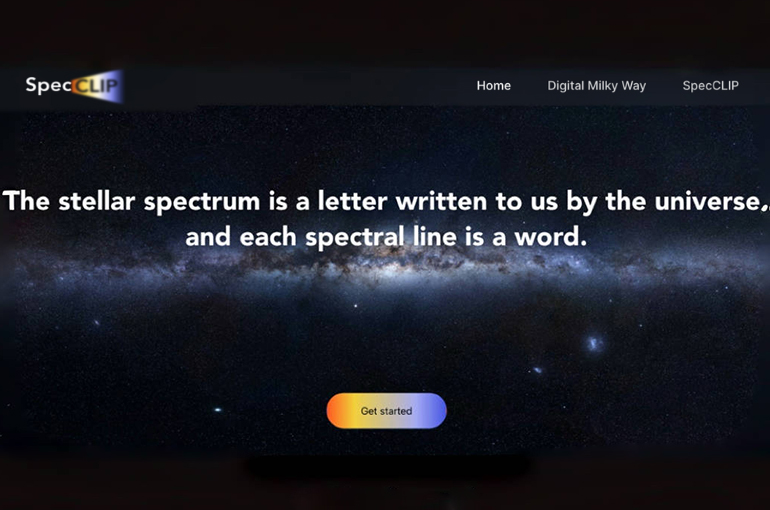
Scientists from the Chinese Academy of Sciences' National Astronomical Observatories, the University of Chinese Academy of Sciences, and other institutions introduced concepts similar to large language models into astronomy and applied a contrastive learning method to make the SpecCLIP model, which is capable of learning and establishing intrinsic connections autonomously between spectral data from different sources, according to a study published in The Astrophysical Journal on Feb. 11.
Stellar spectra contain unique information about stars, including their temperature, chemical composition, and surface gravity. By analyzing these, astronomers can trace the evolutionary history of the Milky Way from its beginning.
The model can predict stellar atmospheric parameters and elemental abundances, perform spectral-similarity searches, and even help identify peculiar celestial objects, the researchers said, noting that it has already been applied in multiple cutting-edge exploration missions, such as searching for planets similar to Earth.
Researchers face a significant challenge due to different survey projects, such as China's Large Sky Area Multi-Object Fiber Spectroscopic Telescope and Europe's Global Astrometric Interferometer for Astrophysics, also known as the Gaia satellite, acquiring spectral data via varying methods, resolutions, and wavelength ranges. The datasets are like stories told in different dialects, making them difficult to combine for large-scale analysis.
The SpecCLIP model acts as a translator that can convert LAMOST's low-resolution spectra and Gaia's high-precision spectra into a universal language, allowing scientists to perform joint analyses with ease, enabling data alignment and transformation across different instruments and survey projects.
Editor: Martin Kadiev





