



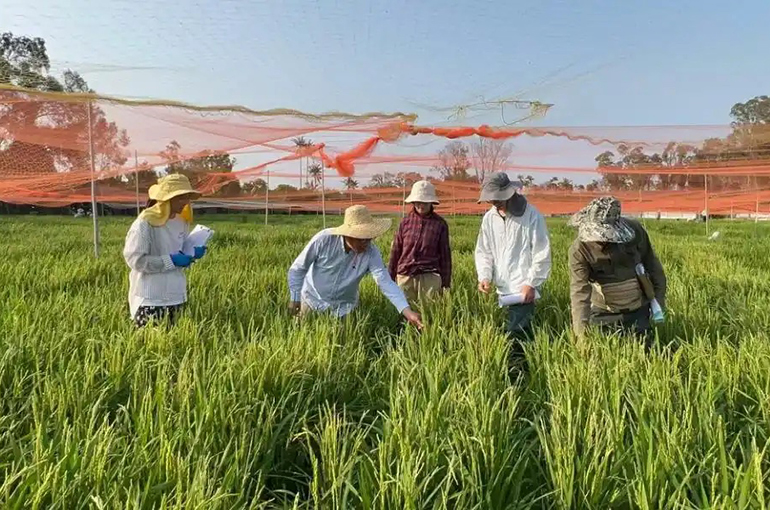
 Chinese Scientists Uncover Genetic Mechanism That Helps Rice Resist Bacterial Blight
(Yicai) April 9 -- After 20 years of research, Chinese scientists have discovered the immune mechanism by which some rice resists bacterial blight, offering a basis for breeding varieties of the widely consumed grain that are both disease-resistant and high-yielding.
A joint team from the Center for Excellence in Molecular Plant Sciences of the Chinese Academy of Sciences, Shanghai Jiao Tong University, and Zhejiang University identified rice gene Xa48 and uncovered the means by which it triggers an immune response to bacterial blight.
The findings, published yesterday in the science journal Nature, provide key theoretical and technical support for breeding new rice varieties that combine disease resistance with high yields.
Bacterial blight, which is caused by the Xanthomonas oryzae bacteria, is a disease affecting rice, commonly found in coastal, lakeside, and low-lying flood-prone areas. It is one of the world’s most devastating plant diseases, as it can cause yield loss of over 70 percent.
The incidence of bacterial blight in China over the past two decades has increased and spread to almost all rice-growing areas as a result of climate change and increasingly extreme weather.
The study found that Xa48 is retained only in rice subspecies grown in the southern Yangtze River region, where bacterial blight occurs more frequently, while it is absent in subspecies north of the region, where flooding is less common. This discovery has major implications for rice breeding.
The researchers also developed a new rice variety by combining the Xa48 gene with the foundational resistance gene Xa21. This confirmed that the presence of both genes can reconstruct a broad-spectrum disease resistance similar to that of wild rice, maintaining stable resistance even under extreme conditions such as typhoons and floods, without affecting yield.
The findings have already been applied in the development of new disease-resistant varieties by several breeding companies and institutions, Yicai learned, including Yuan Long Ping High-Tech Agriculture, Winall Hi-Tech Seed, China National Rice Research Institute, and the Chinese Academy of Agricultural Sciences.
Editors: Dou Shicong, Tom Litting





