



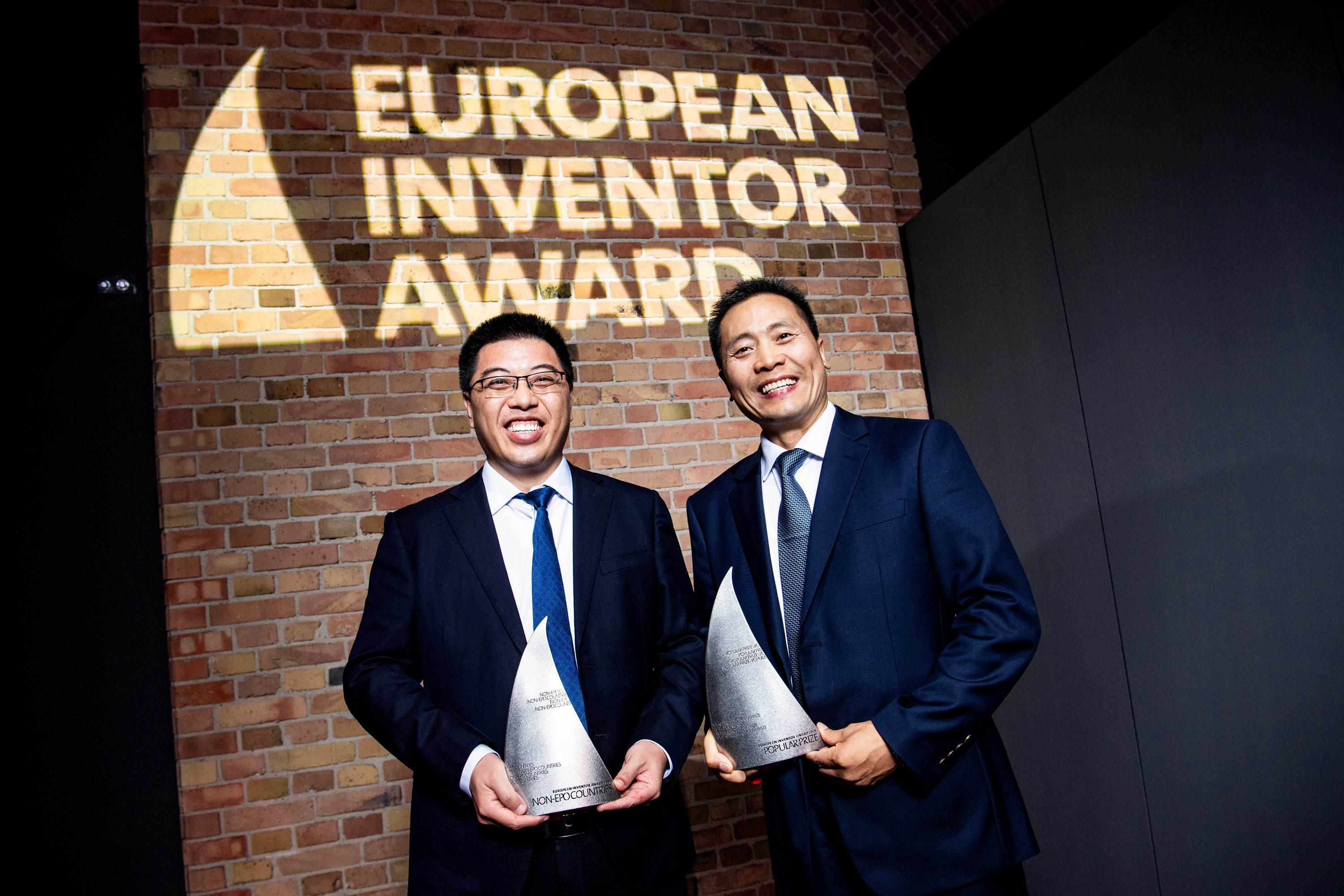
 Chinese Team Wins European Inventor Award for Innovative Smart Battery Recycling
(Yicai) July 8 -- Chinese inventors Yu Haijun, Xie Yinghao, and their research team have won the European Patent Office's 2026 European Inventor Award under the Non-EPO Countries category for their innovative smart battery recycling technology capable of regenerating high-quality cathode materials from spent lithium-ion batteries.
Yu, Xie, and their team, which is under Guangdong Brunp Recycling Technology Co., Ltd, also received the Popular Prize, determined by a combination of public and jury vote, during an award ceremony in Berlin on July 2.
Launched by the EPO in 2006, the European Inventor Award is one of Europe's most renowned innovation prizes, honoring inventors solving major global challenges. Its jury consists of past award finalists with professional expertise in tech, business, and intellectual property. All award candidates must hold a European patent.
China's strong policy support for new energy industries and complete coordinated supply chains are the core advantages that drive the continuous upgrading of domestic lithium battery recycling tech, Yu and Xie said in an interview with Yicai.
China and Europe share common demands and complementary strengths in addressing environmental and resource challenges, Yu and Xie noted, adding that China’s full-scenario, full-chain and lifecycle-oriented application experience in battery recycling could offer practical reference for Europe in scenario-based validation and standards research, and the pair can jointly build fair, mutually recognized global sustainable industrial standards.
More than 2,000 gigawatt-hours of lithium-ion battery capacity were added worldwide between 2018 and 2023, powering around 40 million electric vehicles and thousands of battery storage projects, according to the International Energy Agency. The recovery of critical raw materials, including lithium, nickel, and cobalt, has become an urgent global task as battery demand keeps rising.
The Chinese team's technology can directly convert spent lithium-ion batteries into high-performance cathode materials for new batteries, cutting waste, raw material consumption, and carbon emissions.
Other finalists in the Non-EPO Countries category included a team developing plant-based air-filtration systems and another working on a hydropower technology that guides water toward turbines.
Traditional recycling techniques rely on lengthy processes that consume massive amounts of chemicals and energy. The Brunp Recycling team create a directional recycling technology that directly turns waste batteries into battery-grade nickel, cobalt, and manganese cathode materials while maintaining the material's functional structure.
The team's recycling process recovers 99.6 percent of NCM and 96.5 percent of lithium, according to data released by Brunp Recycling. It reduces acid and alkali use by 73 percent, shortens processing steps by over 18 percent, and delivers regenerated cathode materials with a 61 percent lower carbon footprint than traditional manufacturing.
The research can be traced back to the early 2000s, when the team noticed the rising pressure of waste battery disposal and China's reliance on imported battery raw materials.
Yu is a researcher at Brunp Recycling and put forward Reverse Product Positioning Design and Directional Recycling Technology, while Xie promoted the technology from lab research to industrial application. In 2015, the company joined the ecosystem of Chinese battery giant Contemporary Amperex Technology, enabling large-scale global rollout of the recycling tech across battery supply chains.
Brunp Recycling is a global leader in waste battery recycling and regenerated ternary cathode materials. As a CATL holding subsidiary, it has built a full-chain battery recycling system spanning recycling, resource recovery and material regeneration, helping advance a more circular battery industry through its original directional recycling technology.
The company is willing to cooperate with overseas clients to build recycling production lines and supply recycled materials in key new energy regions to meet local compliance requirements, Yu and Xie said. In the long run, the team intends to promote directional recycling technology in international low-carbon standards, launch full-lifecycle low-carbon battery services, and expand the global supply of recycled battery materials, they pointed out.
Based in Munich but with offices in Berlin, Brussels, the Hague, and Vienna, the EPO has 6,300 employees. Its centralized patent-granting system offers patent protection in up to 46 countries, covering 715 million people worldwide.
Editor: Martin Kadiev





