



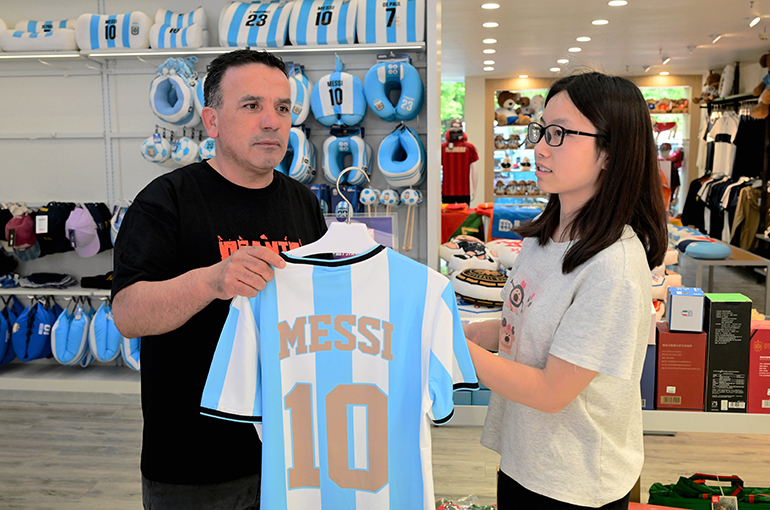
 Chinese Vendors in Yiwu See Best-Ever World Cup Merch Sales
(Yicai) July 16 -- Vendors in Yiwu, the Chinese city boasting the world's biggest wholesale market for small commodities, have seen merchandise sales for the 2026 FIFA World Cup exceed previous editions thanks to a boost in cross-border trade from maturing supply chains, greater merchant participation, and rising demand.
One vendor with a decade-long track record of making and selling soccer jerseys told Yicai that overall sales surged more than 60 percent during this year's World Cup from the one in Qatar four years ago, beating his expectations of a 30 percent jump. Online retail sales have doubled, he noted.
Demand for national team jerseys soared mainly due to the latest World Cup expanding to 48 from 32 participants and the three North American hosts of Canada, the United States, and Mexico boasting large populations and stronger economic power than the Middle East, the vendor pointed out.
More crucially, upgrades to cross-border e-commerce platforms, logistics infrastructure, and service capacity have created opportunities for merchants to secure and fulfill replenishment orders promptly after the World Cup kicked off, he stressed. While large offline bulk orders were mostly completed in May, direct-to-consumer online orders kept pouring in and shipping out daily once the tournament began, he added.
In addition, Kylian Mbappé, Harry Kane, Lionel Messi, Erling Haaland, and other star players have had outstanding individual performances and helped their respective nations boast strong results, generating extra orders for related products, the vendor noted.
"Product prices are not the sole deciding factor for clients, with quality and delivery time also weighing heavily," another business owner in Yiwu said to Yicai. Chinese sellers have built mature operational systems to satisfy diverse client requirements and can flexibly adjust products per consumer requests at any time, the person noted.
Cross-border trade for this World Cup merch features an obvious "tournament pulse" pattern, Zhang Zhouping, executive dean of Bense Think Tank, told Yicai. Orders were highly concentrated in the month leading up to the tournament and the group stage, while the progression or elimination of teams has triggered sharp fluctuations, imposing stringent agility requirements on supply chains, Zhang pointed out.
Vendors have rolled out diversified logistics strategies to cater to different order types, with products expected to see robust sales shipped via sea to be stocked in overseas warehouses ahead of the tournament, Zhang said. On the other hand, hot-item orders emerging mid-tournament are fulfilled through dedicated air freight or cross-border direct mail delivery, Zhang added.
Editors: Tang Shihua, Martin Kadiev





