



 [CIIE] China Extends Trade Truce With US by Two Months
(Yicai) Nov. 9 -- China has extended its trade truce with the United States by two more months, as the pair prepare to implement reciprocal cuts on import tariffs covering a wide range of American agricultural products.
China will hold off levying an additional 24 percent tariff on US imports, a suspension that was set to expire tomorrow, through Jan. 10, the State Council’s customs tariff commission announced today. The 10 percent additional tariff on US goods will remain in place.
The extension will help support a relatively stable and predictable environment for business cooperation between the two countries, the commission said.
The decision will take effect at 1.01 p.m. on Nov. 10, implementing the consensus reached by the Chinese and US heads of state at their meeting in Washington in September, it said. China will continue to monitor US actions and adjust its countermeasures as necessary, the commission added.
Further tariff reductions on a range of US products, including agricultural goods, are expected under the separate “30-for-30” framework established through the China-US Board of Trade. Based on 2024 bilateral trade values, the arrangement covers imports worth about USD30 billion on each side. It does not establish new purchase commitments.
China’s list, released in late September after the state visit to Washington, covers 1,619 tariff lines of US products, including beef, pork, poultry, dairy, corn, wheat, and sorghum. The US list covers 77 tariff lines of Chinese goods, including household items, toys, and holiday decorations.
More than 90 percent of the items on each list will be exempt from all additional tariffs imposed by the other side and receive most-favored-nation tariff treatment, according to China’s commerce ministry. China is open to expanding purchases of American farm produce if the two sides implemented the “30-for-30” arrangement, a ministry spokesperson said on Nov. 5.
Slower Decline in Farm Trade
The decline in China-US agricultural trade has eased this year. It totaled USD20 billion in the first nine months, down 8.1 percent from a year earlier, compared with a 26 percent drop in the same period of last year, Cao Derong, president of the China Chamber of Commerce of Foodstuffs and Native Produce, said on Nov. 6 at the China-US High-Level Dialogue on Agricultural Trade Cooperation.
China’s farm exports to the United States rose 11 percent to USD8.22 billion in the period, while it imported USD11.8 billion of US farm produce. The new arrangements have stabilized bilateral economic ties and market expectations, according to Cao.
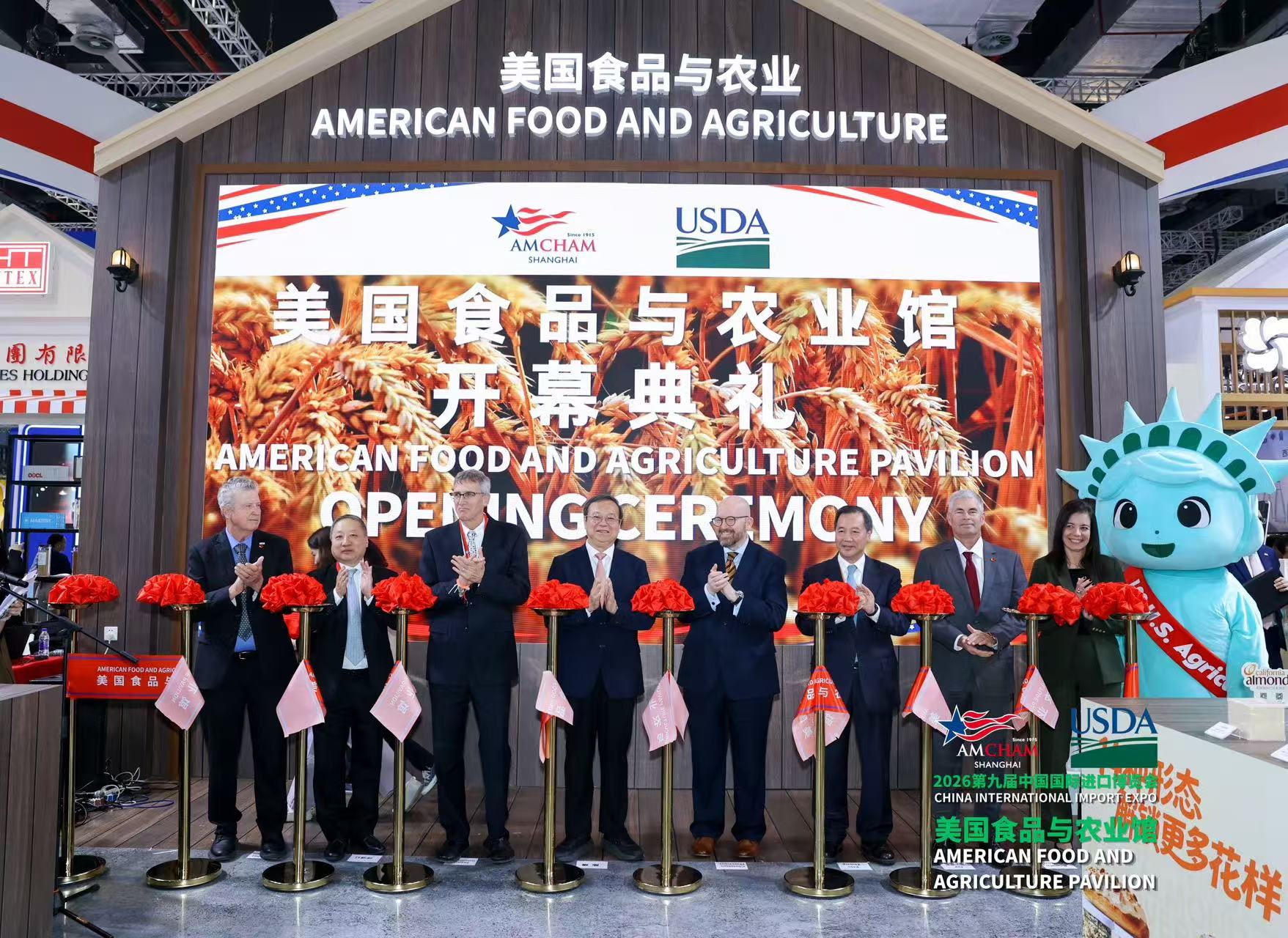
Eric Zheng, president of the American Chamber of Commerce in Shanghai, which co-organizes the US pavilion at the China International Import Exhibition with the US agriculture department, told Yicai that the improving relationship provides a favorable environment to focus on commercial cooperation in food and agriculture. The US is one of the world’s largest agricultural exporters and China one of the largest importers, which makes the two economies complementary. US exporters are looking to translate the positive signs into more business.
Exhibitors at the US Food & Agriculture Pavilion signed six deals worth more than USD650 million on the opening day of the CIIE, according to AmCham Shanghai. Illinois-based Hang Tung Resources signed three of them, worth about USD600 million, for sorghum and wheat, both of which are on China’s tariff-reduction list.
China Becomes Regional Berry Hub
Some American agricultural companies are looking beyond exports from the United States, establishing production operations in China to serve domestic consumers and supply markets elsewhere in the region.
California-based berry producer Driscoll’s, which is exhibiting at the US pavilion for the first time this year, has brought strawberries, blueberries, raspberries, and blackberries -- all grown in southwestern China’s Yunnan province -- to the CIIE.
Driscoll’s planted its first 6.67 hectares of blueberries in Yunnan in 2013. Together with more than 150 local partners, it now cultivates berries on more than 4,000 ha in Yunnan, with annual output in excess of 40,000 tons. Its cumulative investment in China has exceeded CNY3 billion (USD450 million) since it entered the market, the firm said, creating more than 1,000 full-time jobs and over 20,000 seasonal positions.
Local production allows Driscoll’s to move berries into cold storage within about two hours of picking and ship them on the same day. It has set up 16 cold storage facilities across Yunnan’s growing regions, and sources berries from countries such as Peru to maintain supply outside Yunnan’s growing season.
Driscoll’s has also begun using its Chinese mainland production base to serve overseas markets. Since 2023, berries grown in Yunnan have been exported to Hong Kong, Singapore, Malaysia, Thailand, Indonesia and Cambodia, with shipments now stable and growing.
As berry production has expanded in China, competition has increasingly centered on product quality, varieties, and supply-chain capabilities. Its proprietary varieties take five to seven years to reach commercial planting, while technical support for growers, year-round supply, and four types of berries form part of its strategy, the company added.
Editor: Tom Litting





