



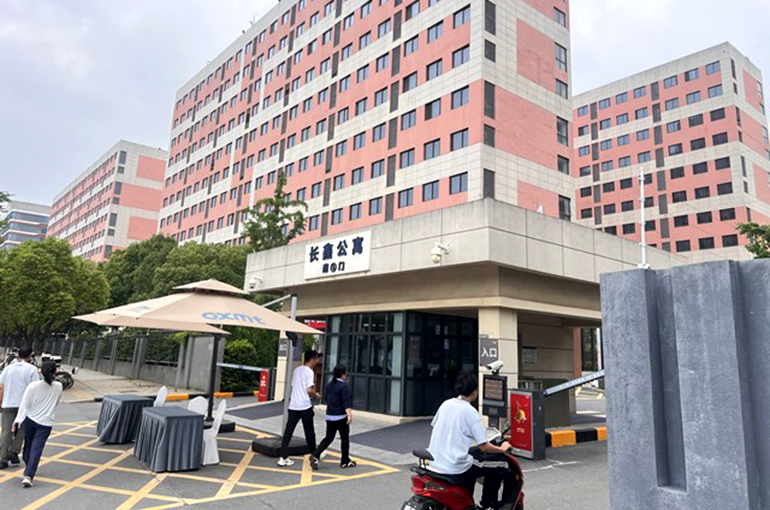
 CXMT's DRAM Plant in Hefei Is Boosting Surrounding Economic Development
(Yicai) May 28 -- Chengxin Memory Technology's dynamic random-access memory factory in Hefei, where the Chinese chipmaker is based, has attracted many highly educated engineers from across the country, which has brought significant stimulus to the overall economic development in the surrounding region.
Workers initially had to travel to the city center to buy daily necessities due to the plant being located about 35 kilometers from the core urban area of Hefei, but as commercial centers, fast food restaurants, supermarkets, and hotels gradually opened around the factory over the past two years, their inconvenience has diminished, Yicai learned during a recent visit.
CXMT, which was approved to list on Shanghai's Nasdaq-style Star Market yesterday, began mass production at the Hefei plant in 2019, two years after starting construction, and has gradually expanded it since. It also has a factory in Beijing and began building a new one in Shanghai's Lingang Special Area in March, which is likely to go live next year.
A worker at a nearby eatery told Yicai that "the restaurant is about full almost every day during meal times, with over 90 percent of the customers being CXMT employees."
The population influx has also driven demand in the local rental market. For example, a 64-square-meter home in the nearby long-term rental complex "Vanke Boyu" has approached the prices of the city's core urban area, with the project quickly reaching full occupancy shortly after opening a year and a half ago, facing a shortage of available units.
Liu Qiang, manager at a local office of real estate agency Lianjia, said to Yicai that at least four of the 10 customers who recently bought homes through his store were employees at CXMT.
CXMT workers who come to buy homes are usually aged 25 to 35, highly educated, and have strong purchasing power, Liu said, adding that some earn over CNY70,000 (USD10,315) a month, with many around CNY30,000 to CNY40,000. Most of them have a master's degree or higher, while many are involved in research and development, Liu said.
Liu's Lianjia store is about a 15-minute drive from the CXMT factory and is on the key route from there to the core urban area of Hefei. The area has accumulated a relatively full range of supporting facilities, including high-end residential properties, a mall, shopping centers, and amusement parks.
"A few days ago, a senior executive from CXMT rented a four-bedroom, two-living room apartment for CNY6,500 (USD960) per month after hardly any negotiation," Liu noted.
Although CXMT has its own worker apartments and offers core employees the opportunity to buy discounted homes, the surrounding area of the factory keeps attracting upstream and downstream supply chain companies as well as service firms, continuing to create a substantial demand for rentals, a real estate market insider told Yicai.
The industrial upgrading in Hefei has been reshaping the urban demographic landscape in recent years, Zhou Kaituo, general manager of CRIC Deep Consulting's Purui Intelligent Research Center in Anhui province, said to Yicai. The city's high-tech industrial development zone is driving more population influx, Zhou added.
With the growth of emerging industrial clusters such as integrated circuits, "Hefei has seen a net influx of about 530,000 people over the past three years, with more than half being under the age of 35," Zhou said, adding that this will inevitably continue to drive demand for high-quality housing.
After CXMT completes its initial public offering, Hefei's real estate market may experience a new peak in demand for high-quality housing within one to two years, several industry insiders told Yicai.
CXMT plans to raise CNY29.5 billion (USD4.4 billion) through its IPO, primarily for upgrading DRAM technology, updating existing factory gear, and developing next-generation storage products. The IPO will be the largest in the Chinese mainland stock market in nearly four years, the 16th biggest ever, and the second-largest on the Star market.
Editors: Tang Shihua, Martin Kadiev





