



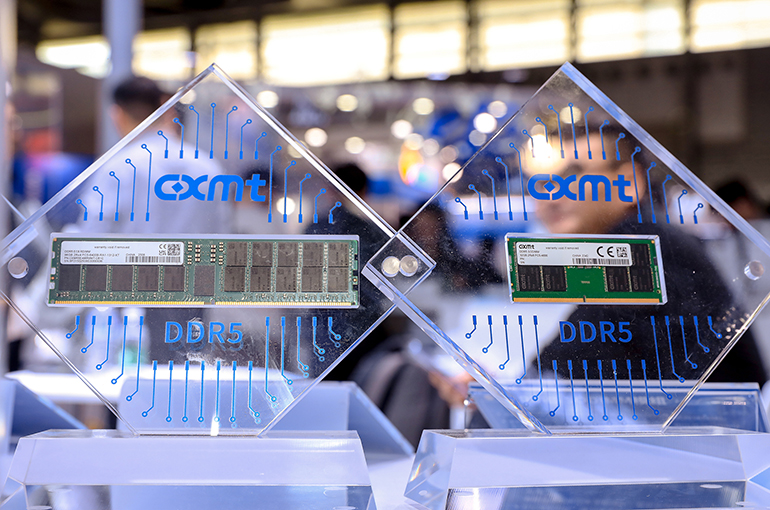
 CXMT's USD4.3 Billion IPO Could Be Star Market's Second-Largest as China's DRAM Industry Gains Ground
(Yicai) July 9 -- Chinese memory chipmaker ChangXin Memory Technologies (CXMT) has launched its Shanghai Star Market initial public offering, seeking to raise CNY29.5 billion (USD4.3 billion) in what is expected to be the second-largest listing in the seven-year-old board's history.
Online and offline subscriptions are scheduled to begin on July 16, according to the prospectus. The IPO comes as CXMT rapidly expands its presence in the global dynamic random access memory (DRAM) market, particularly in consumer electronics.
The company's global DRAM market share climbed from 4 percent in the second quarter of last year to 8 percent in the first quarter of this year, according to industry sources interviewed by Yicai. Market speculation has also emerged that Apple is testing CXMT's DRAM chips for devices sold in China.
According to the prospectus and industry analysis, CXMT's gains have been driven both by its successful product development strategy and by international memory makers shifting production capacity and research and development resources toward server DRAM and high bandwidth memory (HBM).
The company must now defend its growing consumer electronics business while expanding into the more demanding server memory market, where product reliability, long-term validation, and large-scale supply capabilities remain critical competitive advantages.
Consumer Business Gains Momentum
TrendForce said Samsung Electronics, SK Hynix, and Micron Technology have been allocating more resources to HBM and server DRAM, creating structural changes in mobile DRAM supply. As a result, CXMT has been rapidly increasing the market share of its low-power double data rate (LPDDR) products in China's smartphone supply chain.
According to the prospectus, DDR products accounted for 32 percent of CXMT's revenue last year, while the higher-priced LPDDR series contributed 66 percent. LPDDR is mainly used in smartphones, tablets, laptops, and wearable devices, while DDR products are primarily deployed in servers and desktop computers.
A person familiar with the supply chain told Yicai that LPDDR products now account for more than 40 percent of CXMT's total DRAM shipments and have been adopted in more than 30 percent of Android smartphones sold in China, excluding Huawei Technologies. Supply chain sources expect that figure to approach 50 percent soon.
A person familiar with South Korea's Samsung Electronics also confirmed the company's growing market share. “The market share of CXMT's products is rising. Compared with international brands, CXMT's biggest advantage before was product price, which, however, has changed now.”
The source added that procurement prices for some CXMT LPDDR chips are now close to those of international competitors. Compared with equivalent SK Hynix products, the price gap is typically only a single-digit percentage or even negligible.
The improvement reflects the rapid evolution of CXMT's products. Its LPDDR5X chip, launched last year, supports data transfer rates of up to 10,667 megabits per second, matching mainstream flagship mobile DRAM products from Samsung, SK Hynix, and Micron.
"The competitiveness of CXMT's memory products in smartphone memory applications has improved quickly, and these products have been stably used in some of our products," a person from a domestic mobile phone supply chain told Yicai. The source added that, based solely on publicly available specifications, CXMT's LPDDR5X products have caught up with leading international competitors in performance.
As of press time, CXMT had not responded to Yicai's inquiries regarding the adoption rate and market share of its memory products in Android smartphones.
Server Market Remains the Next Challenge
Despite its rapid progress, CXMT still trails global leaders. Industry observers say the company faces the dual challenge of maintaining its growing consumer electronics market share while expanding into the server segment.
During visits to Shenzhen's Huaqiangbei electronics market, Yicai found that shortages have enabled CXMT to maintain premium pricing despite being a domestic supplier. One merchant said: “The prices of CXMT's products with the same capacity are similar to or even more expensive than those of Samsung.”
However, the merchant argued that the company's pricing power is largely supported by tight supply rather than superior product quality or economies of scale. If international manufacturers shift their focus back to consumer electronics, CXMT's pricing advantage may prove difficult to sustain.
The company also remains heavily dependent on the domestic market. According to its prospectus, overseas sales excluding Hong Kong accounted for only 3 percent of total revenue last year.
Industry executives increasingly view the server and HBM markets -- not smartphones and personal computers -- as the key battleground for DRAM manufacturers. Rapid growth in artificial intelligence training and inference has made data centers the primary driver of global DRAM demand.
TrendForce analyst Wang Yuqi told Yicai that 60 percent to 65 percent of today's DRAM market is related to servers, a figure expected to rise to 70 percent by 2027.
Even CXMT has begun making inroads into the server market. An AI server industry insider in Shenzhen told Yicai that the company previously sourced memory chips from Micron but has significantly increased purchases from CXMT this year.
Even so, the server market demands more than high-performance memory chips. Suppliers must also demonstrate long-term reliability, manufacturing consistency, large-scale production capacity, and sustained innovation, alongside strong supply chain integration and global competitiveness.
Editors: Tang Shihua, Emmi Laine





