


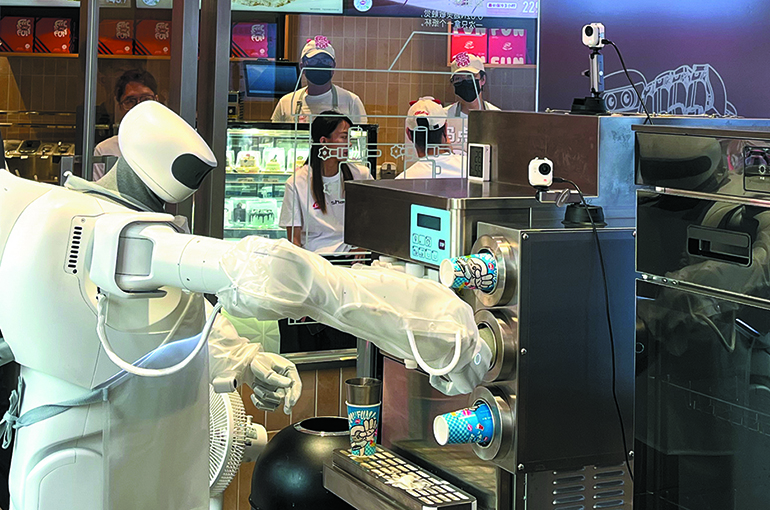
 Humanoid Robot Starts Work at Dairy Queen's 24-Hour Shanghai Ice Cream Parlor
(Yicai) Sept. 1 -- International Dairy Queen has "hired" a humanoid robot to prepare ice cream at its 24-hour store on Nanjing West Road in Shanghai, just across from Louis Vuitton Malletier's ship-shaped flagship shop The Louis, with the android moving smoothly but still taking about twice as long as a human worker per order.
The store has set up a dedicated workspace where the robot uses its two agile hands to autonomously prepare ice cream, limited to just Oreo flavor so far, Yicai noticed during a visit on its first day on the job. DQ deployed the service in collaboration with Chinese robotics startup Sharpa. The two are exploring the possibility of having robots take over store operations during non-peak hours and at night, before gradually increasing their workload, Yicai learned.
The robot's ice cream "handcrafted" process involves 55 steps, including cup retrieval, operating the ice cream machine, adding toppings, and using the blender, according to DQ. At the final stage, it even replicates the brand's iconic "cup flip without spilling" gesture.
Making ice cream is not a simple task for the robot, Li Yifan, co-founder of Sharpa, told Yicai. It requires "flexible" and precise equipment operation, which demands accurate tactile sensing, force control, and artificial intelligence model recognition capabilities, he said.
"For example, when it comes to retrieving a soft paper cup, if the robot's hand exerts too much force, it is likely to pull out multiple cups at once," he noted, adding that this operation relies not only on the dexterity of the hand but also on the AI model's ability to process feedback from tactile and force information, allowing for real-time adjustments to its applied force.
Yicai noticed that the robot worked smoothly but slowly, taking about six minutes to prepare a cup of ice cream, while its human counterparts take only two to three minutes. This means that despite its stable functionality, the store is unlikely to recoup the initial investment in the short term given its order volume and work efficiency.
DQ is not assessing the collaboration purely from an investment return perspective, Alan Hsu, chief executive officer of the brand's China operator CFB Group, told Yicai. Instead, it is more focused on embracing innovative technology, he noted.
Deploying robots at DQ stores will not immediately yield positive returns, Li added. The team is more focused on "fully integrating" the scenario, including enabling robots to adapt to work equipment and commercial environments, allowing them to complete all operational steps autonomously, he pointed out.
Fully integrating the scenario could itself generate a hundredfold or even thousandfold value, Li stressed, adding that this not only enhances the robots' generalization capability but also accumulates high-quality data from real-world settings, unlocking the potential for scalable replication.
"We have successfully implemented the scenario for ice cream production, which can later be extended to preparing more flavors, and even to making hamburgers and pizzas," Li pointed out.
In the long term, the certainty of achieving a positive return on investment from the robot project is relatively high, Li said. The prerequisites are that the speed of ice cream making must at least match that of humans, the equipment costs need to be amortized over more than 10 years, and the production cost of robots, once mass-produced, should drop to around CNY100,000 (USD14,880) per unit from several hundred thousand Chinese yuan, he added.
Editors: Tang Shihua, Martin Kadiev