



 European Firms in China Reevaluate Their Supply Chain Strategies Amid Drawbacks
(Yicai) Jan. 28 -- European businesses operating in China are considering adjusting their supply chain strategies to cope with a growing list of drawbacks, including exposure to trade wars, according to the latest report by the European Union Chamber of Commerce in China.
For most companies, while cost is still a core consideration, economic and trade uncertainty is having an increasing influence on supply chain decision-making, per the Dealing with Supply Chain Dependencies: Challenges and Choices report released by the European Chamber yesterday. Sudden policy shifts are fundamentally changing the way firms think about supply chains globally, but especially in China.
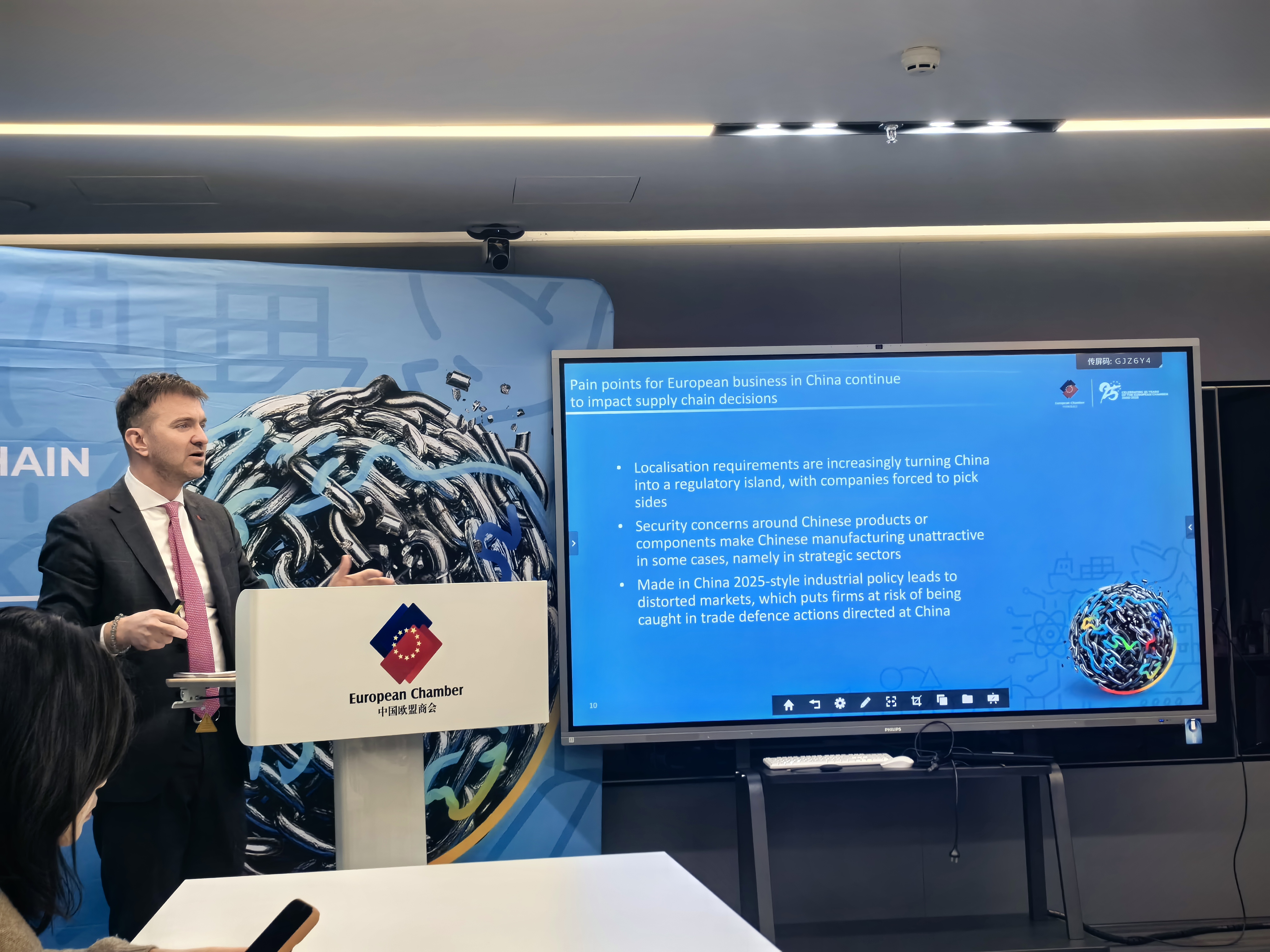
Over 70 percent of the European Chamber's 1,700 member companies from across the EU have reviewed their supply chain strategies for China in the past two years, as they seek to maintain a footprint in this important market while ensuring the resilience of their local and global operations.
Of them, 21 percent are not planning any significant changes, 26 percent are fully or partially onshoring supply chains into the Chinese mainland, and 13 percent are establishing alternative supply chains outside the Chinese mainland or offshoring parts of their supply chains out of the mainland.
"There is a tendency to go from 'just in time' to 'just in case,'" Carlo D'Andrea, vice president of the European Chamber, said at a media briefing in Shanghai yesterday. However, the complexity and all uncertainties are making shifting to 'just in case' too heavy, so companies are looking more at moving back to 'just in time,' he added.
Suppliers are also moving outside of China to pursue diversification. Forty-seven percent of European Chamber members said their Chinese suppliers are transferring operations to other markets, such as the Association of Southeast Asian Nations, North America, and India, reflecting a broader trend of manufacturing regionalization.
"China is the world's only manufacturing superpower, with the efficiency and competitiveness of its supply chains making it an exceptionally attractive base for manufacturing and sourcing," the report noted. "However, long-standing pain points of operating in China are compounding the challenges of a global business environment that is increasingly politicized, uncertain, and susceptible to disruptions."
One of the main pain points is that China's trade surplus with the EU has reached about EUR400 billion (USD480 billion), with the container trade imbalance rising to 1:4 today from 1:2.7 in 2019.
China's export controls on rare earth imposed last April caused production stoppages for some European firms, with European Chamber members claiming they have been waiting months for licence approvals.
E-commerce is still going strong. Data from Alibaba Group Holding's Tmall Global shows that 2,415 new overseas brands entered the Chinese market last year, marking double-digit growth from the year before. The platform now boasts over 40,000 overseas brands from more than 110 countries.
Trade between China and the EU rose 6 percent to CNY5.93 trillion (USD853.8 billion) in 2025 from the previous year, with over one-quarter of products being high-tech goods, according to data from China's General Administration of Customs.
Chinese imports and exports of high-tech goods to the EU grew 11 percent and 7.5 percent, respectively, reflecting continued technological cooperation despite tensions, said Lv Daliang, spokesperson for the GAC.
But trade tensions have intensified on both sides. The EU has launched multiple anti-subsidy investigations into Chinese products and implemented stricter investment screening mechanisms for Chinese companies.
China faced 198 World Trade Organization probes in 2024, nearly 60 percent of which originated from developing countries, showing that concerns extend beyond the EU-China relationship, D'Andrea pointed out.
EU technology export controls, such as restrictions on high-end lithography machines, artificially limit the export potential of their own advantageous products, said Jian Junbo, director of Fudan University's Center for European Studies.
Europe should welcome Chinese investment with a more open attitude, as converting exports into local European production could fundamentally improve trade data while creating jobs, and return to innovation-driven development and re-industrialization rather than over-investing in welfare or military spending, Jian noted.
Meanwhile, China is increasing efforts to facilitate the entry of European agricultural products and high-value consumer goods, such as hosting the China International Import Export, and implementing opening-up measures, Jian pointed out.
Both sides should work together, persist in dialogue and cooperation, properly handle differences, jointly maintain free trade and multilateralism, Lv said.
Editor: Futura Costaglione





