



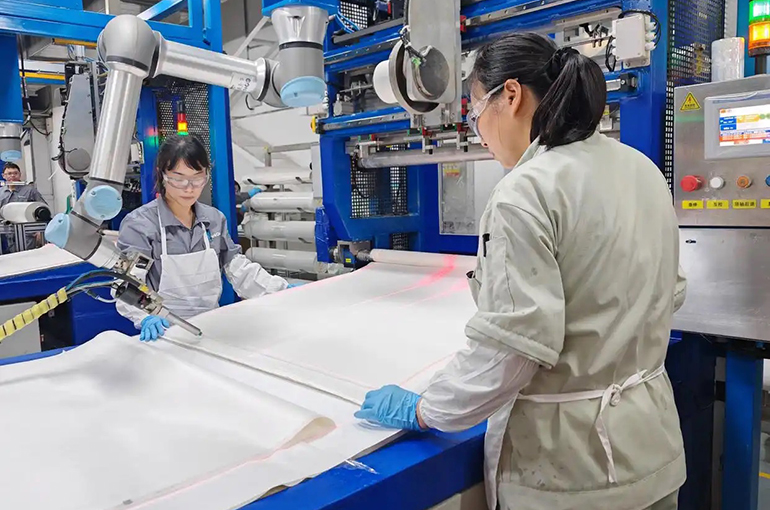
 Foreign Firms Upgrade China Strategies to Deeply Integrate Into Local Market
(Yicai) Jan. 30 -- Foreign companies in China are upgrading and adjusting their local strategies, with more and more of them seeking to build new competitive moats in the Chinese and international markets by deeply integrating across multiple areas, including research and development, production, ecosystems, and community engagement.
A senior executive at a multinational manufacturing company's China arm told Yicai that for the firm to survive and evolve sustainably, it must gain supply chain advantages and stay close to its customers, which has made local investment a necessity rather than an option. The company must proactively integrate itself into the country's vibrant "super ecosystem," the person said.
Integrating into the ecosystem and promoting co-creation has enriched multinational corporations' "in China, for China" strategies, the person said, adding that the approach has also enabled those that view the nation as a "gym" to continually "build muscle" and show their resilience worldwide.
Establishing a strong presence in China is the foundation of Hitachi Elevator's business, Jia Yuhui, president of the Japanese elevators and escalators maker's local division, said to Yicai. The company's largest factory and its biggest R&D team are both in the country, Jia noted.
In response to the structural shift in China's elevator market from "incremental growth" to a focus on "stock optimization and upgrades," modernization and the installation of units in existing buildings are becoming important aspects of improving people's livelihoods in the country, Jia pointed out, adding that the proportion of Hitachi's orders for modernization and installation in older buildings will likely keep rising.
Karcher's China performance grew by about 30 percent this month, Tang Xiaodong, president of the country arm of the world's leading provider of cleaning technology, told Yicai. Its newly launched production line has already reached full capacity, Tang said.
Karcher China sells its product both domestically and overseas, with each accounting for roughly half of its total sales, according to Tang.
The third phase of Karcher China's factory in the Yangtze River Delta region went live at the end of last year.
The previous business model used by foreign companies -- relying solely on technology export and brand premium to make profits -- is no longer effective, Tang said. To secure a foothold in the fiercely competitive Chinese market, they must deeply integrate into the local ecosystem, fully explore the differentiated needs of customers, and continuously innovate based on genuine and growing demands, Tang added.
Karcher China's innovation speed and sales growth in recent years have been attributed to its investment in business localization, which has created a positive feedback loop, encouraging its overseas headquarters to continuously increase investment in the country, Tang stressed.
Providing greater added value to customers through innovation has always been a key focus for Lanxess, so it is actively transforming its business from a raw material-dependent model to one centered on higher value-added specialty chemicals, Michael Rockel, president of the German company's China arm, told Yicai. In addition, it is optimizing costs by building more flexible and localized production facilities, he added.
Lanxess subsidiary Rhein Chemie launched its biggest global investment project in five years with the expansion and upgrade of its Qingdao plant, which began last November, Rockel pointed out. The decision was driven by strong market demand for the company's products, with the factory mainly manufacturing specialty additives for tires, he said.
China is no longer merely a sales destination and low-cost manufacturing base for foreign firms, but instead it is becoming a key source of driving global technological innovation and the evolution of business models, an industry expert said to Yicai. The growth and market position that companies achieve in the country will inevitably translate into lasting and strong competitiveness worldwide, the person added.
To truly share in the long-term benefits brought by China's high-quality development, companies must deeply integrate their R&D, supply chains, product definition, and even social responsibility initiatives with the local industrial ecosystem, social issues, and innovation networks, the expert stressed.
Editors: Tang Shihua, Martin Kadiev





