



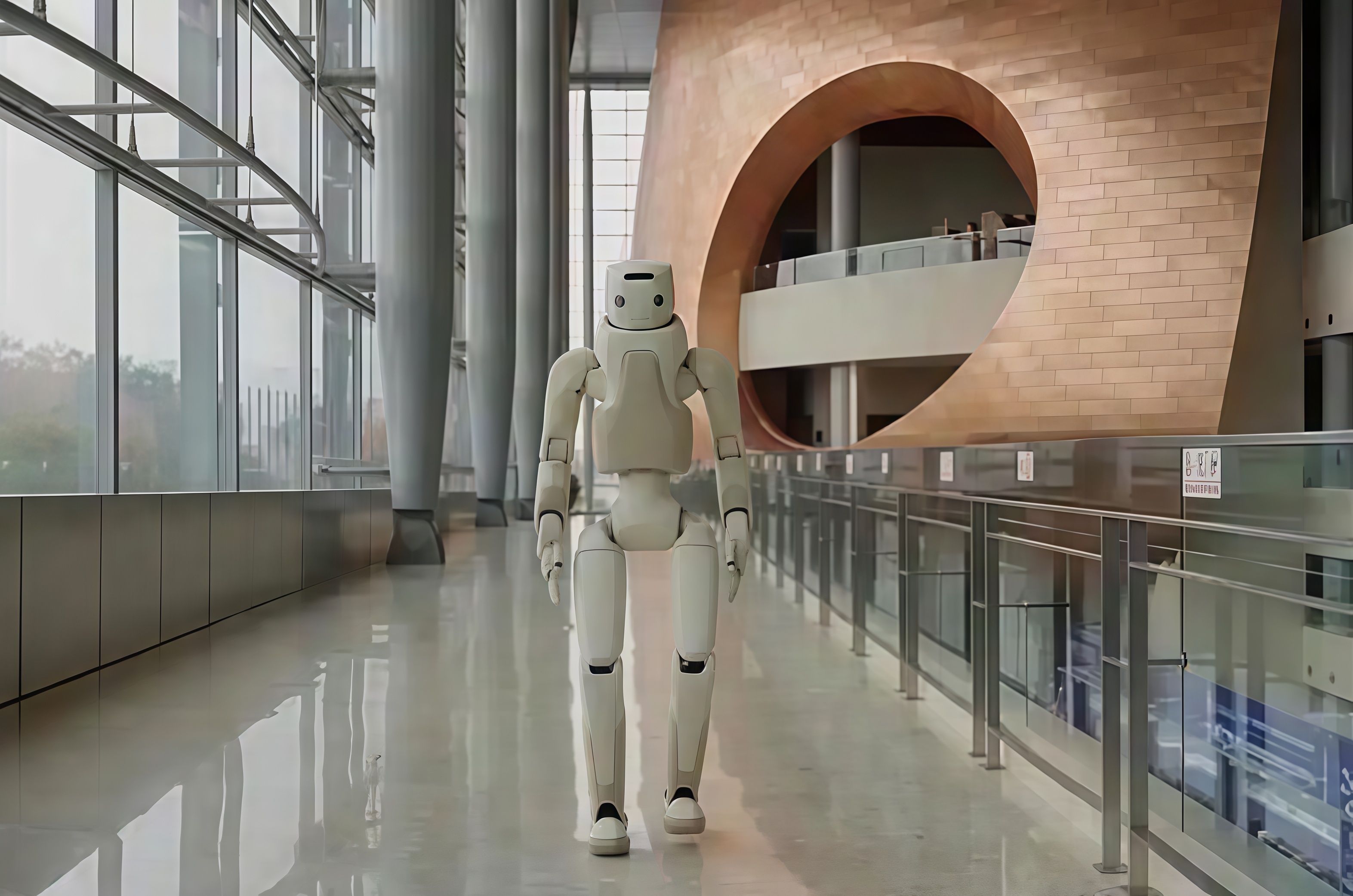
 Fourier’s New Six-Axis Robot Sensor to Cost Just Half as Much as Rivals’, Source Says
(Yicai) Dec. 23 -- Fourier's recently launched six-axis force sensor for humanoid robots will be priced at just half of what other such products on the market cost, according to an insider close to the leading Chinese general-purpose robotics company.
Fourier's new six-axis force sensor will cost less than CNY5,000 (USD710), while other such components currently used in androids are priced at around CNY10,000 (USD1,420), the insider told Yicai.
Six-axis force sensors are precision sensors capable of simultaneously measuring force and torque in three-dimensional space. They function like the "fingertip of a robot," enabling it to detect extremely subtle contact and force changes, thereby providing it with fine tactile and force control capabilities.
Fourier's new six-axis force sensor uses an optical path in its structural design, Yicai learned. It does not use the traditional strain gauge attachment solution but senses force-induced deformation changes through an optical structure, reducing the reliance on manual patch management from the source.
Different from surface-mount six-axis force sensors that mainly rely on strain gauges to detect force deformation, the optical solution directly measures deformations through an optical structure, robotics engineer Lin Yipei said to Yicai. Calibration is no longer entirely dependent on manual labor, but can be done with parameter collection and model verification by automated equipment, Lin said.
"Six-axis force sensors will shift to a standard feature from an optional configuration next year, so it is not surprising that robot manufacturers are reconsidering their technical approaches," Lin pointed out.
Many manufacturers, including Ubtech Robotics, X-Humanoid, Spirit AI, and Tesla, have installed six-axis force sensors on the wrists and ankles of their robots.
Prices of other China-made visual and tactile sensors, speed reducers, and dexterous hands have also significantly dropped this year, with some plunging by more than 50 percent, Yicai learned.
The decline in prices of core upstream components stems from changes in manufacturing processes and methods, as well as diversified participation driving parts to "reduce costs first and expand scale," another robotics engineer said to Yicai. "The active cost-cutting by manufacturers may also be clearing hurdles in advance for the mass application of humanoid robots."
Editor: Martin Kadiev





