



 Asia Is Now AI’s Center of Gravity, Boao Forum Report Says
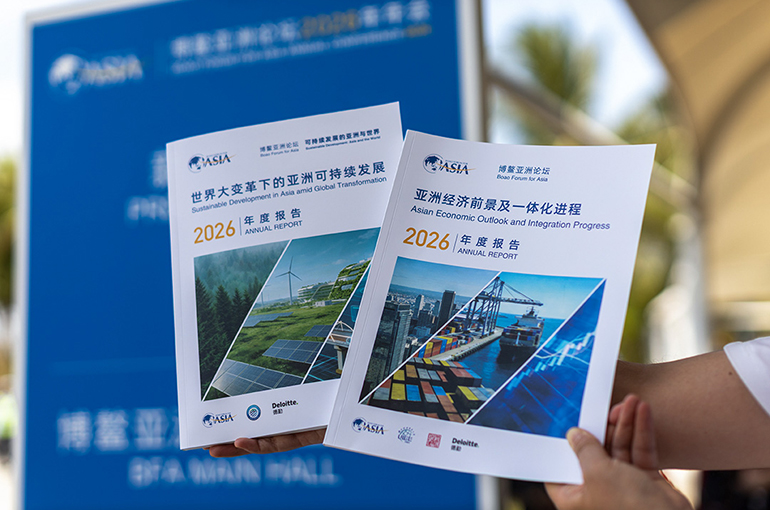
(Yicai) March 25 -- Asia has emerged as the new focal point of global artificial intelligence development, according to a flagship annual report by the Boao Forum for Asia.
“Over the past decade, the center for artificial intelligence development has gradually shifted from Europe and America to Asia,” this year’s Asian Economic Outlook and Integration Progress Annual Report said, as the region benefits from a “massive digital population, diverse application scenarios, comprehensive industrial chains, and systematic policy support.
“Asian economies are forging a distinctive AI development path,” the report noted. “This features the close integration of technological innovation and industrial implementation, where application scale and data resources mutually reinforce each other, creating an efficient ‘feedback mechanism' that accelerates AI commercialization.
“This trend not only reshapes the regional technological landscape but also significantly elevates Asia’s influence within the global AI ecosystem, transforming it from a follower to a leader,” it said.
Asia's AI market is expected to top USD106.4 billion this year, up from last year’s USD76.9 billion, and will likely reach USD403.9 billion by 2030, the report said.
The report also highlights a stratified AI development landscape across Asia, with countries following differentiated pathways. This diversity creates a foundation for regional collaboration and integration, it said.
For example, China demonstrates full-chain AI maturity from strategic planning, research, and development to industrial deployment and ecosystem building. Other Asian countries, such as Indonesia and the Philippines, are in the earlier stages of development but have great market potential, the report said.
This differentiated landscape fosters regional complementarity while creating the conditions for knowledge-sharing and mutual policy learning, according to the report. Leading countries provide models in policy designs, technological practices, and industrial experience for those catching up, while the new application scenarios, market size, and innovation needs of other nations offer new validation and growth opportunities for tech-exporting countries.
Asia's Economic Resilience
The Asian economy will likely lead global growth again this year, though the expansion may slow amid trade tensions, fiscal pressures, and geopolitical risks, the report said. Weighted real gross domestic product may expand 4.5 percent this year, lower than last year’s 4.7 percent clip, while global economic growth is expected to fall to 2.7 percent from 2.8 percent.
Most Asian countries continue to have sound economic fundamentals and relatively ample policy space, providing strategic buffers for coping with external shocks, the report pointed out.
Driven by digitalization, green transformation, and the investment boom in high-tech sectors such as AI, Asian economies have beefed up investment in these areas and turned this into a key factor driving regional economic growth in the short term, while also enhancing the region's economic growth potential from a long-term perspective.
Despite mounting global trade uncertainty, the foundations of regional trade integration in Asia remain resilient, the report said. China and the Association of Southeast Asian Nations “stand out as the region's twin ‘anchors of stability,’” it noted.
China was the largest trading partner for 23 Asian economies in 2024, with trade dependence on the country exceeding 20 percent for all ASEAN members, Japan, and South Korea.
Editors: Dou Shicong, Martin Kadiev





