



 Hangzhou Hosts Second Event Under New Initiative Encouraging Foreign Exporters to Sell in China
(Yicai) March 17 -- The second event under the ‘Big Market for All: Export to China’ initiative is being held in Hangzhou, eastern Zhejiang province, to encourage overseas exporters to sell products to the Chinese market.
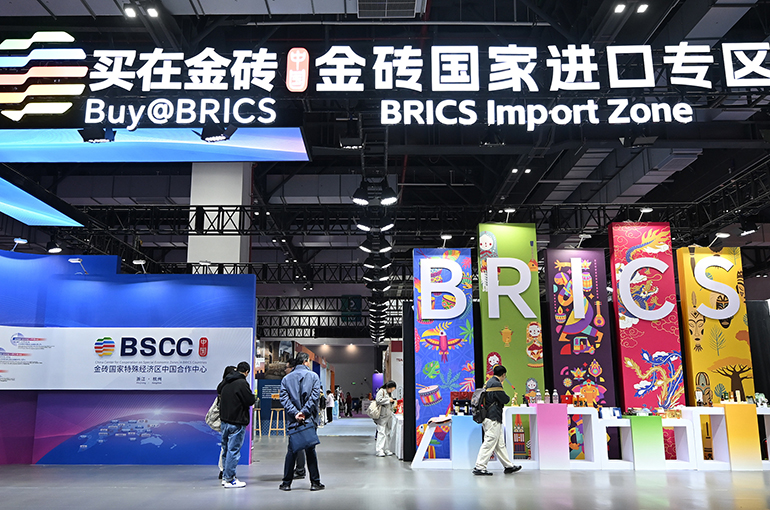
Hosted by the Ministry of Commerce and the Zhejiang provincial government, the three-day event ending today set up two themed exhibition areas for imported products and superior consumer goods from over 300 companies from 85 countries. It comprises eight exhibition blocks for import enterprises, BRICS countries, cross-border e-commerce, new energy vehicle sales, and others.
The ‘Big Market for All: Export to China’ initiative, which will feature 100 events, was launched early last month to enhance supply-demand matching and strengthen international exchanges to bring more high-quality products and services to Chinese consumers. The first event took place in Beijing on Feb. 4.
The Hangzhou event aims to expand imports, building a one-stop exhibition and sales platform for imported consumer goods. It provides Chinese enterprises and local consumers with convenience in buying international products without going abroad, and helps high-quality products worldwide enter China efficiently.
The exhibition block for BRICS countries displays high-quality products from Brazil, Russia, India, and South Africa. Other pavilions showcase excellent goods from Thailand, Uzbekistan, Egypt, and Vietnam, enabling Chinese consumers to buy products that they could have only bought abroad.
This is a Chinese initiative aiming to expand unilateral and autonomous opening-up, Xiao Lu, deputy director-general of the MOFCOM’s department of foreign trade, said at the Hangzhou event. It is called ‘Export to China’ rather than ‘Import to China’ because it is seen from the viewpoint of China’s trade partners, she added.
China is the world’s second-largest economy and second-biggest importer, Commerce Minister Wang Wentao said at the event. Industry upgrading and improvements in people’s livelihood have been releasing new demand, creating huge import potential, he noted, adding that the country is willing to further open up to and share with the rest of the world.
The MOFCOM will continue to build high-quality platforms to make China the best export destination for more countries’ products via targeted connections, Wang pointed out.
China’s imports hit a new record high of CNY18.48 trillion (USD2.68 trillion) last year, staying as the world’s second-largest importer for 17 years in a row, according to official data. The nation has contributed around 30 percent to the world’s economy in recent years as the major export destination for nearly 80 countries and regions.
China aims to have more in-depth cooperation with regional and global partners via foreign trade, Zeng Gang, director of the Institute of Urban Development at East China Normal University, told Yicai.
The country needs to import raw materials, advanced technology, equipment, and services, but it also hopes to hike the impact of the domestic market on its economy, relying on product exhibition and sales events like ‘Big Market for All: Export to China,’ Zeng noted.
“China’s domestic demand has contributed to more than 50 percent of its economic growth, but objectively speaking, there is still great room for expansion,” he added.
Editors: Tang Shihua, Futura Costaglione





