



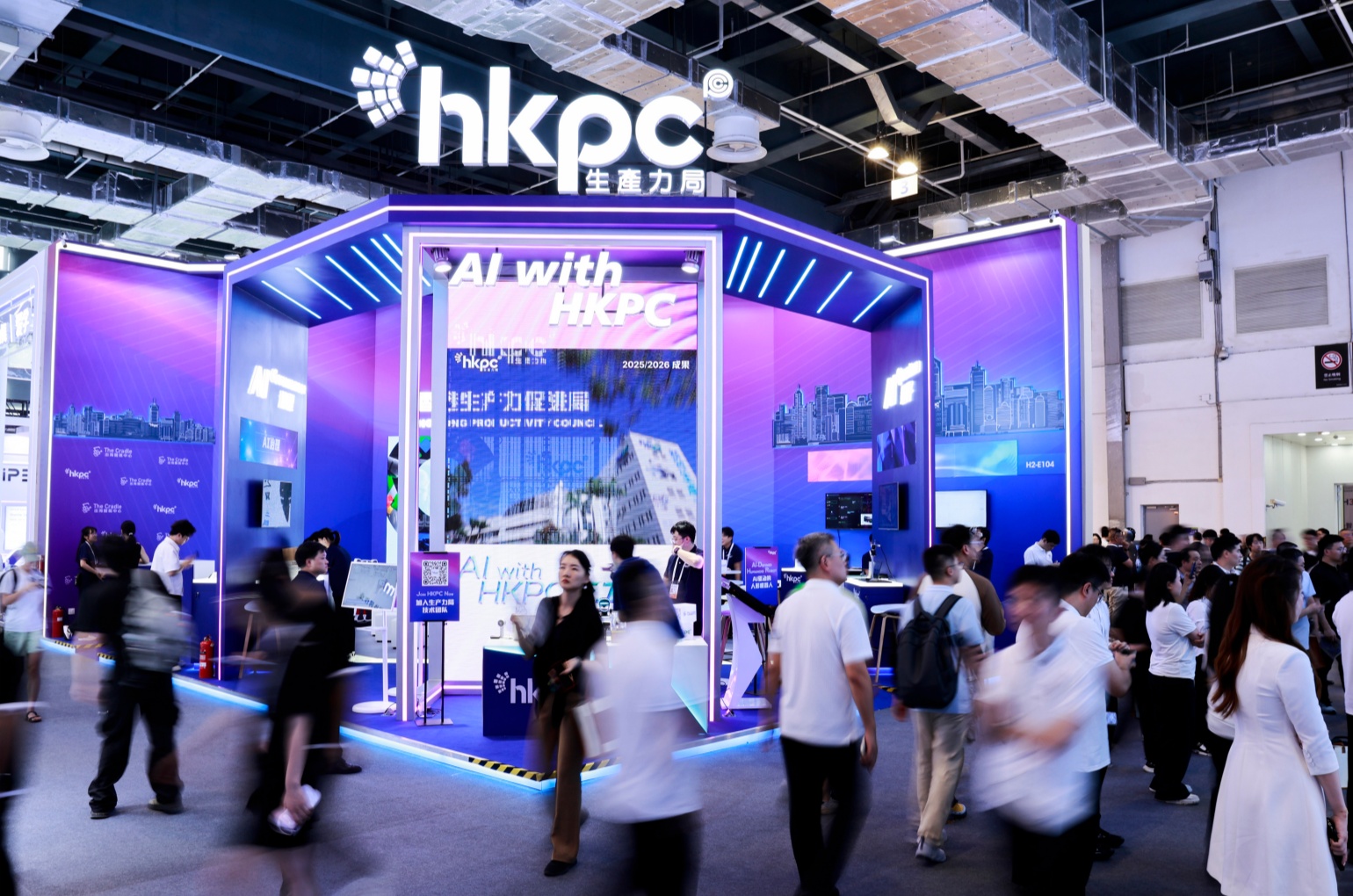
 HKPC Shows How AI Can Help Chinese Mainland Firms Go Global at WAIC
(Yicai) July 20 -- The Hong Kong Productivity Council set up an "AI Smart Factory" exhibition area at the World AI Conference in Shanghai to demonstrate how AI can empower Chinese mainland companies' transition from technology trials to industrial applications and overseas markets.
"There are many Chinese mainland AI companies with strong potential to expand overseas," Edmond Lai, chief digital officer and chief executive officer of mainland business of HKPC, said regarding his impression at this year's WAIC, which ends today. The organization takes part in the event for the second time and plans to set up service outlets in the Yangtze River Delta region, he added.
The HKPC also promotes its overseas expansion support platform, The Cradle, Go Global Service Centre, which was launched in 2025 with partners including innovation institutions from the Yangtze River Delta region, Zhongguancun and the Greater Bay Area. The centre aims to help companies address challenges related to international standards, intellectual property protection, supply chain management, and overseas market entry.
One of the key challenges faced by Chinese mainland companies when going global are mainly whether they can prove that "their technology or services comply with international standards" and "how to make sure that their intellectual property is protected overseas," Lai noted.
Using a factory in Mexico as an example, Lai said that "some companies may face worker attendance issues, with 10 percent of employees absent." If a company allocates manpower based on its mainland experience, it is easy to create a gap in shift scheduling, he pointed out.
In addition, delivery robots commonly seen in Chinese mainland hotels struggle to obtain access to elevator maintenance systems in overseas markets, with such commercial barriers making their deployment difficult, Lai added.
About 70 percent of the HKPC's clients are small and medium-sized enterprises, 20 percent are government agencies, and the rest are large companies, Lai said.
What the HKPC is looking for are scenarios where there are no solutions in the market that can fully meet the needs of enterprises, he pointed out. In the manufacturing industry, if a solution achieves only 80 percent completion, the actual effectiveness may only be 20 percent, he said, noting that the 20 percent refinement work is often the key to whether the solution can truly achieve 80 percent practical effectiveness.
The HKPC's role is not to replace companies' technical capabilities, but to supplement gaps in practical know-how that determines the success or failure of projects, Lai stressed. Yunji Technology, a service robot developer that went public in Hong Kong last October, is an example of this service model.
Yunji Tech has set up an industry-university-research collaboration innovation laboratory with the help of the HKPC to expand into Southeast Asia and the Middle East, with its service robots used in over 30,000 hotels and more than 100 hospitals worldwide as of the end of June 30 last year, according to data released by the company.
Layout for the Future
The HKPC also showed its independently self-developed open AI platform "HKPC Picasso" at the WAIC, providing six large language model modules and supporting rapid development and deployment of various smart solutions, having assisted the industry in developing over 500 AI solutions.
In response to a new request by a client, the HKPC's development team took just half a day to create an application and delivered it to the client for verification the next day, Lai pointed out.
The AI digital management system developed in collaboration with Hong Kong-funded mold company Hongrita Group has achieved data interconnection among production bases in Shenzhen, Zhongshan, and Malaysia, setting a fully automated "lights-out factory," the HKPC said. After upgrading, Hongrita's annual inventory dropped 30 percent, while its overall equipment efficiency jumped 15 percent, it added.
There are also some earlier and more forward-looking technological directions in the exhibition area, such as quantum computing frameworks and algorithms used to explore the potential applications of workshop scheduling and logistics path optimization.
This direction is still in the research and development verification phase, with a long way to go before it can be implemented in actual production, a person from HKPC’s intelligent new industries and emerging technologies team pointed out.
Hopefully, HKPC can bring more successful cases when taking part in the WAIC next year or the year after, especially from the Yangtze River Delta region, Lai stressed.
Editor: Martin Kadiev





