 How a Tiny Vegetable Seed From China’s Ningxia Is Taking Root in Global Markets
(Yicai) Sept. 21 -- How does a vegetable seed travel thousands of kilometers from Ningxia Hui Autonomous Region, deep in China’s heartland, to farms across North America, Central Asia and the Middle East?
A vegetable seed’s journey overseas begins long before it is harvested, Pei Xiaoxiang, general manager of vegetable breeding and seed export firm Taijin Seed Industry, told Yicai during a recent visit to its operations. Breeders must consider from the outset whether a variety can adapt to the local environment and meet market demand.
“When working with overseas customers, Taijin Seed tries to understand exactly what they need and what problems they wish to solve,” Pei said. “For example, the Middle East and Central Asia are characterized by drought, low rainfall and high temperatures, so we conduct targeted breeding accordingly.”
Targeted breeding requires both technology and talent. Taijin Seed allocates 20 percent of its annual sales revenue to research and development. The Shizuishan-based company has worked with nine Chinese research institutions to commercialize nine scientific research achievements and has established an academician workstation for vegetable molecular breeding and seed production in Ningxia in cooperation with Zou Xuexiao, a scholar at the Chinese Academy of Engineering.
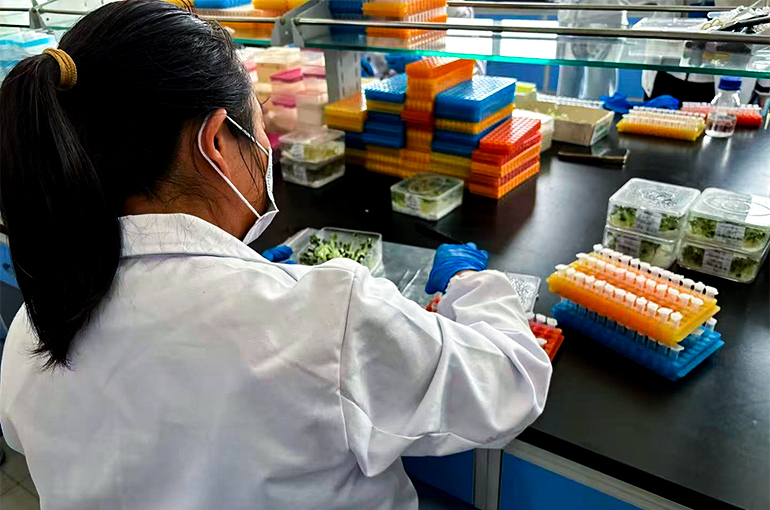
After the firm’s seeds are harvested, they undergo germination and purity tests before being cleaned, graded, coated and packaged at a processing facility. After packaging, they are tested again before the company applies to the quarantine authorities for origin inspection, obtains an export phytosanitary certificate and completes customs procedures.
New Markets
Taijin Seed has shifted its market expansion strategy in recent years in response to changes in the external environment, Pei said.
"The tariffs from the trade war have significantly pushed up costs for our US clients, as there are no readily available substitute varieties in the short term. As a result, customers have chosen to raise their selling prices to offset the impact of the tariffs," he added.
In the long run, Chinese seeds are also facing competition internationally from countries such as India, Thailand and Vietnam where production costs are lower, said Pei.
This has prompted Taijin Seed to explore new markets. Using Ningxia’s climate as a benchmark, the company is looking for markets in regions between 32 and 40 degrees north latitude.
In 2018, Taijin Seed turned its attention to the Middle East and Central Asia. Pei cited one zucchini seed variety as an example, saying it now accounts for a 60 percent share of the market in Egypt.
Branching into these new markets, however, was not straightforward. When the firm first entered Egypt in 2018, local farmers had strong loyalty to established seed brands from Europe, North America and Japan, and were not familiar with Chinese seeds, he told Yicai.
Taijin Seed initially worked with local customers to invite influential farmers to conduct small-scale trials free of charge.
"Egypt’s desert regions are hot and dry, and many traditional seed varieties tend to have low yields in extreme heat,” Pei said. “However, our zucchini variety carries genetic traits adapted to Ningxia’s arid and hot climate, allowing it to maintain strong growth, straight fruit and stable yields even in extreme weather conditions. The actual performance of a seed in a field is the best passport of entering a market.”
R&D Push
"Investment in R&D must continue to increase so that we can develop varieties that truly meet market needs,” Pei said. “With the agricultural workforce declining globally and labor costs continuing to rise, our future breeding efforts will concentrate on varieties suited to large-scale mechanized planting and harvesting. Only by helping growers reduce costs and improve efficiency can our seeds develop an irreplaceable competitive advantage in international markets.”
Taijin Seed's future strategy is to "stay rooted in China, consolidate its presence in North America, and expand into the Middle East," Pei said. Over the longer term, the company will continue to focus on breeding innovation and strengthening brand awareness.
Taijin Seed is a private technology enterprise which mainly exports seeds for tomatoes, peppers, eggplants, zucchinis and cucumbers. Its products are now sold in 27 countries, including the United States, Turkey and Egypt and account for more than 95 percent of Ningxia's total vegetable seed exports.
Editor: Kim Taylor