



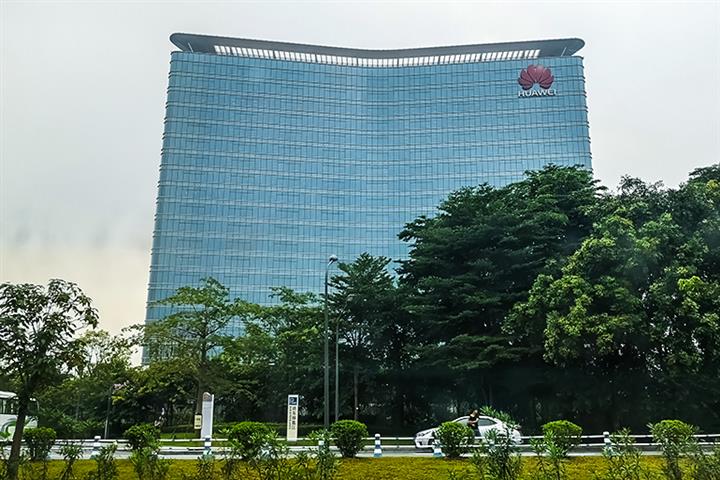
 Huawei’s Annual Earnings Meet Expectations Despite Pandemic, US Sanctions
(Yicai Global) March 31 -- Huawei Technologies said profit rose in line with expectations last year, gaining 3.2 percent, despite the impact of the global pandemic and the Chinese tech giant being on a US trade blacklist.
Net profit stood at CNY64.6 billion (USD 9.83 billion) in the year ended Dec. 31, the Shenzhen-based private company said today. Revenue rose 3.8 percent to CNY891.4 billion (USD135.85 billion), compared with a 19.1 percent clip in 2019.
Huawei has been hit by escalating US trade sanctions imposed since 2019 over alleged national security concerns, and was forced to sell its budget smartphone brand Honor last November as it was barred from a variety of US products and services.
Huawei slipped one place to fifth in the rankings of the world’s biggest smartphone makers in the final quarter of 2020, according to market research firm IDC, and may drop out of the top six this year TrendForce said in a January report.
Still, the earnings results were basically in line with expectations, said Hu Houkun, Huawei’s rotating chairman.
Revenue from Huawei’s consumer business rose 3.3 percent to CNY482.9 billion, while that from its carrier business gained 0.2 percent to CNY302.6 billion. Income from its corporate business jumped 23 percent to CNY100.3 billion.
At CNY584.9 billion, China accounted for 65 percent of the firm’s total income. Revenue from the Asia-Pacific region, excluding China, fell 8.7 percent to CNY64.4 billion, while Europe, the Middle East and Africa dropped 12.2 percent to CNY180.8 billion.
ICT Focus
Huawei will keep its strategic direction unchanged and focus on the information and communications technology industry and consumer business, Hu said.
Hu put emphasis on fifth-generation wireless networks, cloud and connectivity for the ICT industry. In the carrier business field, Huawei helped stabilize 1,500 networks in more than 170 countries and regions, meeting people’s needs for online working, education, and shopping during the pandemic.
Huawei's self-developed HarmonyOS is now running on large screens, cars and wearable devices, and will be available on mobile phones in the next step, Hu added.
The company’s annual flagship phone releases, such as the recent release of its second-generation foldable mobile, will go ahead according to plan, Hu said. But the situation is not entirely clear and it is difficult to predict performance, he added.
Huawei reiterated its position as an incremental component supplier in the field of intelligent connected cars, with the goal to help automakers build good cars. The firm has developed a new computing and communication architecture for next-generation intelligent networked vehicles, and more than 30 intelligent components will also be available in succession.
Editors: Xu Wei, Tom Litting





